ON Semiconductor Posted Stronger Profit as AI Data Center Demand Surged

Wall Street rarely gets excited over a revenue number that missed estimates, yet that is exactly what happened when onsemi released its latest results. Shares jumped in after-hours trading, and the reason had little to do with the topline figure and everything to do with where the growth is coming from. AI infrastructure spending has quietly turned one of the world’s largest power semiconductor makers into a direct beneficiary of the data center boom.
The numbers tell a story of a company climbing out of a prolonged industry downturn. Revenue came in at 1.6 billion dollars, up 9 percent year over year and 6 percent sequentially, while non-GAAP earnings per share grew nearly four times faster than revenue. Gross margin expanded for a fourth straight quarter to 39.3 percent, and management now expects AI data center revenue to more than double for the full year. For anyone tracking the chip industry, or pursuing a vlsi course in noida to build a career around this exact kind of technology, this quarter is a useful case study in how power semiconductor design decisions translate into real financial outcomes.
Why AI Data Centers Became onsemi’s Growth Engine
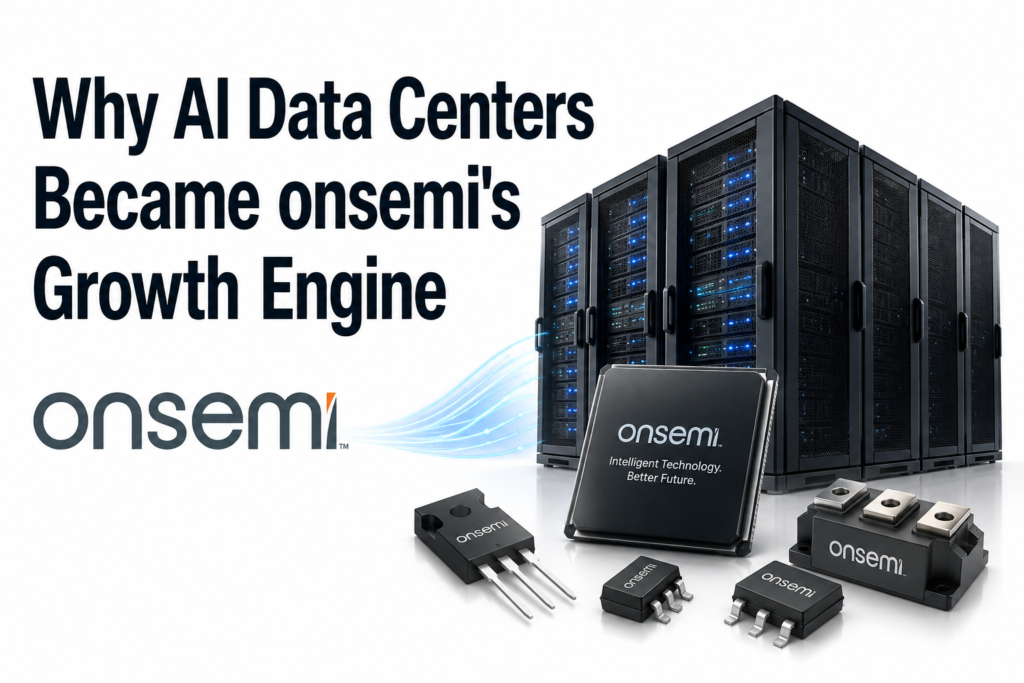
The single biggest driver behind this quarter’s strength was demand tied to AI computing infrastructure. onsemi’s leadership described the AI data center segment as the company’s fastest-growing business, and the company has widened its expectations from doubling revenue this year to now expecting it to more than double. That is a meaningful upgrade, and it reflects something specific happening inside modern data centers: as GPU clusters get denser and power-hungrier, the electrical systems that feed, regulate, and cool them have become just as critical as the processors themselves.
onsemi doesn’t sell the AI chips everyone talks about. Instead, it supplies the power management components sitting quietly behind them, silicon carbide devices, high voltage power solutions, and components across what the company calls the entire power tree. Design wins with major players including NVIDIA’s MGX platform, along with hyperscale customers like AWS, show how deeply embedded these power components have become in next-generation server racks. As AI workloads scale, so does the need for efficient power delivery, and that need doesn’t slow down even when broader semiconductor demand is soft.
The Financial Turnaround Behind the Headlines

Beyond the AI story, the underlying financial mechanics of this quarter deserve attention. Earnings per share grew roughly four times faster than revenue, a sign of strong operating leverage taking hold as utilization rates improve. Free cash flow margin expanded dramatically compared to a year earlier, moving from roughly 7 percent up to around 27 percent. That kind of jump usually signals that a company has worked through excess inventory, tightened its cost structure, and is now converting incremental sales into disproportionately higher profit.
Guidance for the coming quarter reinforced this trajectory. Management pointed to gross margin expectations in the 40 to 42 percent range, continuing a streak of consecutive quarterly improvements. For a company that spent much of the last two years working through a cyclical semiconductor slump, this kind of consistent margin expansion signals more than a one-off good quarter. It points to structural improvement in product mix, with AI-related and automotive silicon carbide content playing a growing role in the revenue base.
Silicon Carbide and the China Growth Story

Another theme worth watching is the strength coming out of China, particularly in silicon carbide. Even as the company navigated a modest year-over-year decline in some legacy revenue streams, silicon carbide sales in China are expected to grow sharply, aided by expanding relationships with electric vehicle makers. This matters because it shows onsemi’s growth story is not a single-market bet. Automotive electrification and AI infrastructure are running on parallel tracks, both pulling on the same underlying power semiconductor expertise.
This diversification is relevant for engineers and students of power electronics design, since it reflects how the same core competency, efficient power conversion at high voltage and high density, applies equally to an electric vehicle drivetrain and a GPU server rack. Companies that can serve both markets tend to be more resilient across semiconductor cycles, and onsemi’s results this quarter reflect exactly that kind of cross-market strength.
What This Means for the Semiconductor Industry and VLSI Careers
onsemi’s results arrive at a moment when broader industry forecasts are turning notably bullish. Global semiconductor revenue projections for the year point toward crossing the trillion dollar mark, with computing and data storage segments leading growth thanks to AI-driven demand in memory and logic chips. Power management, often overlooked compared to flashier processor and memory announcements, is proving to be one of the quieter but more durable beneficiaries of this AI buildout.
For anyone building skills in chip design, this quarter is a strong argument for paying closer attention to power management and analog design, not just digital logic. The market is rewarding companies that solve the physical constraints of AI hardware, heat, power delivery, and efficiency, just as much as those designing the compute silicon itself. That is precisely the kind of hands-on, industry-relevant knowledge covered in a well-structured vlsi course in noida, where learners get exposure to the full spectrum of chip design, from digital and analog circuits to power electronics fundamentals that companies like onsemi depend on.