Best VLSI Courses After Engineering to Get Jobs at Top Semiconductor Companies

Picture this: a chip smaller than your fingernail, packed with billions of transistors, quietly powering the phone in your pocket, the car you drive, and the AI models everyone keeps talking about. Someone designed that chip. Someone will design the next one too — and right now, the semiconductor world is desperately short of people who know how.
If you have just finished your engineering degree and are wondering what comes next, VLSI is one of the few fields where the timing genuinely works in your favor. India’s semiconductor push has moved from announcements to actual tape-outs, fabs, and hiring sprees, and companies are actively looking for freshers who can hit the ground running. But “learn VLSI” is a vague instruction. The real question is which course, which specialization, and which skills will actually get you shortlisted at a company like Qualcomm, Intel, AMD, or a growing Indian design house. Here are four course directions worth serious consideration.
1. RTL Design and Digital Verification Courses
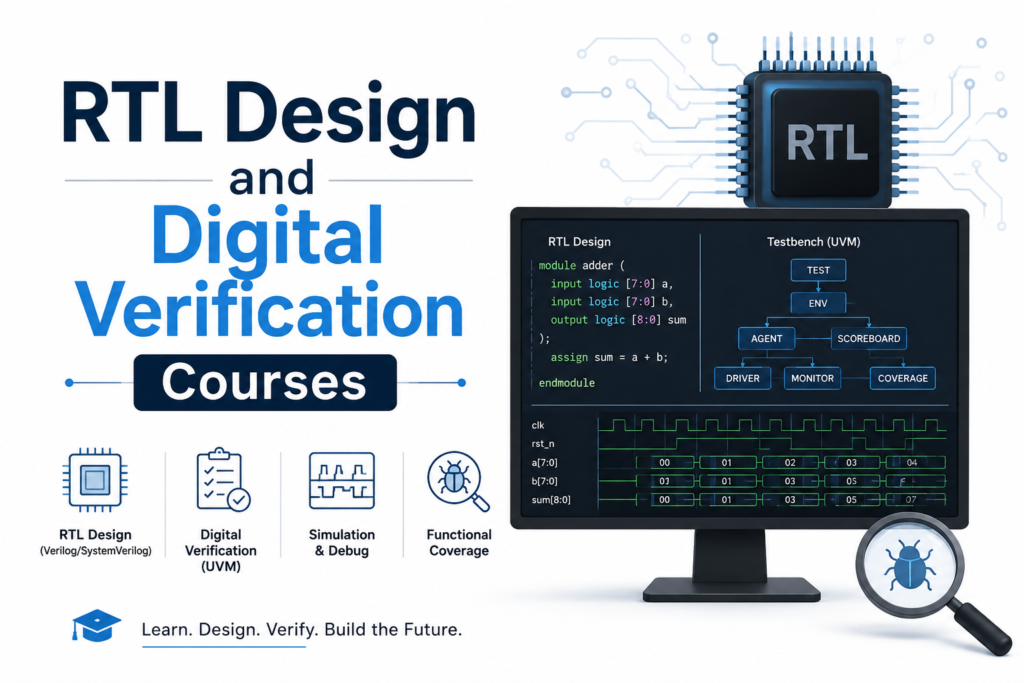
This is usually the first real fork in the road. RTL (Register Transfer Level) design courses teach you to describe hardware behavior using Verilog or VHDL — essentially writing the blueprint of a chip before it becomes silicon. A good course pushes you well past syntax and into actually building things: counters, arithmetic logic units, finite state machines, small processors, and the testbenches needed to prove they work.
Verification has quietly become the bigger opportunity of the two. As chips grow more complex, companies need more people checking designs than building them from scratch. Courses that teach SystemVerilog along with the basics of UVM (Universal Verification Methodology) are especially valuable right now, since verification openings for freshers have grown faster than almost any other VLSI role. If you enjoy logical thinking, debugging, and finding the one edge case nobody else spotted, this path suits you well. Look for programs with daily hands-on coding and simulation rather than lecture-heavy content — recruiters can tell the difference in an interview within the first five minutes.
2. Physical Design (Backend) Courses
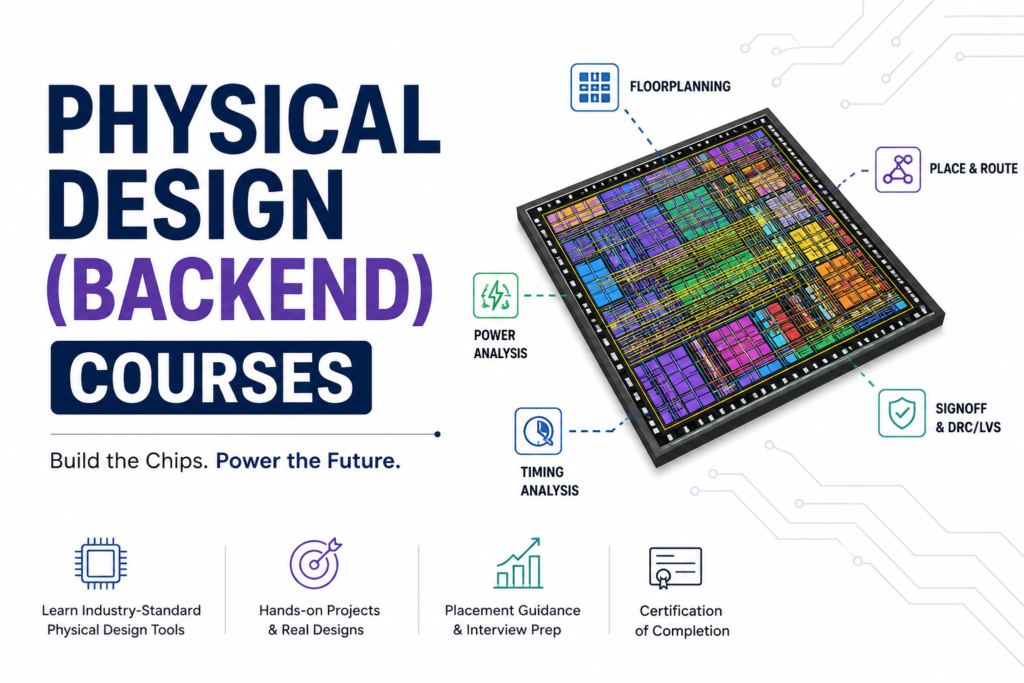
If RTL design is the blueprint, physical design is construction — turning that logical description into an actual chip layout with transistors, wires, and timing that has to work under real electrical constraints. This branch covers floorplanning, placement, clock tree synthesis, routing, and Static Timing Analysis (STA), typically using industry tools from Cadence or Synopsys.
Physical design has become one of the fastest-growing specializations in India specifically, partly because backend design work scales well with the country’s expanding design centers. A solid course will walk you through the full RTL-to-GDSII flow rather than isolated topics, because interviewers increasingly ask candidates to explain the entire chain, not just their favorite step. As chips move to smaller nodes like 3nm and 2nm, low-power and variability-aware design has become a recurring interview theme, so a course touching on power optimization alongside pure layout work gives you a real edge over someone who only learned the mechanical steps.
3. Analog and Mixed-Signal IC Design Courses
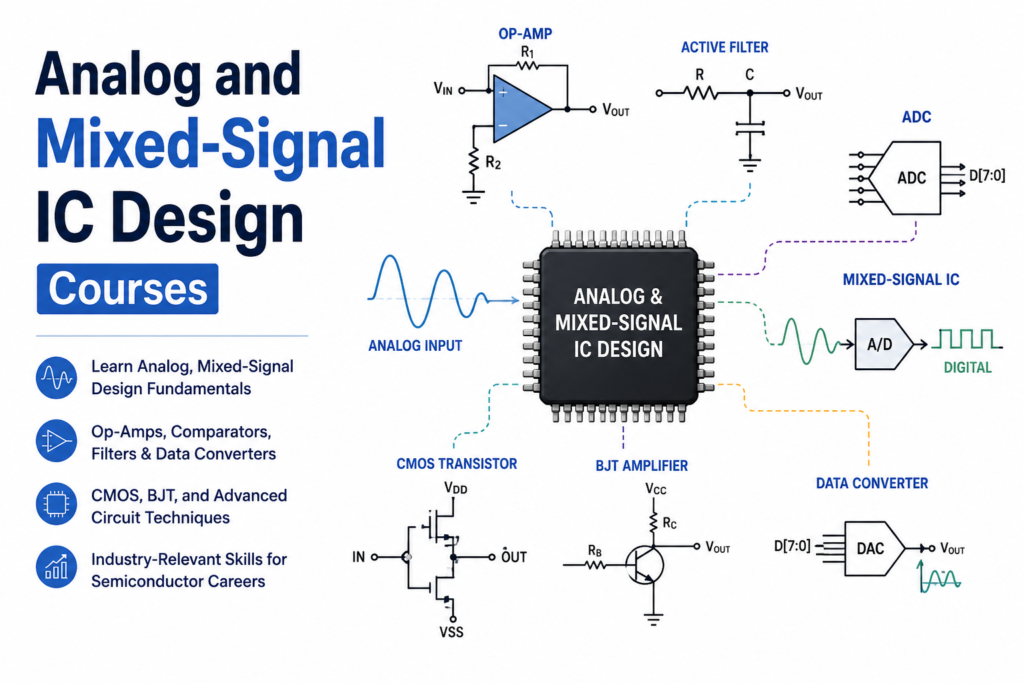
Not every chip is purely digital. Sensors, power management units, RF front-ends, and data converters all rely on analog and mixed-signal design, and this specialization tends to attract far less competition simply because fewer people pursue it seriously. That works in your favor if you enjoy circuit-level thinking rather than pure logic.
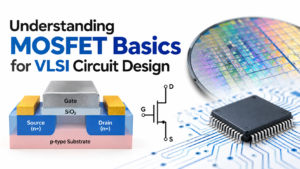
These courses typically cover CMOS device behavior, amplifier design, biasing techniques, and layout considerations specific to analog blocks, often using tools like Cadence Virtuoso. The learning curve is steeper than digital design, and the course quality matters enormously here — a program built around real circuit-level projects, rather than only theory slides, will prepare you far better for the kind of design questions analog interviewers actually ask. Given the growing demand for automotive-grade chips, IoT sensors, and power-efficient devices for edge AI, analog and mixed-signal skills are quietly becoming some of the most valuable in the entire industry.
4. Emerging Specializations: AI Accelerators, DFT, and Chiplets
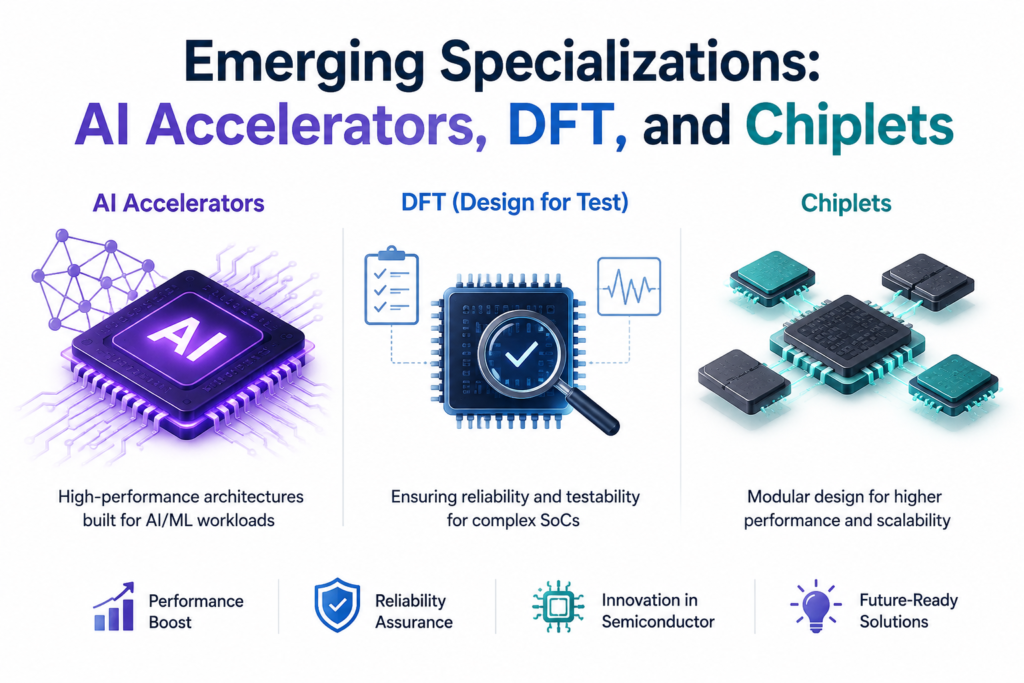
Beyond the traditional frontend-backend split, a newer set of specializations is gaining real traction. Design for Test (DFT) focuses on building testability into a chip so manufacturing defects can be caught before shipment — a role in constant demand because every chip that gets manufactured needs to be tested. Courses covering scan insertion, ATPG, and BIST are a smart, less crowded entry point into the industry.
Then there is the newer wave: AI accelerator design, chiplet-based architectures, and heterogeneous integration. As companies pack more specialized compute into single packages instead of single monolithic chips, engineers who understand how separate dies communicate and share power and thermal budgets are becoming genuinely scarce. Courses touching on high-level synthesis, advanced packaging concepts, or AI hardware fundamentals may feel niche today, but they position you for where the industry is heading over the next few years rather than where it already has been.
Choosing the Right Course for You
There is no single “best” VLSI course — there is only the best course for the direction you actually want your career to go. Before enrolling anywhere, ask whether the curriculum reflects current industry tools and workflows, whether it includes real, gradeable projects, and whether it offers any kind of interview or placement support. A course that teaches you to think like a working design or verification engineer, rather than one that simply covers a syllabus, is the one that will actually get you noticed by a hiring manager at a top semiconductor company.
The chip industry is not slowing down anytime soon. Choose a specialization that genuinely interests you, commit to consistent hands-on practice, and the job offers tend to follow.