
Why AI Infrastructure and Semiconductor Investments Are Driving the Next Wave of AI Growth

Every chatbot reply, every recommendation feed, and every self-driving car decision begins as a tiny electrical signal racing through a chip smaller than a fingernail — and right now, the world is spending more money than ever before to build more of those chips, faster than ever before, in a race that is quietly reshaping global technology, industry, and investment priorities all at once.
That spending spree isn’t a passing headline. Technology giants are pouring hundreds of billions of dollars into data centers, advanced processors, and high-speed memory at a scale the industry has never witnessed. What was once a quiet, specialized corner of engineering has turned into one of the biggest economic stories of the decade, shaping markets, jobs, and national policy all at once.
Beneath every AI model that writes, predicts, or drives, there’s a sprawling web of factories, packaging plants, and server farms working around the clock. Understanding why this buildout is happening — and where the money is really flowing — helps explain some of the most important shifts happening in technology today. Below, we break it down into four areas that matter most.
1. The Trillion-Dollar Infrastructure Race

The scale of current investment is genuinely historic. Industry estimates now suggest that global spending on AI data center infrastructure could cross $4 trillion by 2028, with a massive share of that money going directly toward semiconductors. Major cloud providers have individually committed tens of billions of dollars in capital spending for this year alone, most of it aimed squarely at AI capacity.
What makes this cycle different from past technology booms is how concentrated the value has become inside the chip itself. A single AI server rack today can contain thousands of individual semiconductor components, and those chips alone account for the overwhelming majority of a rack’s total cost. In other words, when a company says it’s “investing in AI,” what it usually means is that it’s investing in silicon — logic processors, memory, and the specialized hardware that makes large-scale computing possible.
2. Memory and High-Bandwidth Chips Are Becoming the New Bottleneck

For years, processing power got most of the attention. Now, memory has quietly become just as important. High Bandwidth Memory, or HBM, is one of the fastest-growing segments in the entire chip industry, because AI systems need to move enormous amounts of data in and out of processors at extremely high speed.
Analysts tracking the memory market expect demand for advanced DRAM and HBM to keep climbing sharply as AI workloads scale up. This shift means semiconductor companies are no longer competing only on raw processing speed — they’re competing on how efficiently their chips can talk to memory, how much power they consume, and how well they can be packaged together. It’s a subtle change, but it’s reshaping which companies win contracts and which get left behind.
3. A Global Manufacturing and Supply Chain Rebuild

Chip demand doesn’t mean much without the factories to build them. Over the past several years, semiconductor companies have announced hundreds of billions of dollars in new manufacturing investments, spread across dozens of projects worldwide. Governments are actively competing to attract these facilities, viewing chip manufacturing as both an economic opportunity and a matter of national security.
This has triggered a broader rebuild of the global supply chain — from raw materials and equipment to advanced packaging techniques that let multiple chips work together as one unit. Packaging, in particular, has become a strategic chokepoint, since even the most advanced processor is only as good as the connections binding it to memory and other components. The result is a manufacturing ecosystem that’s more distributed, more competitive, and more closely watched by policymakers than at any point in recent memory. Even equipment makers and materials suppliers, once considered background players, are now seeing record order books as fabs race to add capacity for next-generation AI chips.
4. What This Means for Careers and Skills in the Chip Industry
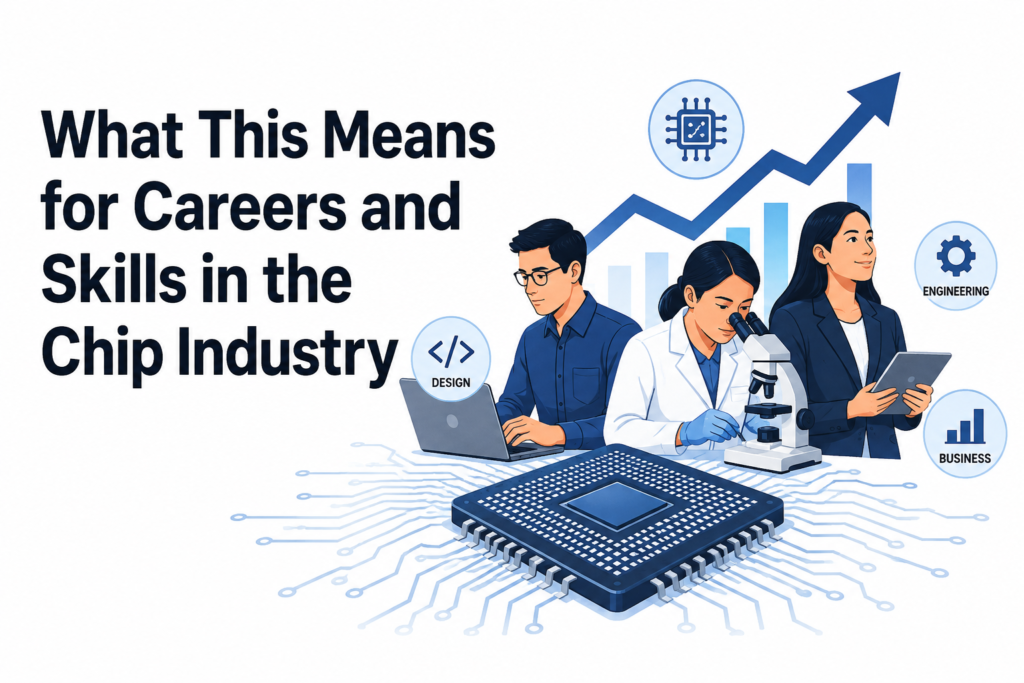
All of this investment creates a real demand for people who understand how chips are actually designed, tested, and manufactured. As companies expand their design teams and manufacturing footprints, there’s growing interest in practical, hands-on training that goes beyond theory. Cities with strong engineering ecosystems are seeing rising demand for focused, industry-relevant learning paths, and a good VLSI course in Noida can be a practical way to build the specific design and verification skills that chip companies are actively hiring for right now.
This matters because the AI infrastructure boom isn’t just a story about big tech budgets — it’s also a story about the people building the underlying hardware. As semiconductor design work grows more complex, professionals who can work confidently with chip design tools, verification flows, and physical design concepts are finding themselves in a genuinely strong position, especially as more design and testing work continues to shift toward hubs with access to solid, updated training programs.