
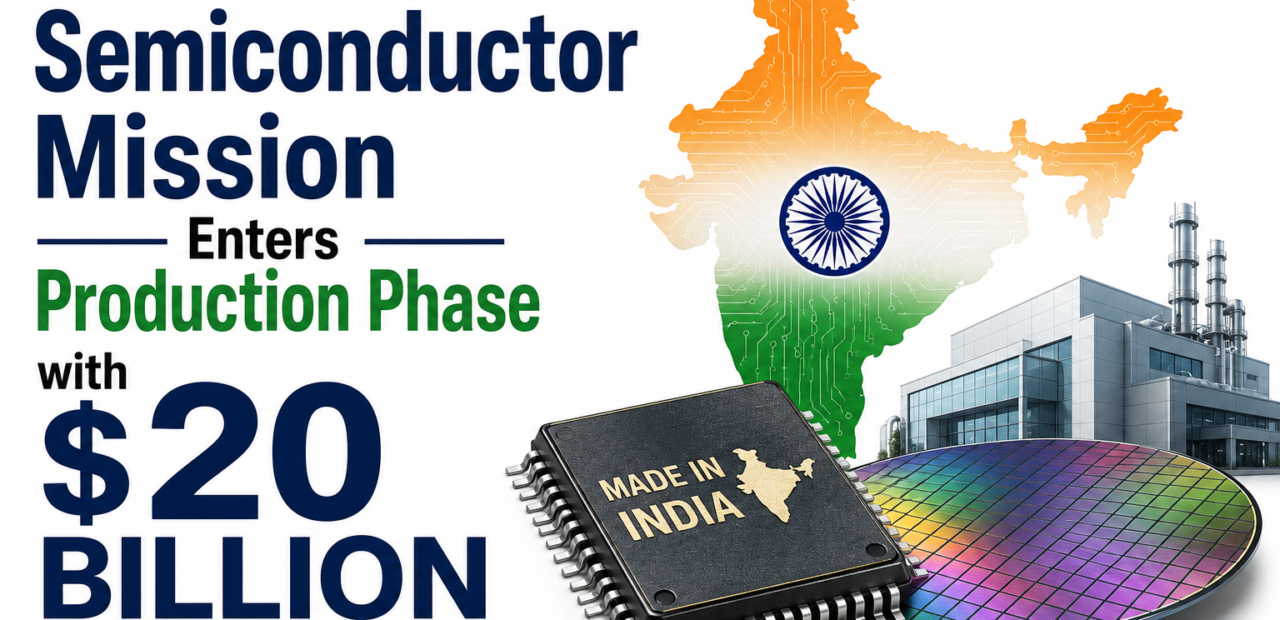
India’s Semiconductor Mission Enters Production Phase with $20 Billion Investment

Three factories on Indian soil are already producing chips, and nine more are racing to catch up. That single fact changes the entire conversation around India’s chip ambitions. For years, semiconductor announcements in India meant ribbon-cuttings, foundation stones, and cautious optimism about a future that always seemed a few years away. That phase is now firmly behind the industry, replaced by working assembly lines and measurable output.
The country has now moved from paperwork to production lines. Twelve semiconductor units, spread across six states, are backed by close to $20 billion in combined investment. The government has just approved a follow-on push called Semicon 2.0, signaling that this is not a one-time push but a long-term industrial strategy. What was once a distant goal is now a running assembly line, and the shift is worth understanding in detail.
From Policy to Production: What Changed

India’s first serious attempt at building a domestic chip industry dates back to 2005, when a major manufacturer explored setting up a fabrication plant in the country. That deal never materialized, and for nearly two decades, semiconductor manufacturing remained a talking point rather than a reality. The Semicon India programme, launched in 2022, was designed to fix the structural issues that had stalled earlier attempts: unclear incentive structures, land acquisition delays, and inconsistent policy support.
The results are now visible. Officials have confirmed that three of the twelve approved units have already begun chip production, while the remaining projects are in various stages of construction and trial runs. This marks a genuine transition from the planning and approval stage to actual output on the factory floor, something India’s semiconductor story has never achieved before at this scale.
The Companies Building India’s Chip Ecosystem
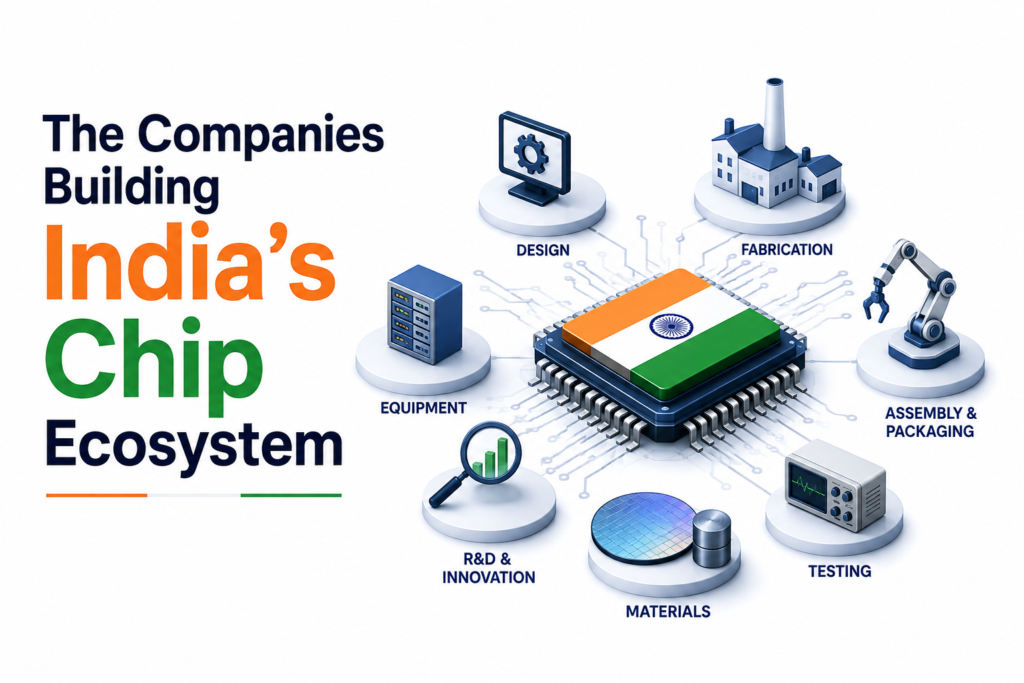
The $20 billion investment is not coming from a single source. It is spread across a mix of domestic conglomerates and global technology names, each contributing a different piece of the semiconductor value chain.
Tata Electronics has positioned itself as a central player, with a strong focus on assembly, testing, and packaging operations, commonly referred to in the industry as OSAT and ATMP facilities. A separate joint venture between HCL and Foxconn adds another layer to this ecosystem, while CG Power has been steadily scaling up its own semiconductor packaging capacity.
On the global side, a major American memory chip company inaugurated a large-scale assembly and test facility in India earlier this year, representing one of the biggest single foreign investments in the sector so far. Together, these projects cover the full spectrum of chip manufacturing, from raw wafer fabrication to the final packaged product that ends up inside a phone, car, or laptop.
Why Global Chipmakers Are Betting on India

The interest from international players is not accidental. The global semiconductor industry has spent the last few years re-evaluating its dependence on a small handful of manufacturing hubs. Supply chain disruptions, geopolitical tensions, and rising costs elsewhere have pushed manufacturers to look for reliable alternative locations, and India has worked to position itself as exactly that.
A stable policy environment, a large domestic electronics market, and government incentives covering a meaningful share of project costs have made India an attractive option. It also helps that India already has a strong base in chip design and semiconductor software work, giving new manufacturing units access to a deep pool of engineering talent rather than starting from zero.
That said, the road ahead is not without risk. Semiconductor fabrication is notoriously difficult to execute on schedule, even in countries with decades of experience in the field. Several of the newly approved plants are targeting production start dates within this year, which is an aggressive timeline by global standards. Any delays or cost overruns could dent investor confidence at a stage when momentum matters most.
What This Production Shift Means for the Industry and Careers

A functioning domestic semiconductor supply chain changes more than just where chips are made. It reshapes the broader electronics and technology ecosystem around it. Companies that design circuits, build testing equipment, or supply raw materials for chip manufacturing all stand to benefit as this ecosystem matures around India’s growing fab and packaging capacity.
This also opens up a wider range of career paths in chip design, verification, and semiconductor manufacturing than existed even five years ago. As demand for skilled professionals in VLSI design and chip verification grows alongside these new facilities, structured, hands-on learning has become far more valuable than theoretical knowledge alone. For those looking to build practical, industry-relevant skills in this space, a good vlsi course in noida can offer direct exposure to tools, design flows, and verification methods that mirror what these new fabs and design centers are actually looking for. Given that many of India’s semiconductor and electronics design firms have a strong presence in the Delhi NCR region, being close to that ecosystem while training adds a real advantage.