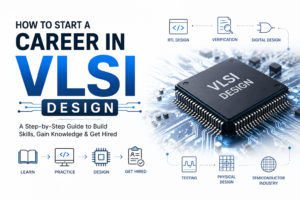




How Working Professionals Can Build a Successful Career in VLSI

Every smartphone in your pocket, every electric car on the road, and every AI server humming away in a data center owes its existence to a tiny piece of silicon that most people never think about. That silicon is the reason VLSI has quietly become one of the most rewarding fields a working professional can step into right now, even if you’re already years into a different job.
If you’ve been wondering whether it’s too late to make the switch, the truth is that the semiconductor industry is expanding faster than the pool of trained talent available to fill it. Companies are actively looking for people who understand chip design, verification, and the tools that bring a circuit from concept to silicon. This creates a real vlsi career opportunity for anyone willing to put in focused, structured effort, regardless of how many years they’ve already spent working in a different domain.
Why VLSI Is Becoming a Top Choice for Career Changers

The semiconductor industry isn’t just growing, it’s transforming how the entire tech world operates. Artificial intelligence, electric vehicles, 5G networks, and edge computing all depend on custom silicon, and that dependence has pushed hiring demand to levels the industry hasn’t seen in years. Governments in multiple countries are pouring money into domestic chip manufacturing, and that investment trickles down into thousands of new design, verification, and layout roles.
For someone already working in electronics, embedded systems, or even software, this shift matters. Companies would rather hire someone with strong fundamentals and a genuine willingness to learn than wait months for a perfect resume. The barrier to entry has as much to do with mindset and preparation as it does with a specific degree, which is exactly why so many professionals are making this move successfully.
How to Start a Career in VLSI Without Starting From Zero
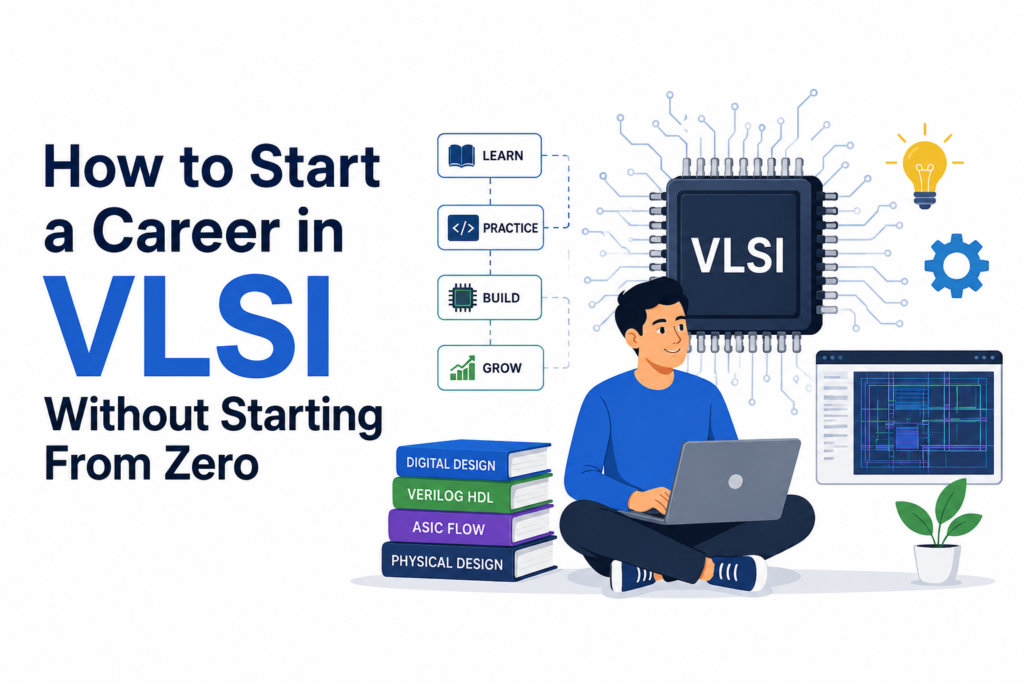
Wondering how to start a career in VLSI when you’re already juggling a full-time job? The good news is you don’t need to quit anything or go back to a classroom for years. Start by getting clear on which part of the chip design flow excites you most: front-end work like RTL coding and verification, or back-end work like physical design and timing closure.
Once you’ve picked a direction, build a learning routine around it. Short, focused online courses that include hands-on labs with industry tools like Verilog, SystemVerilog, or basic EDA software give you something tangible to show. Set aside even an hour a day rather than waiting for a big block of free time, because consistency beats intensity when you’re learning something new alongside a job.
Building Practical Skills That Recruiters Actually Notice

Theory alone won’t get you hired. Recruiters in this space want to see that you can actually do the work, which means hands-on projects matter more than certificates alone. Try designing a small digital circuit from scratch, writing testbenches to verify it, or working through a basic synthesis flow using open-source or trial versions of standard tools.
Documenting these projects properly, explaining your design choices, the challenges you faced, and how you solved them, turns a simple exercise into proof of real capability. Beyond technical skills, recruiters also value people who can explain their thought process clearly, since chip design is deeply collaborative and mistakes can be expensive. Practicing how you talk about your work is just as important as the work itself.
Leveraging Your Existing Professional Experience

One advantage working professionals have over anyone starting completely fresh is context. If you’ve spent years in software development, you likely already understand logic, debugging, and structured problem-solving, all of which translate directly into digital design and verification work. If your background is in hardware or embedded systems, you’re even closer to the finish line than you might realize.
Frame your transition around this overlap rather than treating your past experience as irrelevant baggage. A project manager who understands how chip design cycles work brings something different to a design verification role than someone with no professional history at all. Employers notice candidates who can connect their past experience to the value they’ll bring in a new role, so don’t undersell what you’ve already built.
Staying Relevant as the Industry Keeps Evolving

VLSI in 2026 looks different from VLSI a decade ago, and it will keep changing. Power optimization has become a bigger focus as devices shrink and performance demands grow, and hardware security is now a serious hiring priority as chips become targets for cyberattacks. Specialized areas like AI accelerator design and custom silicon for data centers are opening entirely new career paths that didn’t exist a few years back.
Staying relevant means treating learning as an ongoing habit rather than a one-time push before landing a job. Following industry publications, joining online communities where engineers discuss real design challenges, and occasionally revisiting your fundamentals will keep your skills sharp long after you’ve made the initial transition. The professionals who thrive long-term are the ones who never stop treating themselves as students of the craft, even after they’ve built a stable career.
Conclusion
Breaking into VLSI as a working professional isn’t about starting over, it’s about redirecting the discipline and experience you already have toward a field that badly needs skilled people. The demand is real, the opportunities are growing every year, and the path in is more accessible than it looks from the outside. Pick a direction, build something with your hands, and let your existing professional strengths do the rest of the talking.
1. Can working professionals switch to a VLSI career?
Yes. With structured VLSI training, hands-on projects, and EDA tool experience, professionals from ECE, EE, or software can transition successfully.
2. Is VLSI a good career for experienced professionals?
Yes. The growing semiconductor industry offers strong demand, competitive salaries, and long-term growth for skilled VLSI professionals.
3. How long does it take to learn VLSI while working?
Most professionals can gain job-ready VLSI skills in 6–12 months with consistent learning, practical projects, and regular practice.
4. Which VLSI domain is best for career switchers?
RTL Design, Design Verification, Physical Design, DFT, and Analog Layout are popular VLSI domains with strong hiring demand.
5. Can software engineers move into VLSI?
Yes. Software engineers with C/C++, Python, Linux, and scripting skills can transition into Design Verification or EDA-related VLSI roles.