



Why CCTV Cameras Are India’s Next Semiconductor Battleground

India’s CCTV industry is entering a significant transformation, and the change is no longer limited to installing more surveillance cameras across cities, highways, offices, factories, and public infrastructure. Modern CCTV systems are becoming intelligent electronic devices that depend on advanced semiconductor technologies to capture, process, analyse, and securely transmit video data. Image sensors, System-on-Chips (SoCs), memory, processors, and connectivity components are now central to camera performance. As India expands its domestic electronics manufacturing capabilities, the surveillance industry is creating an important opportunity for semiconductor designers, component manufacturers, and embedded technology companies. This shift makes CCTV an increasingly relevant application area in India’s broader semiconductor development journey.
The opportunity is also gaining attention because of changing security requirements and the country’s growing focus on trusted electronics supply chains. Government regulations introduced for CCTV security have increased the importance of hardware traceability, firmware protection, and transparency around critical components. At the same time, Indian manufacturers are looking beyond product assembly towards developing greater control over camera architecture, software, and semiconductor integration. With demand increasing across smart cities, transportation networks, industrial facilities, and residential applications, CCTV cameras could become an important market for India’s semiconductor ecosystem. The real question is whether India can turn this growing demand into long-term domestic chip design and manufacturing capabilities.
India’s Growing CCTV Market Is Creating a Semiconductor Opportunity

India’s surveillance industry is expanding as businesses, government organisations, housing societies, and infrastructure projects adopt network-connected cameras. According to a September 2026 industry report by Counterpoint Research and ELCINA, India’s CCTV market is projected to increase from ₹10,200 crore in FY26 to ₹24,600 crore in FY29. This growth is expected to increase demand for IP cameras, network video recorders, and intelligent surveillance platforms.
However, the opportunity extends beyond assembling camera units. Every modern network camera requires multiple electronic components, including image sensors, processors, memory, power-management circuits, and communication interfaces. As demand shifts towards higher-resolution video, real-time analytics, and connected monitoring, manufacturers will need more capable and reliable semiconductor solutions. This creates an opportunity for Indian chip designers and electronics suppliers to participate in a growing technology market.
Why Semiconductor Chips Are Becoming Critical to CCTV Cameras
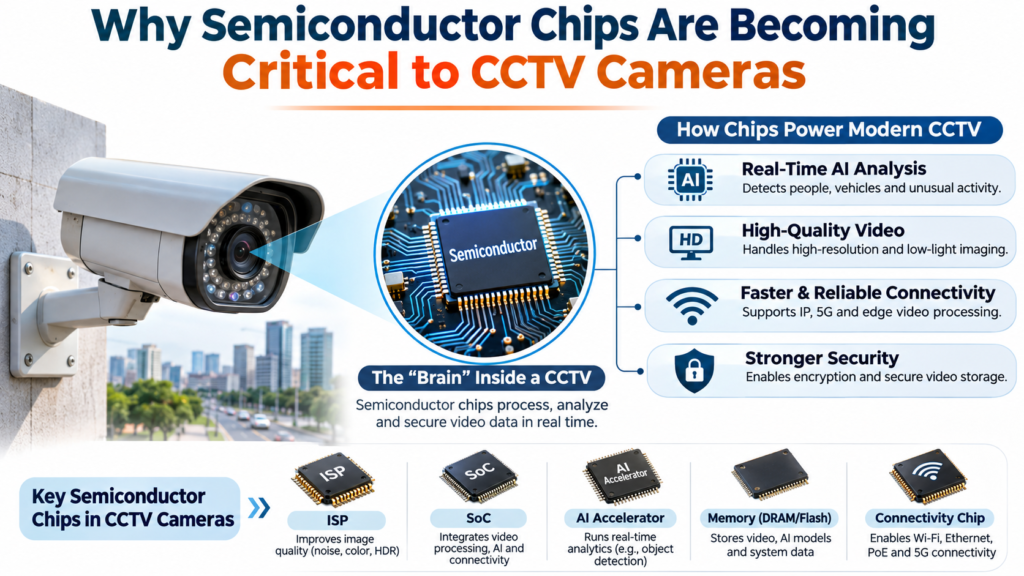
A modern CCTV camera is effectively an embedded computing system. Its image sensor converts incoming light into digital information, while the image signal processor (ISP) improves image quality through functions such as noise reduction, colour correction, and exposure control. The System-on-Chip coordinates essential operations, including video encoding, connectivity, and, in advanced models, AI-based analytics. Memory and storage components support video buffering, processing, and recording.
The demand for intelligent surveillance is increasing the importance of specialised chip architecture. Features such as object detection, motion classification, people counting, and number plate recognition require additional processing capabilities. Edge AI enables cameras to analyse selected information locally rather than sending every video stream to a remote server. This can reduce network traffic and support faster responses. Consequently, efficient vision processors, NPUs, image sensors, and secure semiconductor designs are becoming important areas of development.
India’s CCTV Security Regulations Are Reshaping the Supply Chain

Security and component transparency have become important considerations in India’s surveillance market. The government’s Essential Requirements for CCTV cameras introduced mandatory security-related compliance measures, including hardware and firmware assessments. Requirements include documenting the origin of critical components such as the System-on-Chip and testing devices for vulnerabilities that could enable unauthorised remote access. These measures are intended to improve product security and supply-chain accountability.
This regulatory transition is encouraging manufacturers to reassess their component sourcing and product architecture. Companies must consider not only camera performance and pricing but also firmware integrity, hardware traceability, secure boot, and compliance testing. The government reported 507 CCTV models certified against the applicable Essential Requirements in March 2026. Such developments create opportunities for domestic technology providers, although replacing imported semiconductor components will require investment, technical expertise, and dependable manufacturing partnerships.
Opportunities for Indian Semiconductor Startups and Chip Designers
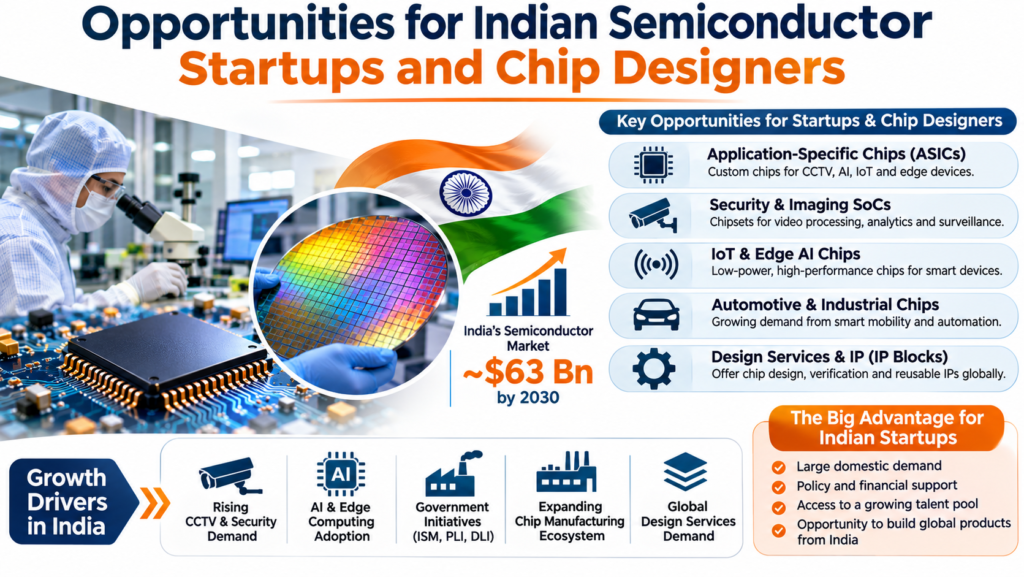
India’s CCTV expansion creates a potential market for fabless semiconductor companies working on vision processors, AI accelerators, image-processing chips, and connectivity solutions. Rather than competing immediately with global semiconductor giants across every chip category, Indian startups can target specialised applications where local engineering, product integration, and customer collaboration offer advantages. Surveillance cameras provide one such application because manufacturers need processors designed around specific performance, power, security, and cost requirements.
The opportunity also extends to semiconductor intellectual property, embedded software, PCB design, testing, and camera-module development. Domestic chip designers can collaborate with CCTV manufacturers to evaluate their processors in actual products and improve designs through real-world testing. However, successful adoption depends on more than developing a working prototype. Startups must demonstrate product reliability, consistent supply, competitive pricing, software support, and long-term maintenance capabilities before their chips can achieve wider commercial adoption.
Can CCTV Manufacturing Strengthen India’s Semiconductor Ecosystem?
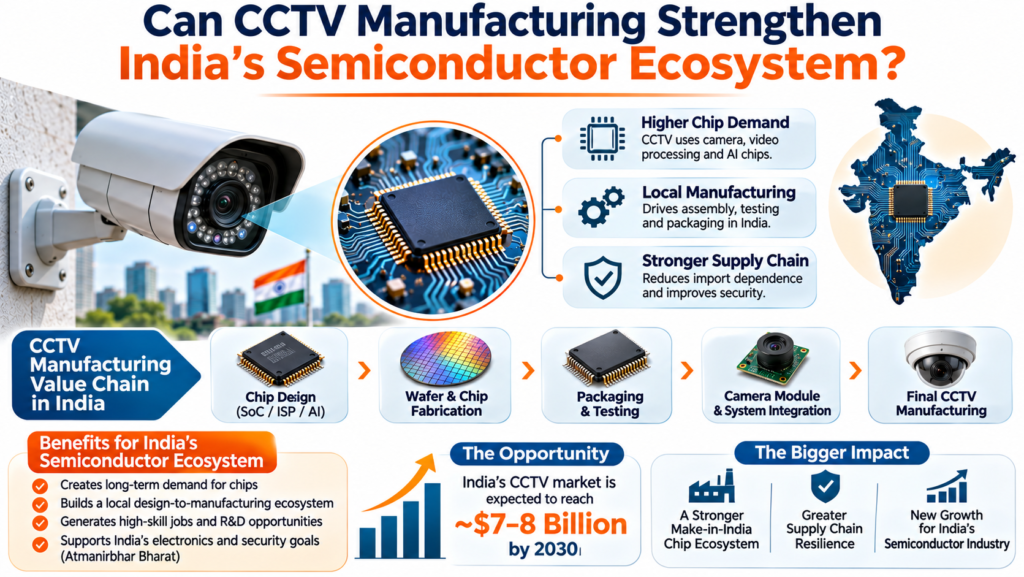
CCTV manufacturing can contribute to India’s semiconductor ambitions by creating demand for locally developed electronic components and specialised chips. The Electronics Component Manufacturing Scheme supports domestic production across several electronics categories, including camera-module sub-assemblies, printed circuit boards, and related supply-chain components. These capabilities can strengthen the broader electronics manufacturing base in which surveillance products operate.
Nevertheless, domestic camera assembly and domestic semiconductor manufacturing are different achievements. A camera assembled in India may still depend on imported image sensors, memory, processors, and other critical components. Building genuine semiconductor independence requires coordinated progress in chip design, fabrication, packaging, testing, component production, and product development. If Indian manufacturers, semiconductor startups, research institutions, and policymakers work together, the CCTV sector could become a practical commercial market for homegrown semiconductor technologies.