


How to Start a Career in VLSI Design

Somewhere inside your phone, your laptop, and even your car, there’s a piece of silicon smaller than your fingernail doing more work than an entire factory did fifty years ago. Someone designed that chip. That someone could be you.
VLSI, or Very Large Scale Integration, is the process of packing millions and sometimes billions of transistors onto a single chip. It’s the invisible engine behind smartphones, electric vehicles, medical devices, and the AI systems everyone keeps talking about. If you’ve been curious about this field but weren’t sure where to begin, this guide walks you through it in plain language.
The good news is that you don’t need a mysterious insider connection or a decade of experience to get started. What you need is a clear roadmap, a bit of patience, and a willingness to learn tools that look intimidating at first but become second nature with practice. Let’s break down exactly how to move from curious beginner to job-ready chip designer.
What a VLSI Career Actually Looks Like Today
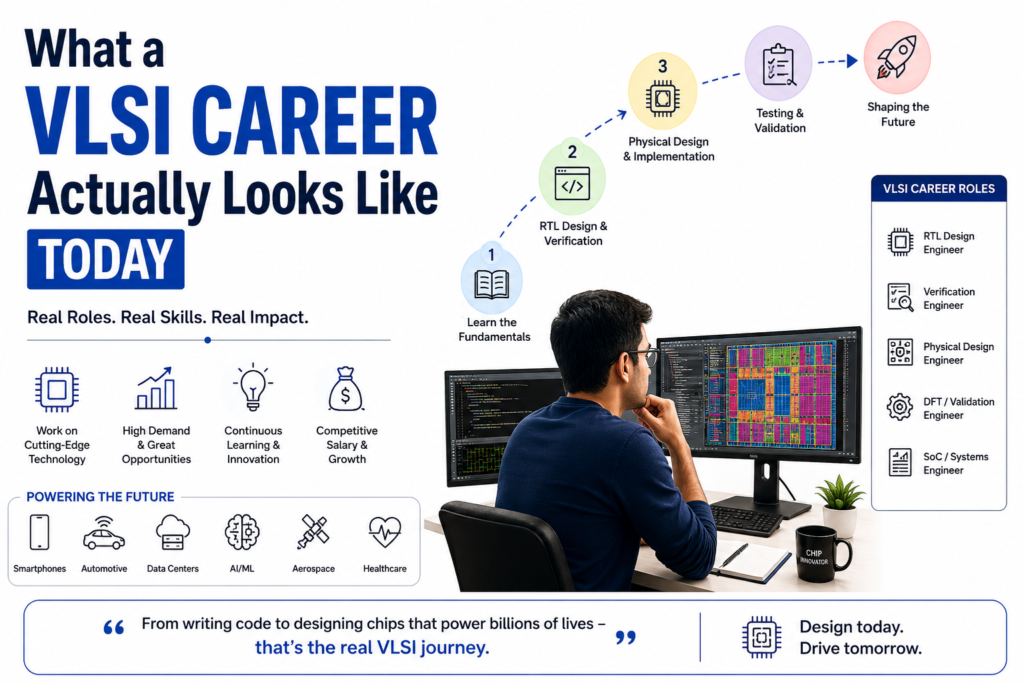
The word “chip design” sounds like one job, but it’s really an umbrella covering several distinct career paths. RTL design engineers write the logic that describes how a chip should behave. Verification engineers try to break that logic before it ever reaches silicon, hunting for bugs in simulated environments. Physical design engineers take the verified logic and turn it into an actual layout, mapping out how transistors and wires fit onto the chip. There are also roles in analog design, DFT (design for testability), and CAD engineering, where professionals build and maintain the software tools everyone else relies on.
Each path suits a different kind of thinker. If you enjoy building systems from scratch and making architectural decisions, design roles will feel natural. If you’d rather hunt for edge cases and prove that something is broken before it costs a company millions, verification might be your calling. Neither path is objectively better; they’re just different flavors of problem-solving inside the same industry.
Demand across all these roles has grown sharply, driven by AI accelerators, electric vehicles, 5G and 6G infrastructure, and a global push toward domestic chip manufacturing in several countries. That growth means more openings, but it also means companies are choosier about who they hire, which is exactly why the next few sections matter.
Skills You Need Before You Touch a Real Chip
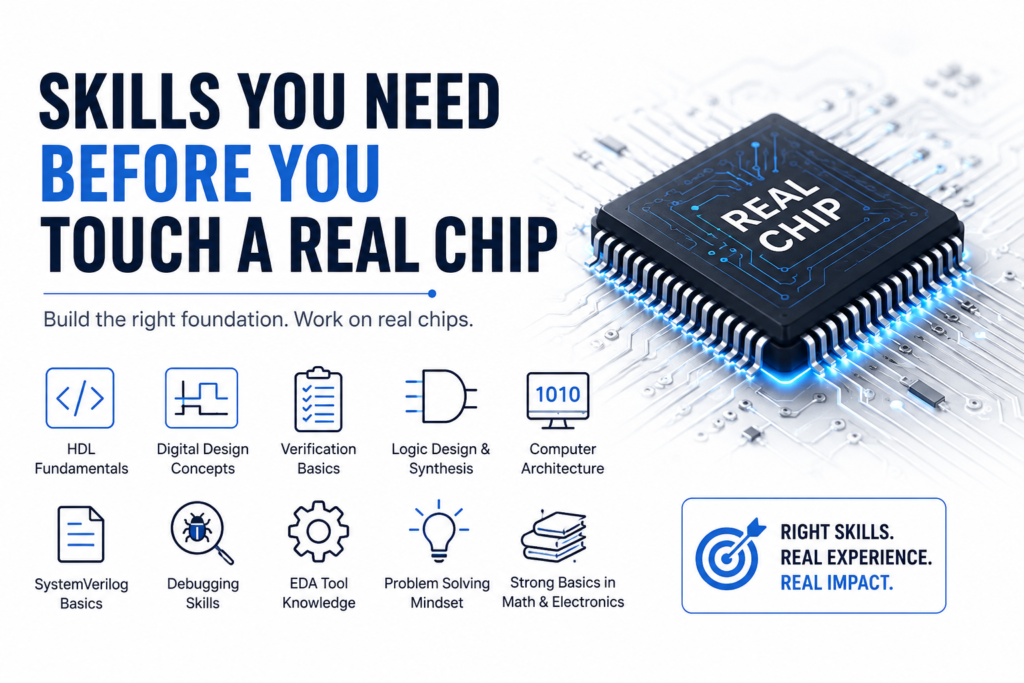
Before diving into expensive tools or advanced courses, get comfortable with the fundamentals. Digital logic design, Boolean algebra, and an understanding of combinational and sequential circuits form the bedrock of everything else. Skipping this stage to jump straight into flashy tools usually backfires, because every advanced concept assumes you already have this foundation solid.
From there, hardware description languages become your bread and butter. Verilog is the simpler starting point, while SystemVerilog adds object-oriented features and verification constructs that most employers now expect. Learning to write clean, synthesizable code and pairing it with a basic testbench is one of the best exercises you can do early on. A simple project, like designing a UART transmitter with a finite state machine, teaches you counters, shift registers, and timing all at once.
Beyond HDL, basic scripting in Python or Tcl helps you automate repetitive tasks, which is a skill EDA-heavy roles value highly. A working understanding of semiconductor physics, power optimization, and thermal behavior rounds out your technical base. None of this needs to be mastered overnight. Building it piece by piece, project by project, is far more effective than trying to cram everything before you apply anywhere.
Tools and Technologies Shaping the Industry

Once your fundamentals are solid, it’s time to get hands-on with the software that actually runs the industry. Cadence, Synopsys, and Siemens EDA are the three names you’ll encounter constantly, offering suites for simulation, synthesis, and physical layout. Getting even basic exposure to one of these tools, through a free trial, a training program, or a university lab, makes a noticeable difference on your resume.
The industry itself is shifting quickly. Artificial intelligence is now woven directly into chip design workflows, with machine learning models helping optimize layouts, predict timing violations, and speed up verification cycles that used to take weeks. Advanced process nodes like 3nm and below are pushing engineers to understand new transistor architectures and extreme ultraviolet lithography. Chiplet-based designs, where multiple smaller dies are combined instead of building one massive chip, are becoming mainstream because they’re cheaper to manufacture and easier to scale.
Staying aware of these shifts doesn’t mean you need to master all of them immediately. It means choosing one or two areas, like low-power design or AI-assisted verification, and going deep enough that you can speak about them intelligently in an interview. Recruiters notice candidates who understand where the industry is headed, not just where it’s been.
How to Build a Portfolio and Land Your First Role

Certificates open doors, but portfolios get you through them. Recruiters in this field consistently say that hands-on projects matter more than a stack of course completions. Pick a manageable project, such as designing and verifying a small processor block, and document your process from specification through testing. Publishing your work, even informally, on a personal site or a code-sharing platform gives interviewers something concrete to discuss.
Open-source hardware projects, particularly around RISC-V, offer a low-barrier way to contribute to real designs and get noticed by people already working in the field. Internships remain one of the most reliable entry points, since they let you apply classroom concepts under real deadlines and mentorship. If a formal internship isn’t available, look for research projects or smaller design competitions that simulate the same pressure.
Networking still matters in a field this specialized. Following industry publications, joining online communities focused on chip design, and attending virtual or in-person conferences can surface opportunities long before they’re posted publicly. Many first roles come through a referral or a conversation rather than a cold application, so treat relationship-building as part of your preparation, not an afterthought.