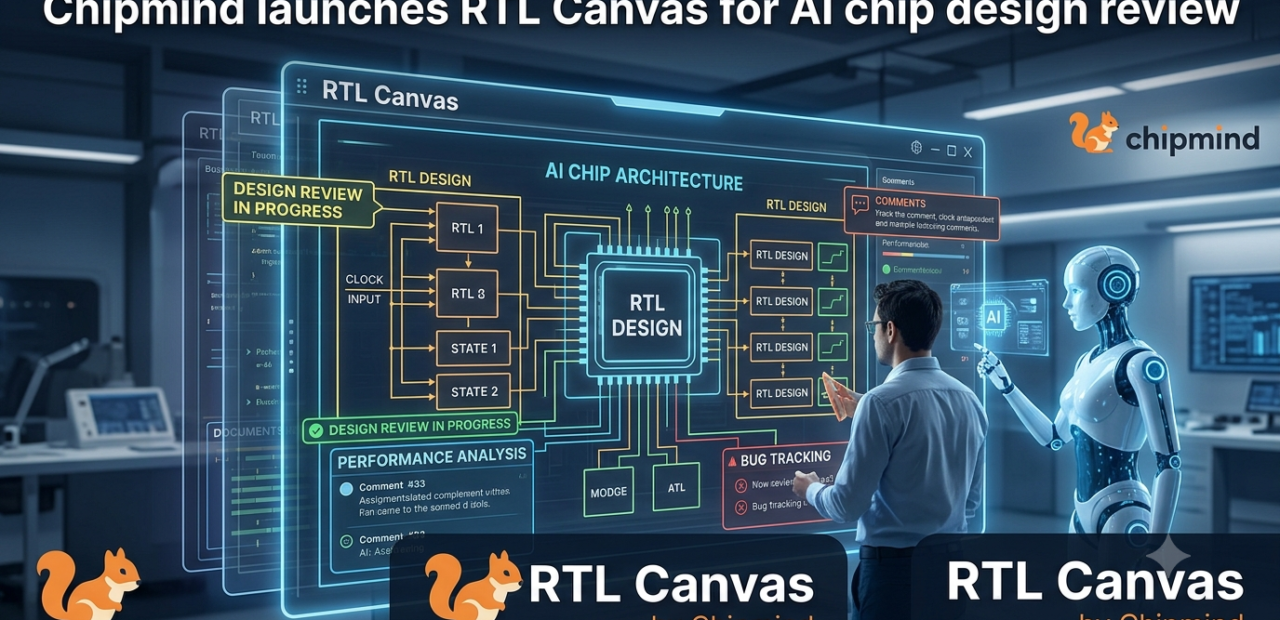
Chipmind launches RTL Canvas for AI chip design review

Picture an engineer staring at a thousand-line pull request generated by an AI agent overnight, trying to figure out whether the machine actually understood the chip it just rewrote. That is the exact problem a Zurich-based startup just decided to fix.
Chipmind, a company building AI agents for semiconductor design, has rolled out a new tool called RTL Canvas. It is built around a simple but overdue idea: chip engineers do not think in walls of code, they think in blocks, buses, and diagrams. So instead of forcing humans to review AI-generated hardware code as raw text, RTL Canvas turns every change into a visual structure that shows what was modified, why, and what still needs a human eye.
The timing matters. AI agents have gotten remarkably good at writing and iterating RTL, the code that defines how a chip actually behaves. But speed created a new problem. Agents can generate changes faster than any human team can read them, and while an agent can verify what was explicitly specified in its instructions, it cannot catch the judgment calls that were never written down anywhere. Architectural intent, unstated assumptions, and edge cases that nobody thought to mention are still squarely a human responsibility. The tools available for that kind of review, though, have not kept pace. Most teams are still stuck flipping through dense pull requests or static diagrams that do not update as the design evolves.
Why Text-Based Review Was Becoming a Bottleneck
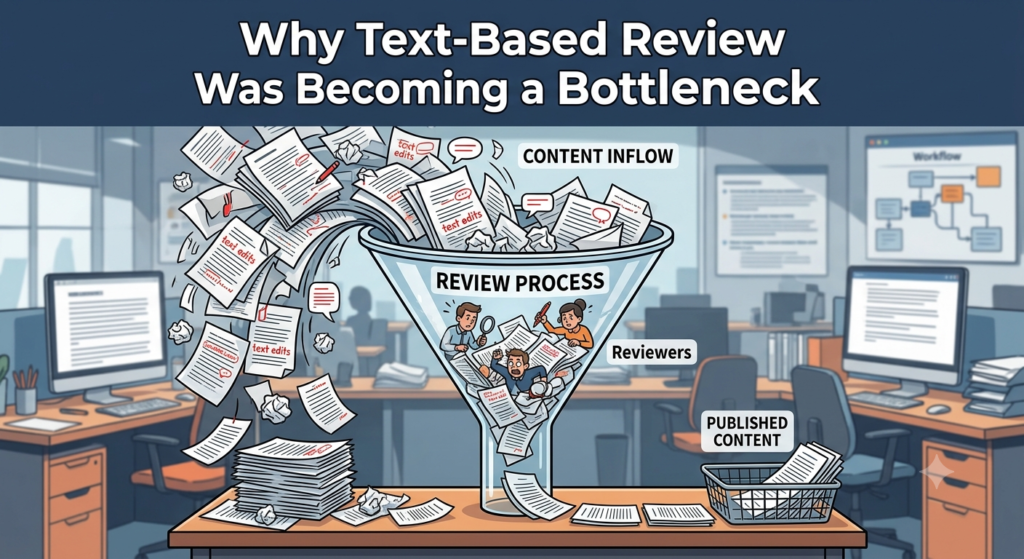
For years, the assumption in chip design automation was that the hard part was generation: getting an AI to write correct, synthesizable hardware code. That problem is largely solved now. The harder, less talked-about problem is trust. When an AI agent hands over a redesigned block, someone still has to decide whether to merge it, and doing that from a text diff is slow and mentally exhausting, especially on large system-on-chip projects where a single change can ripple across dozens of interconnected modules. Chipmind’s pitch is that the actual bottleneck in modern chip development has quietly shifted from writing and testing code to reviewing and trusting it.
What RTL Canvas Actually Does Differently
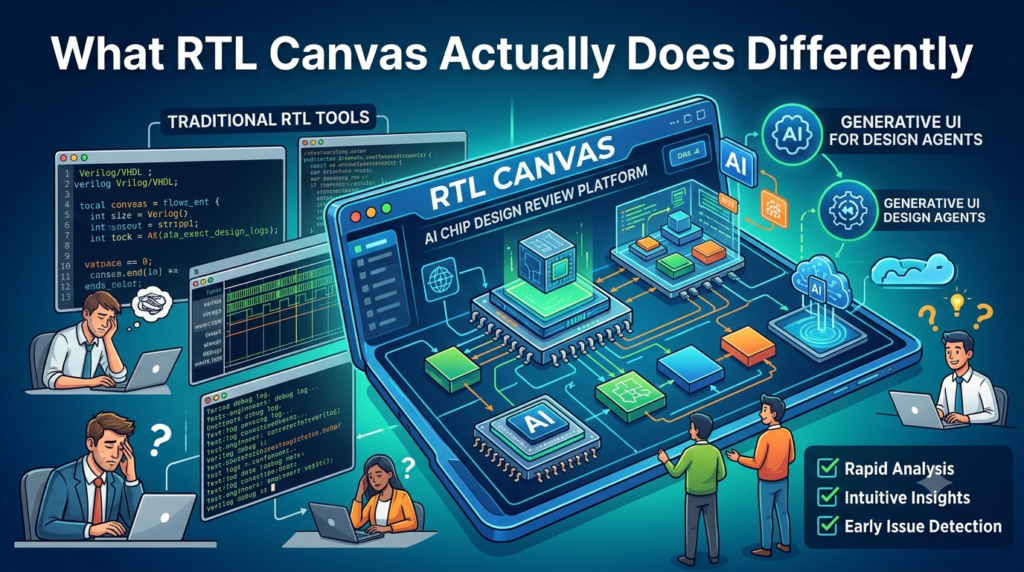
Instead of a chat window and a pile of generated files, RTL Canvas gives engineers a live diagram of the existing architecture. Engineers can sketch their intended changes directly onto that diagram, and the AI writes the underlying RTL to match. When the agent proposes a change, the canvas regenerates on the fly to show the modified structure alongside its reasoning, the evidence behind it, and anything that remains unverified. Nothing is meant to merge quietly. The idea is to recreate the feeling of two engineers standing at a whiteboard sketching an architecture together, except one of them happens to be an AI that can also write and simulate the code in real time.
The Bigger Shift This Points To

This launch fits into a broader pattern happening across AI-assisted engineering tools right now: the interface is becoming as important as the model behind it. A powerful agent that communicates only through text output eventually hits a wall, not because the AI is wrong, but because humans cannot verify its work fast enough to trust it. RTL Canvas is essentially a bet that the next real gains in AI-driven chip design will not come from smarter models alone, but from better ways for humans and AI to collaborate on the same visual surface, catching mistakes before they become expensive silicon.
Where This Leaves Chip Design Teams

For now, Chipmind is positioning RTL Canvas as an enterprise tool, aimed at semiconductor teams that are already dealing with the review backlog created by AI-generated code. It plugs into a company’s existing design database and EDA toolchain rather than replacing it, which lines up with how Chipmind has approached automation since it emerged from stealth: augmenting existing workflows instead of asking teams to rebuild them from scratch. Whether this becomes the standard way engineers review AI-generated hardware remains to be seen, but it addresses a gap that has been getting harder to ignore as agentic coding tools spread into hardware design, an industry where a single unnoticed error can be far more costly to fix than in software.
What is clear is that the conversation around AI in chip design is maturing. The early question was whether AI could write usable RTL at all. The current question, and the one RTL Canvas is trying to answer, is how humans stay meaningfully in the loop once it can. That shift, from raw capability to verifiable trust, is likely to shape how a lot of AI tools in technical fields evolve from here, not just in semiconductors.