



Bangalore vs Hyderabad: Where Should VLSI Engineers Build Their Career in 2026?

The Indian semiconductor industry is entering one of its most exciting phases, and for VLSI engineers, the choice between Bangalore and Hyderabad has become more important than ever. Both cities are attracting major global chip companies, expanding design centers, and benefiting from strong government support for semiconductor manufacturing and research. However, each city offers a different mix of career opportunities, salary potential, cost of living, work culture, and long-term professional growth.
This article compares Bangalore and Hyderabad across the factors that matter most to VLSI professionals in 2026. From job availability and leading semiconductor employers to learning opportunities, compensation trends, startup ecosystems, and future industry outlook, we’ll examine how each city stacks up. Whether you’re a fresh engineering graduate planning your first VLSI job or an experienced engineer considering your next career move, this comparison will help you identify which city best aligns with your professional goals and long-term aspirations.
1. The Job Market: Volume vs Opportunity

Bangalore has long been the beating heart of India’s chip design ecosystem. It hosts a dense cluster of multinational R&D centers working on everything from processors to networking chips, along with dozens of design service companies that keep the hiring pipeline constantly active. The sheer volume of openings, the number of teams working on cutting-edge nodes, and the presence of nearly every major EDA and semiconductor name make it the city where opportunities are simply more frequent.
Hyderabad, on the other hand, has quietly built real depth rather than just breadth. It has become a strong base for wireless chip design, mixed-signal work, and R&D centers tied to global product companies. It may not match Bangalore’s sheer job count, but the roles here are often just as advanced, and the competition for each opening tends to be slightly less intense simply because fewer engineers are chasing the same seats.
2. Cost of Living and Real Take-Home Value

A salary figure on an offer letter means very little without context. Bangalore’s rents, traffic-driven commute costs, and general cost of living have climbed steadily, which quietly eats into what looks like an attractive package. Engineers moving there for the first time are often surprised by how much of their monthly income disappears into rent alone, especially in areas close to the major tech corridors.
Hyderabad tends to offer a noticeably lower cost of living for a comparable lifestyle. Housing is more affordable, commutes are generally shorter, and the overall pace of the city feels less chaotic. For someone comparing two similar offers, the actual purchasing power of a Hyderabad salary can end up higher than a Bangalore one, even if the number on paper looks smaller. This is worth factoring in seriously rather than chasing the bigger figure blindly.
3. Skill Growth, Mentorship, and Learning Curve

Career growth in VLSI is rarely just about the paycheck. It is about how fast you learn, who mentors you, and how quickly you get exposed to real, complex design problems. Bangalore’s advantage here is density. With so many experienced engineers and senior architects working in one city, informal mentorship happens naturally through meetups, alumni circles, and cross-company networking that is harder to replicate elsewhere.
Hyderabad is catching up quickly, largely because of a growing number of specialized training setups. Anyone serious about entering or upskilling in this field should look closely at a good vlsi course in Bangalore before committing to a city move, since the right foundational training can matter more than the city itself in the first two years of a career. A strong vlsi training institute in hyderabad can bridge the gap between classroom concepts and the kind of hands-on design and verification skills that actual projects demand, which levels the playing field against Bangalore’s mentorship advantage.
4. Future Outlook: Where Is the Industry Heading in 2026 and Beyond

The bigger story shaping both cities is the government-backed push to build a homegrown semiconductor ecosystem, which is pulling in fresh investment across design, fabrication, and packaging. Bangalore continues to be the default landing spot for this investment because of its existing density of talent and infrastructure, and it is likely to remain the largest single market for VLSI roles for the foreseeable future.
Hyderabad’s trajectory looks different but equally promising. It is positioning itself as a strong secondary hub, particularly for companies looking to expand outside an increasingly saturated Bangalore market. Rental costs, easier hiring, and government incentives around infrastructure are nudging more design centers to open satellite offices there. For someone starting out today, this means Hyderabad could offer more room to grow into senior roles simply because the ecosystem there is younger and less crowded at the top.
5. Long-Term Career Trajectory: Which City Ages Better?
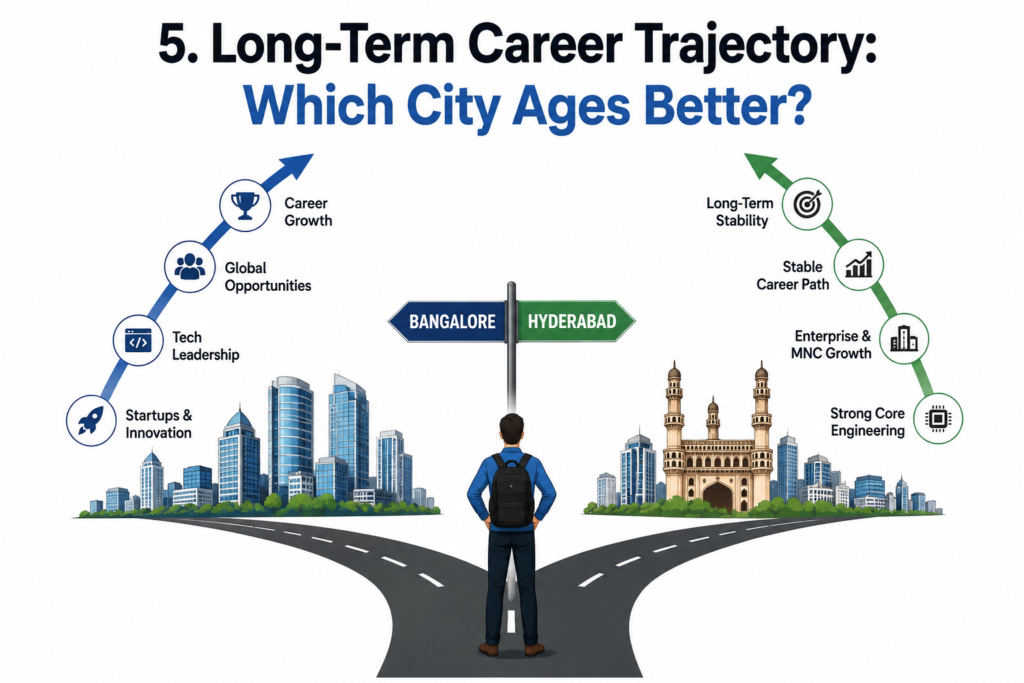
Here’s the honest answer: it depends on what stage you’re at and what you want out of the next ten years.
If you want immediate access to the widest range of established teams, deep specialization tracks, and a mature professional network, Bangalore’s head start is real and won’t disappear overnight. If you want to ride a growth curve — joining an ecosystem while it’s still being built, with government tailwinds, startup energy, and lower living costs stretching your early-career savings further — Hyderabad’s trajectory looks compelling. With design centers opening in both cities and semiconductor manufacturing projects like Micron’s Gujarat plant and Tata’s Dholera fab feeding demand across the ecosystem, neither bet looks like a bad one.
The more useful question isn’t “which city wins” — it’s “which environment matches how I want to grow.” A structured, well-taught foundation matters more than the pin code you start in, so whichever city you choose, invest early in solid training and real project experience.
Conclusion
There is no universal right answer here, only the right answer for your situation. If dense networking, the widest range of openings, and constant exposure to multiple companies matter most to you, Bangalore remains hard to beat. If you value affordability, a calmer pace of life, and a market that is growing rather than saturated, Hyderabad is quietly becoming one of the smartest bets in Indian tech.
Whichever city you lean toward, the real differentiator will be the depth of your technical foundation. Before packing your bags, it is worth spending time researching training options, talking to working professionals in both cities, and being honest with yourself about the kind of environment where you learn and perform best. The city is just the setting; the skills you build are what actually carry your career forward.
1. Which city is better for VLSI jobs in 2026: Bangalore or Hyderabad?
Both cities offer excellent opportunities for VLSI engineers. Bangalore has a larger number of semiconductor companies, startups, and R&D centers, while Hyderabad offers lower living costs, a rapidly growing chip ecosystem, and major investments from global semiconductor companie
2. Is Bangalore still the best city for VLSI engineers?
Yes. Bangalore remains India’s largest semiconductor hub, hosting companies like Intel, Qualcomm, AMD, NVIDIA, Texas Instruments, Synopsys, Cadence, and many VLSI startups. It provides abundant job opportunities, networking events, and career growth.
3. Is Hyderabad becoming a semiconductor hub?
Absolutely. Hyderabad has witnessed rapid growth due to government initiatives, semiconductor investments, EDA companies, and expanding design centers. Many global semiconductor companies are increasing their presence in Hyderabad, making it one of India’s fastest-growing VLSI destinations.
4. Which city offers higher salaries for VLSI engineers?
On average, Bangalore offers slightly higher salaries because of its mature semiconductor ecosystem and strong competition for experienced engineers. However, Hyderabad often provides better savings due to its lower cost of living.
5. Which city has a lower cost of living for semiconductor professionals?
Hyderabad generally has a lower cost of living than Bangalore. Housing, transportation, and daily expenses are more affordable, allowing many engineers to save a larger portion of their salary.