

Microcontroller vs Microprocessor: Complete Guide for Beginners

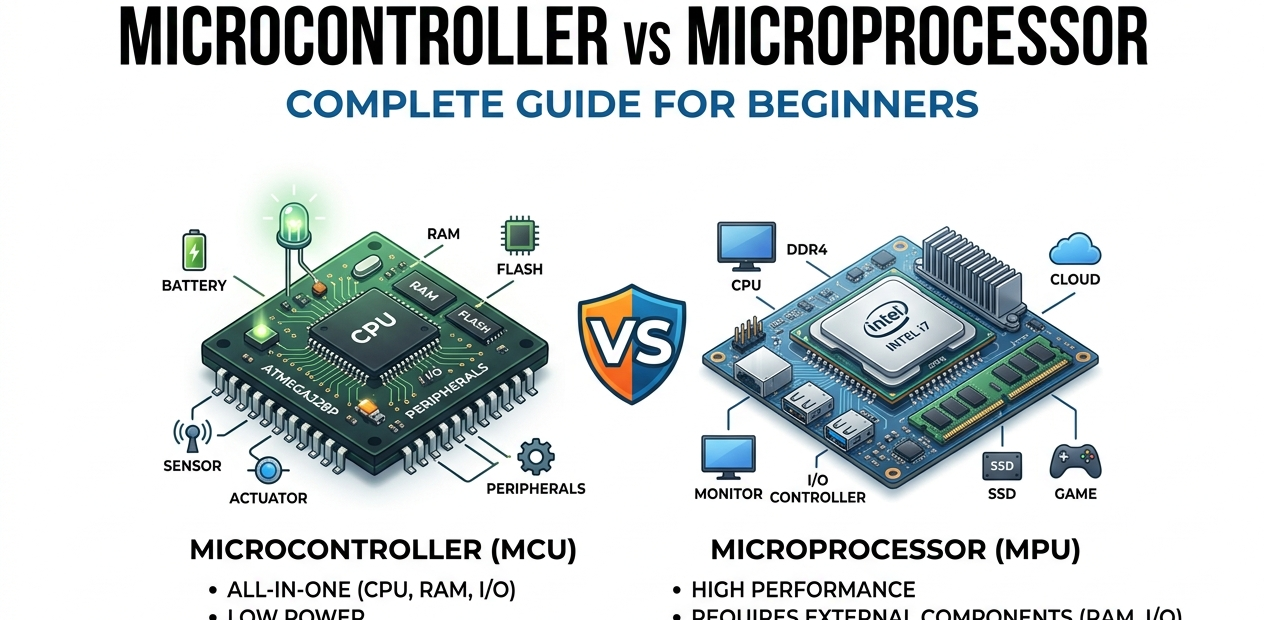
Choosing between a microcontroller (MCU) and a microprocessor (MPU) is one of the most critical decisions in hardware engineering. While both function as the silicon “brains” of electronic systems, their internal architectures, operational capabilities, and intended applications are radically different. Microcontrollers consolidate memory, processing power, and I/O peripherals onto a single chip, making them highly efficient, self-contained units for dedicated, real-time embedded control tasks.
Conversely, microprocessors operate as high-performance central processing units that require external memory modules, storage drives, and peripheral controllers to function. Designed to handle complex mathematical operations, multi-tasking operating systems, and heavy software stacks, MPUs power modern personal computers, gaming consoles, and enterprise servers. Understanding their fundamental trade-offs in speed, power, and cost is essential for building optimal hardware solutions.
Microcontroller vs. Microprocessor: Core Technical Differences
| Feature / Metric | Microcontroller (MCU) | Microprocessor (MPU) |
| System Integration | Single-chip solution (CPU, RAM, ROM, I/O all integrated). | Standalone CPU chip; requires external RAM, Flash, and I/O. |
| Core Architecture | Typically Harvard Architecture (separate data & instruction buses). | Typically Von Neumann Architecture (shared memory bus). |
| Clock Speed | Moderate speed (Kilohertz to a few hundred Megahertz). | High speed (1 GHz to multi-GHz range). |
| Memory Capacity | Small on-chip Flash (KB to MB) and RAM (KB to MB). | Large external DDR RAM (GBs) and storage drives (GBs to TBs). |
| Power Consumption | Very low (Milliwatts); optimized for battery power. | High (Watts to tens of Watts); requires dedicated power delivery. |
1. Hardware Architecture: System-on-a-Chip vs. Standalone CPU
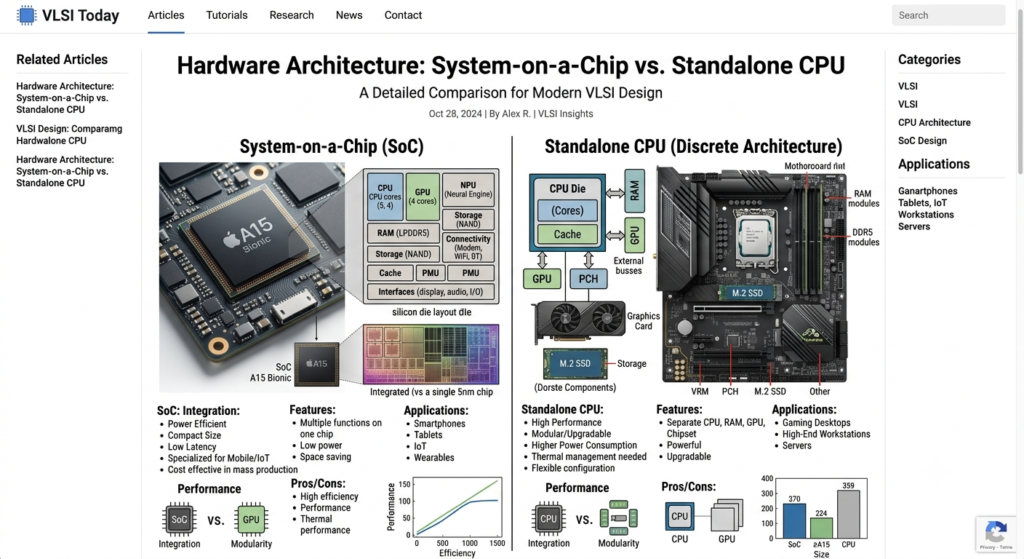
The primary physical distinction between a microcontroller and a microprocessor lies in their internal level of integration. A microcontroller is an all-in-one system designed on a single piece of silicon. It houses a Central Processing Unit (CPU) alongside internal volatile memory (RAM), non-volatile program storage (Flash/ROM), timer modules, analog-to-digital converters (ADCs), and general-purpose input/output (GPIO) pins. Because every component necessary to run a program is built directly onto the die, a microcontroller requires very few external parts to begin operating.
A microprocessor, on the other hand, operates purely as a high-speed central computing core. It contains the arithmetic logic unit (ALU), registers, and control units required to execute complex mathematical instructions, but lacks built-in memory or peripheral interfaces. To build a functional system around an MPU, hardware engineers must connect external dynamic RAM (DDR memory), storage devices, power management ICs, and communication interfaces on a printed circuit board (PCB). This design separation allows microprocessors to scale computational capacity massively, though it results in a larger circuit footprint.silicon real estate goes toward processing rather than sharing space with memory or peripherals. That’s why they dominate laptops, servers, and high-performance computing systems where raw speed matters more than power savings or compact size.
Performance and Processing Capabilities
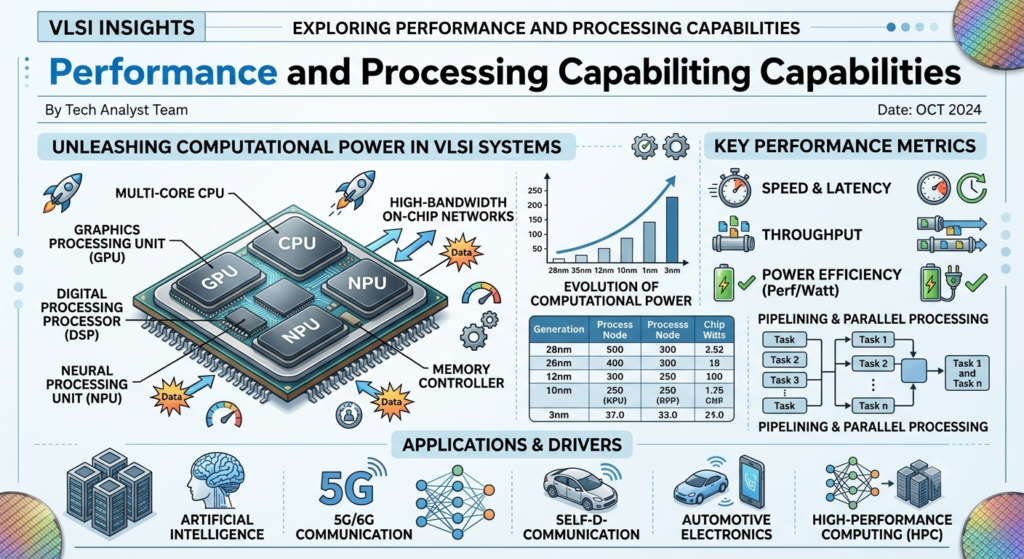
When comparing raw execution speed, microprocessors significantly outpace microcontrollers. MPUs operate at clock frequencies ranging from 1 GHz to well over 5 GHz, utilizing multi-core designs, deep pipeline stages, and multi-level cache structures (L1, L2, L3) to process billions of instructions per second. This vast throughput allows microprocessors to perform heavy concurrent tasks like video encoding, 3D graphics rendering, complex mathematical modeling, and multi-threaded desktop software execution effortlessly.
Microcontrollers run at substantially lower clock speeds, typically spanning between 8 MHz and 600 MHz. However, this lower clock rate is a deliberate design choice optimized for deterministic, real-time control. While an MPU may take unpredictable time frames to switch tasks due to operating system overhead and cache misses, an MCU executes code with precise microsecond timing. This makes microcontrollers vastly superior for tasks where hardware must instantly respond to sensor inputs, interrupt signals, or motor control loops.
Read More: How to Build a Career in Embedded Systems and IoT
Key Differences Between Microcontroller and Microprocessor
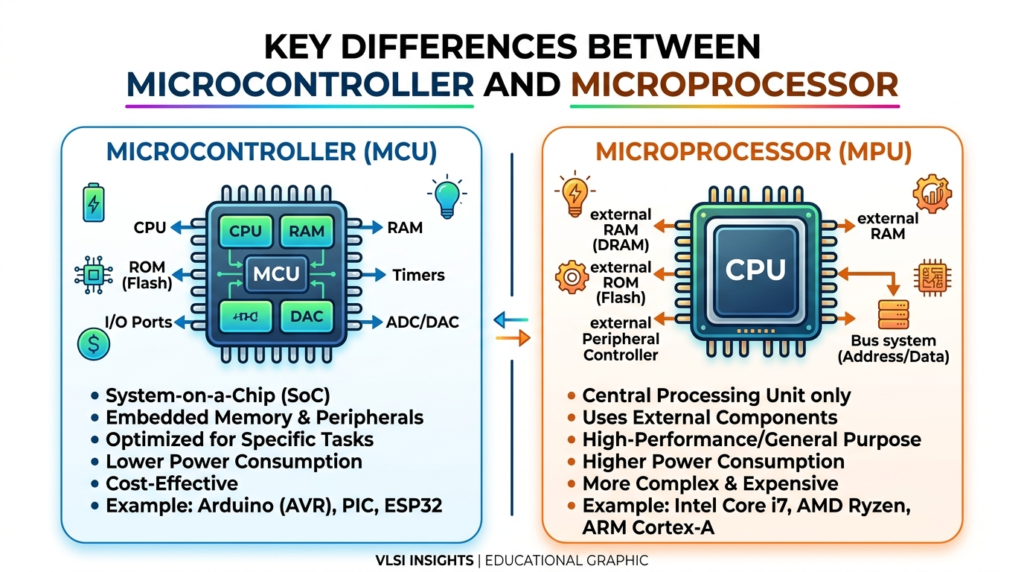
Understanding where these two chips diverge makes it much easier to pick the right one for a project. Here’s how they actually compare:
- Integration: A microprocessor needs external RAM, ROM, and I/O ports to function, while a microcontroller has all of these built directly onto the chip.
- Power consumption: Microcontrollers are designed for low power draw, which is why battery-powered gadgets rely on them, whereas microprocessors typically consume more power to sustain higher performance.
- Cost: Because microcontrollers combine everything into one chip, they tend to be more affordable for single-purpose devices, while microprocessor-based systems need extra components that raise the overall cost.
- Processing power: Microprocessors are built for heavy computation — multitasking, running operating systems, handling complex software — while microcontrollers are optimized for lightweight, dedicated tasks.
- Application scope: Microprocessors run general-purpose systems like PCs and servers, while microcontrollers are the go-to choice for embedded, task-specific devices like sensors, appliances, and automotive control units.
Neither chip is “better” in an absolute sense — the right choice depends entirely on whether a project needs broad computing flexibility or focused, efficient control of a single function. A simple way to remember it: if the device needs to run a full operating system, browse files, and handle multiple applications at once, it needs a microprocessor. If the device just needs to sense, control, or automate one specific function reliably for years on a coin-cell battery, a microcontroller is almost always the smarter and cheaper route.
Real-World Applications: Where Each One Fits
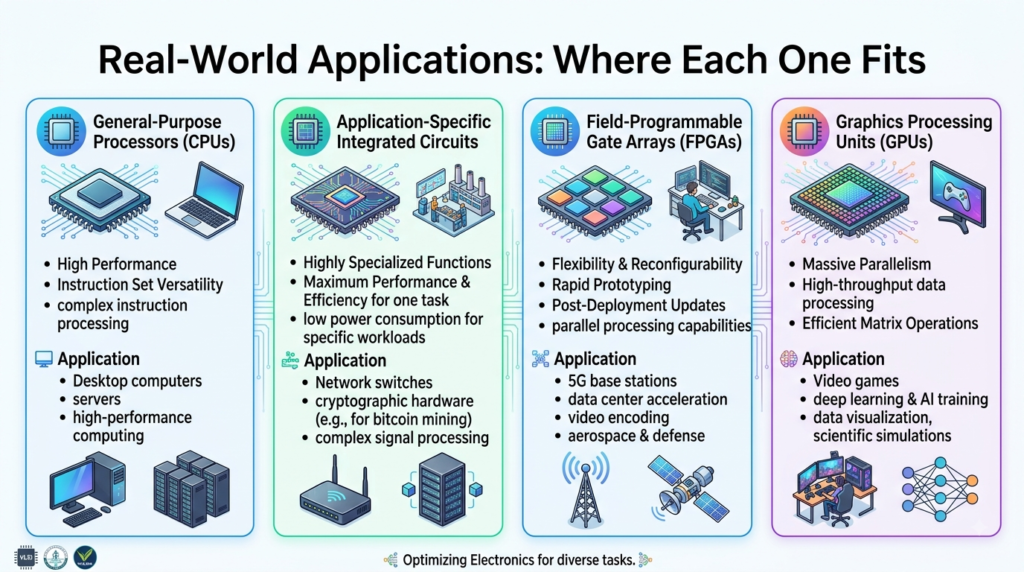
Microprocessors are everywhere general computing happens. Laptops, desktops, smartphones’ application processors, and cloud servers all lean on microprocessors because they need to run multiple programs, manage large amounts of data, and handle complex operating systems smoothly. Any device where flexibility and raw speed matter — think video editing rigs or data centers — is built around a microprocessor.
Microcontrollers, on the other hand, quietly run the world around us without anyone noticing. They’re inside your microwave, your car’s anti-lock braking system, home security alarms, industrial robots on factory floors, and medical devices like glucose monitors. According to recent market analysis, automotive electronic control units alone accounted for roughly 30% of microcontroller demand in 2025, driven by the growing number of control units packed into modern vehicles for safety and automation features. Meanwhile, connected devices across homes, factories, and wearables are projected to cross 20 billion units by 2030, and nearly all of them will be powered by microcontrollers rather than microprocessors — because efficiency and reliability matter more than raw computing power in these use cases.
Latest Trends Shaping Microcontrollers and Microprocessors in 2026
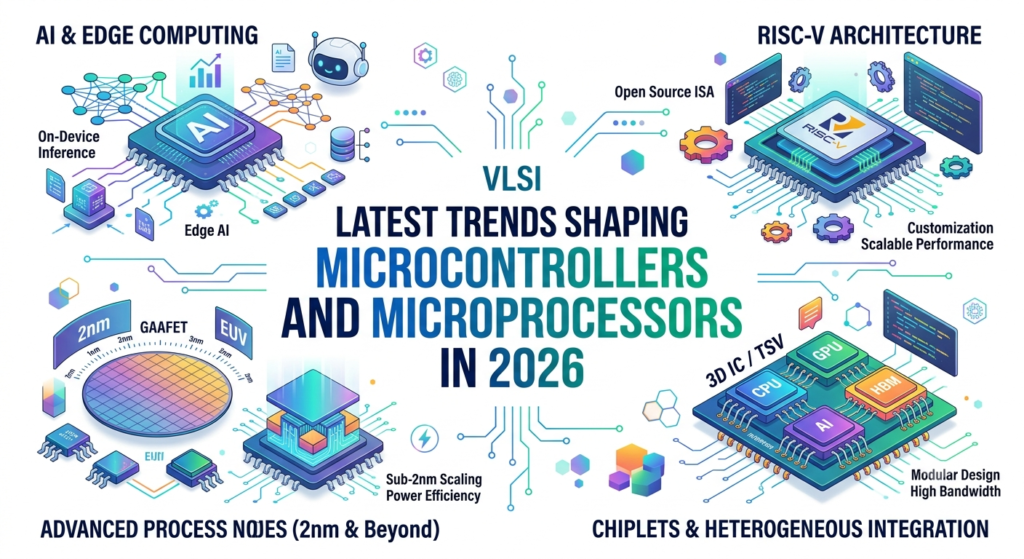
The line between these two chip categories is getting more interesting as new technology pushes both forward. A few shifts worth knowing about:
- Edge AI is moving into microcontrollers. Chipmakers have started building neural processing capability directly into low-power MCUs, allowing devices to run basic AI models locally instead of sending data to the cloud. This means wearables, robots, and industrial sensors can now make smart decisions instantly, without draining battery life or depending on constant internet connectivity.
- RISC-V architecture is gaining ground. Open instruction-set designs are lowering licensing costs and giving smaller manufacturers the freedom to build custom, efficient chips — a shift that’s reshaping how both microcontrollers and microprocessors are designed and priced.
- 32-bit MCUs are becoming the default, replacing older 8-bit and 16-bit designs even in simple appliances, because the price difference has shrunk while the performance gap has grown.
- The overall chip market is expanding fast. The global microcontroller market alone is expected to grow at a double-digit annual rate through the early 2030s, fueled by automotive electrification, industrial automation, and the sheer number of “smart” everyday products entering the market.
- On the microprocessor side, high-performance chips are increasingly chiplet-based, combining multiple smaller dies into one package to boost performance without the cost and complexity of building a single giant chip — a trend already showing up in the latest datacenter and edge-inference processors.
These developments show that microcontrollers and microprocessors aren’t standing still — they’re both evolving to meet the demands of a world where nearly every device is expected to be smart, connected, and efficient.
Conclusion
At the end of the day, the microcontroller vs microprocessor debate isn’t about which chip is superior — it’s about matching the right tool to the right job. If a project needs heavy computing, multitasking, and flexibility, a microprocessor paired with external memory and peripherals is the way to go. If it needs to run one task reliably, cheaply, and with minimal power draw, a microcontroller’s all-in-one design wins every time. As edge AI, RISC-V architectures, and smarter embedded systems continue to reshape the electronics industry in 2026 and beyond, understanding this distinction isn’t just useful trivia — it’s the foundation for making smarter design and product decisions in an increasingly connected world.
1. What is the difference between a microcontroller and a microprocessor?
A microcontroller includes CPU, memory, and peripherals on one chip, while a microprocessor mainly contains the CPU and needs external components.
2. Which is better, microcontroller or microprocessor?
Microcontrollers are better for dedicated embedded applications, while microprocessors are better for complex systems requiring high processing power.
3. Is Arduino a microcontroller or microprocessor?
Arduino boards generally use microcontrollers, such as the ATmega328P, to control embedded applications and electronic devices.
4. Where are microcontrollers used?
Microcontrollers are used in IoT devices, automobiles, appliances, robotics, medical equipment, industrial systems, and consumer electronics.
5. Where are microprocessors used?
Microprocessors are commonly used in computers, laptops, servers, and advanced embedded systems requiring powerful processing capabilities.
6. Can a system use both a microprocessor and a microcontroller together?
Yes, many complex systems utilize both. In modern automotive designs or robotics, a microprocessor handles high-level tasks like graphical user displays, camera processing, and network routing, while a secondary microcontroller manages real-time tasks like motor control, sensor reading, and safety interlocks.
7. Which option is cheaper to manufacture in mass production?
Microcontrollers are significantly cheaper for mass production. Because an MCU integrates processor, memory, and I/O into one chip, it minimizes total component count, shrinks board size, and simplifies PCB design, drastically lowering manufacturing costs.