


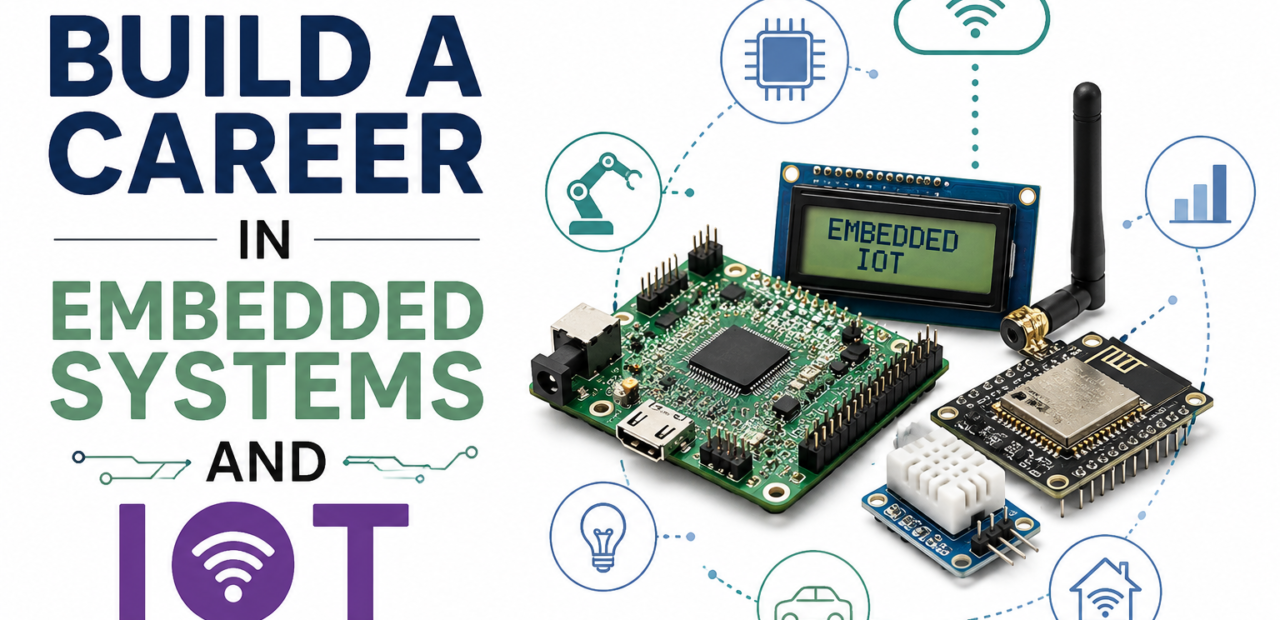
How to Build a Career in Embedded Systems and IoT

The demand for skilled hardware and software developers is surging as smart devices, connected infrastructure, and autonomous systems expand globally. An entry point into building a career in embedded systems and the Internet of Things (IoT) requires mastering a blend of hardware engineering, low-level software design, and cloud architecture. Entering this domain can open doors across various industries, including robotics, consumer electronics, industrial automation, and automotive tech.
Achieving success in embedded systems and IoT involves navigating a structured technical roadmap. A solid engineering foundation requires gaining hands-on hardware intuition, learning low-level programming languages, mastering real-time processing, and implementing secure cloud communication protocols. Understanding each core pillar allows aspiring engineers to strategically focus their learning, build industry-ready portfolio projects, and accelerate their career growth.
Embedded Systems vs. Internet of Things (IoT): Key Domain Comparison
| Domain Pillar | Embedded Systems Engineering | Internet of Things (IoT) Engineering |
| Primary Scope | Designing low-level hardware-software systems dedicated to specific deterministic tasks. | Connecting hardware nodes to networks and cloud platforms for centralized data processing. |
| Core Software Focus | Bare-metal C/C++, register access, RTOS scheduling, interrupt service routines, device drivers. | Embedded firmware, MQTT/CoAP protocols, cloud integration APIs, network security, Python/Node.js. |
| Hardware Targets | Microcontrollers (STM32, AVR, PIC), DSPs, FPGAs, automotive ECUs. | Wireless SOCs (ESP32, Nordic nRF), single-board computers (Raspberry Pi), cellular gateways. |
| Network & Connectivity | On-board serial protocols: UART, SPI, I2C, CAN, LIN. | Wireless & cloud layers: Wi-Fi, BLE, LoRaWAN, Cellular, MQTT, AWS IoT Core. |
Mastering the Core Technical Stack: Low-Level Programming and Hardware
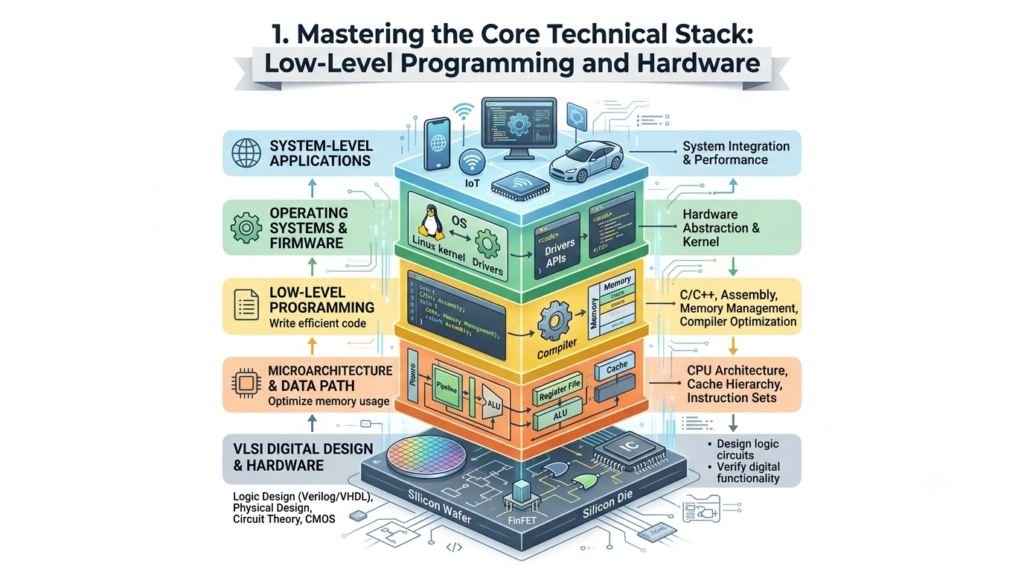
Building a strong foundation in embedded systems requires proficiency in low-level programming languages, primarily C and C++. Engineers must understand hardware architecture, register manipulation, pointers, and manual memory management. Beyond writing firmware, developers need to read circuit schematics, interface with microcontrollers like STM32 or ESP32, and master essential hardware communication protocols such as UART, I2C, and SPI.
A solid grasp of electronics complements software expertise by allowing developers to debug hardware-level issues effectively. Working directly with sensors, actuators, oscilloscopes, and logic analyzers ensures code executes predictably on physical silicon. Gaining expertise in register-level peripheral control and bare-metal programming builds the foundational technical competence needed to handle complex commercial embedded software architectures.
Real-Time Operating Systems (RTOS) and Embedded Linux
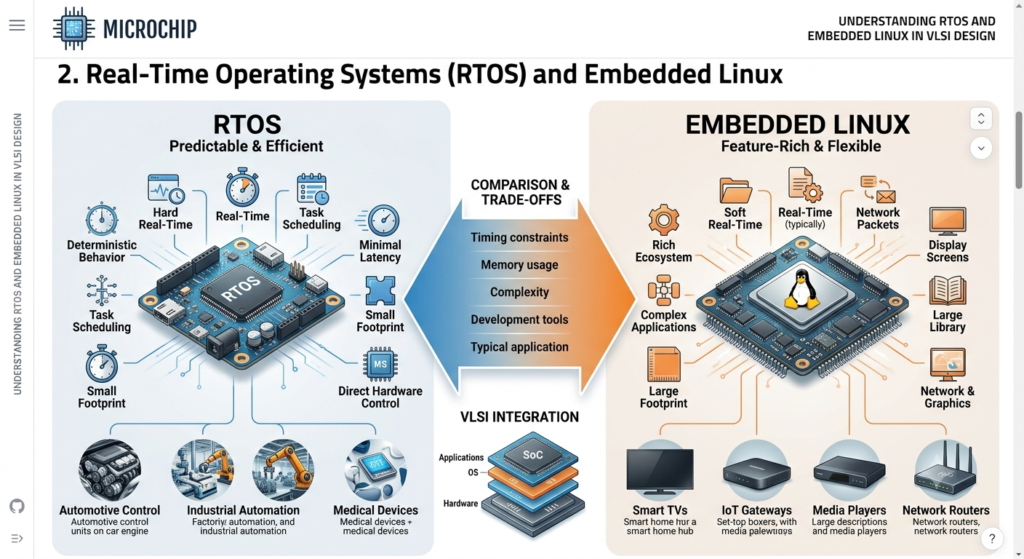
As embedded applications scale beyond basic microcontrollers, understanding concurrent task execution becomes critical. Engineers must learn Real-Time Operating Systems (RTOS) like FreeRTOS or Zephyr to handle multi-threading, task scheduling, memory protection, and interrupt management. RTOS skills enable developers to build predictable, low-latency firmware suited for time-critical industrial and medical applications.
For high-performance hardware platforms, mastering Embedded Linux and Board Support Packages (BSPs) is essential. Writing custom kernel drivers, configuring bootloaders, and utilizing toolchains like Yocto or Buildroot bridge the gap between complex microprocessor hardware and high-level software application layers. This expertise opens career opportunities in advanced automotive ECUs, robotics, and edge gateway development.
Read More: Microcontroller vs Microprocessor: Complete Guide for Beginners
3. Learn One RTOS and One Communication Stack Properly
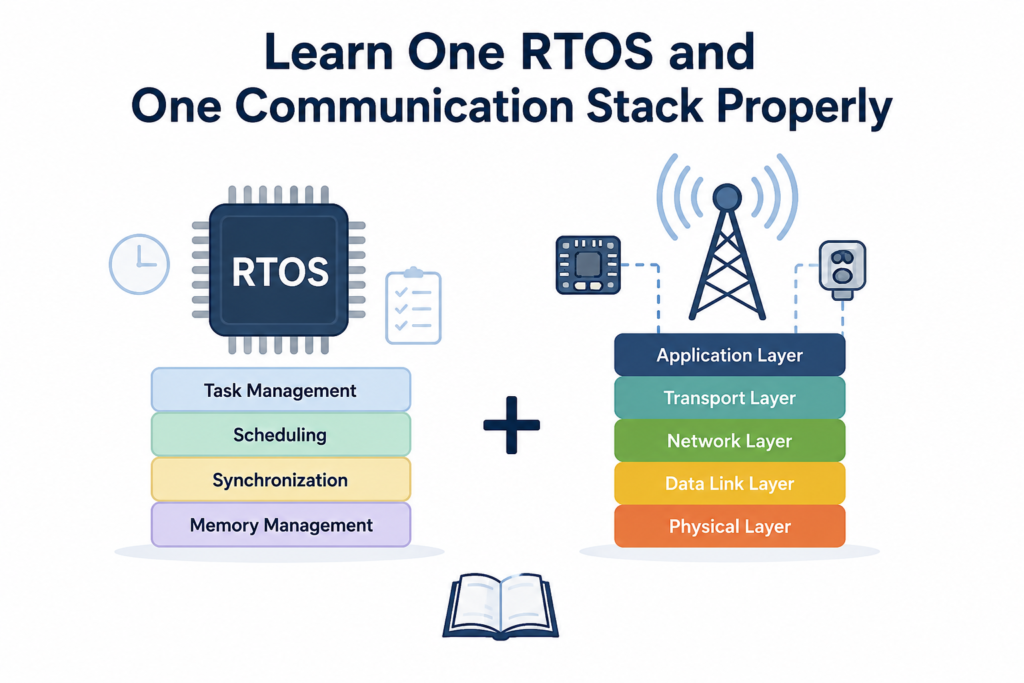
Bare-metal programming teaches you the fundamentals, but most professional embedded work today runs on a real-time operating system. FreeRTOS is the most widely used starting point, and learning how tasks, queues, semaphores, and priority scheduling work will open doors to more complex projects and jobs. Alongside this, pick one wireless communication stack and learn it in depth rather than skimming five of them. Bluetooth Low Energy and Wi-Fi are the most common choices for connected devices, while LPWAN options like LoRa are increasingly used for long-range, low-power sensor networks.
On the software side, get familiar with MQTT, since it’s the backbone of how countless connected devices report data to servers and receive instructions back. Understanding this end-to-end flow — from a sensor reading, through firmware, over a wireless link, into a cloud platform — is what separates a hobbyist from someone who can build a shippable connected product.
4. Treat Security and Power Efficiency as Core Skills, Not Extras
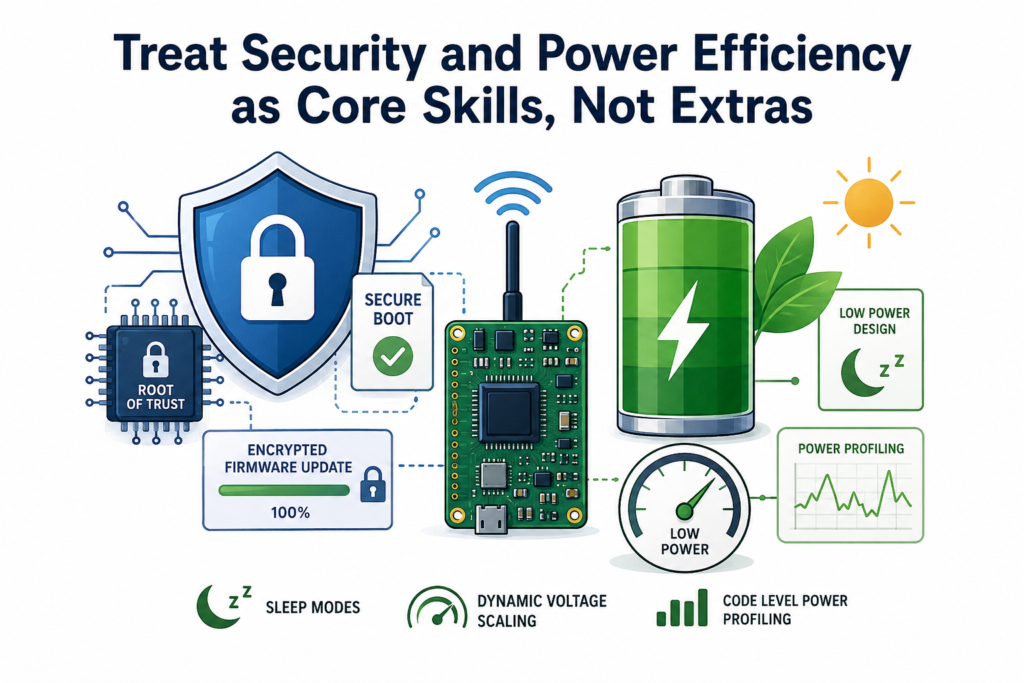
A few years ago, security and battery life were treated as nice-to-have details you’d deal with near the end of a project. That’s no longer true. Devices connected to the internet are constant targets, and a single unpatched device on a network can compromise everything around it. Learning the basics of secure boot, encrypted firmware updates, and hardware-based root-of-trust concepts is quickly becoming a baseline expectation rather than a specialization.
Power efficiency deserves the same seriousness. Many connected devices today are expected to run for years on a single battery or even survive on harvested energy from solar or thermal sources. Understanding sleep modes, dynamic voltage scaling, and how to profile power consumption at the code level will make your designs genuinely production-ready rather than something that only works on a lab bench with an unlimited power supply.
5. Specialize, Then Keep Widening Your View
Once you have the basics solid, pick a direction. Automotive embedded work involves things like CAN bus communication and strict safety standards. Industrial and infrastructure roles lean heavily on reliability and long-term maintenance-free deployment. Consumer IoT and wearables focus more on power efficiency, connectivity, and fast iteration. Medical device work demands an extremely rigorous, well-documented development process because mistakes there have real consequences.
Specializing doesn’t mean narrowing your curiosity, though. The engineers who grow fastest keep an eye on adjacent trends — open hardware architectures like RISC-V that let smaller teams design custom chips without heavy licensing costs, and the early but growing use of machine learning models running directly on microcontrollers for tasks like anomaly detection or voice triggers. You don’t need to master every new development, but staying aware of where the field is heading keeps your skills from going stale.
Conclusion
Building a career in embedded systems and IoT isn’t about chasing the newest buzzword every few months. It’s about stacking solid fundamentals, hands-on hardware experience, and a genuine understanding of how connected devices behave in the real world — under real power constraints, real security threats, and real physical conditions. The field rewards patience and depth far more than flashy shortcuts.
The good news is that demand for people who can do this well continues to grow steadily, driven by everything from smart infrastructure to electric vehicles to industrial automation. If you’re willing to put in the unglamorous work of learning how hardware actually behaves, there’s a genuinely solid, long-term career waiting on the other side of it.
1. What are embedded systems in IoT?
Embedded systems are dedicated devices with hardware and software that collect, process, and exchange data, enabling smart IoT applications.
2. Where are embedded systems used in IoT?
Embedded systems power smart homes, healthcare devices, industrial automation, connected vehicles, agriculture, and wearable technology.
3. Why are embedded systems important for IoT?
They provide real-time processing, low power consumption, reliable control, and seamless communication between connected IoT devices.
4. What is a real-world example of embedded systems in IoT?
Smart thermostats, fitness trackers, security cameras, and smart meters use embedded systems to monitor, process, and share data.
5. Which industries use embedded systems in IoT?
Healthcare, automotive, manufacturing, agriculture, logistics, retail, and smart cities rely on embedded systems for IoT solutions.
6. What are the key skills needed to work with edge AI and TinyML?
Edge AI involves running machine learning inference directly on low-power microcontrollers. Key skills include model quantization, memory optimization, understanding specialized DSP extensions, and using frameworks like TensorFlow Lite for Microcontrollers or Edge Impulse alongside standard C/C++ firmware workflows.
7. How can a fresher build an industry-ready portfolio to land their first job?
Focus on building complete, end-to-end hardware projects rather than simple tutorial builds. Build a project that reads sensors, processes data locally using an RTOS, transmits information securely using MQTT over BLE/Wi-Fi to a cloud backend, and handles low-power sleep modes. Document your schematics and publish clean, commented code repositories on GitHub.