



Why Chennai Is the Best Place to Learn and Work in VLSI

Picture a city where chip design labs, semiconductor policy announcements, and hiring drives all happen within a few kilometres of each other. That city isn’t Bangalore or Hyderabad — it’s Chennai, and most people outside the semiconductor world have no idea it’s quietly becoming India’s most underrated VLSI hub.
While Bangalore hogs the headlines, Chennai has spent the last few years building something more durable: a genuine ecosystem connecting design talent, global chipmakers, and state-backed semiconductor investment. If you’re trying to figure out where to build a long-term career in chip design, this is worth a closer look before you decide.
Chennai’s Semiconductor Ecosystem Is Growing Fast

Tamil Nadu isn’t just talking about semiconductors — it’s putting real money behind them. The state’s Semiconductor and Advanced Electronics Policy, followed by the Tamil Nadu Semiconductor Mission 2030, has positioned Chennai and its surrounding industrial belt as a serious player in India’s chip ambitions. In 2026 alone, the state attracted tens of thousands of crores in fresh investment across electronics, semiconductors, and advanced manufacturing, spread across industrial clusters in Chennai, Tiruvallur, Ranipet, and nearby regions.
This matters because a VLSI career doesn’t grow in isolation — it grows wherever the industry is expanding. Tamil Nadu already leads India in electronics exports, and its manufacturing zones host global names like Samsung, Foxconn, and Flex, which in turn pulls in a dense supplier and design ecosystem around them. A Centre for Advanced Semiconductor Technology is also being set up with support from IIT Madras, backed by state seed funding, which signals that Chennai’s semiconductor push is being built on research and design capability, not just factory floors. For anyone tracking where the next wave of opportunity will land, this steady, policy-backed growth is a strong signal that Chennai’s VLSI scene isn’t a short-term trend.
A Strong Base of Top VLSI Companies in Chennai

One of the biggest reasons professionals gravitate toward this city is the sheer concentration of established names already operating here. Chennai is home to a mix of multinational semiconductor giants, specialized IC design firms, and IT majors running dedicated VLSI divisions. Companies working on wireless technologies, mixed-signal ICs, microcontrollers, embedded systems, and chip testing all maintain a presence in the city, alongside firms handling ASIC design, verification, and SoC development.
This isn’t a one-company town where your career depends on a single employer’s fortunes. The diversity of top VLSI companies in Chennai — ranging from global chip designers to IC testing specialists to engineering services firms — means there are multiple entry points and multiple directions to grow in, whether your interest lies in RTL design, verification, physical design, or analog layout. It also means that when you’re ready to switch roles or specializations, you don’t have to relocate to do it.
Where to Get Quality VLSI Training in Chennai
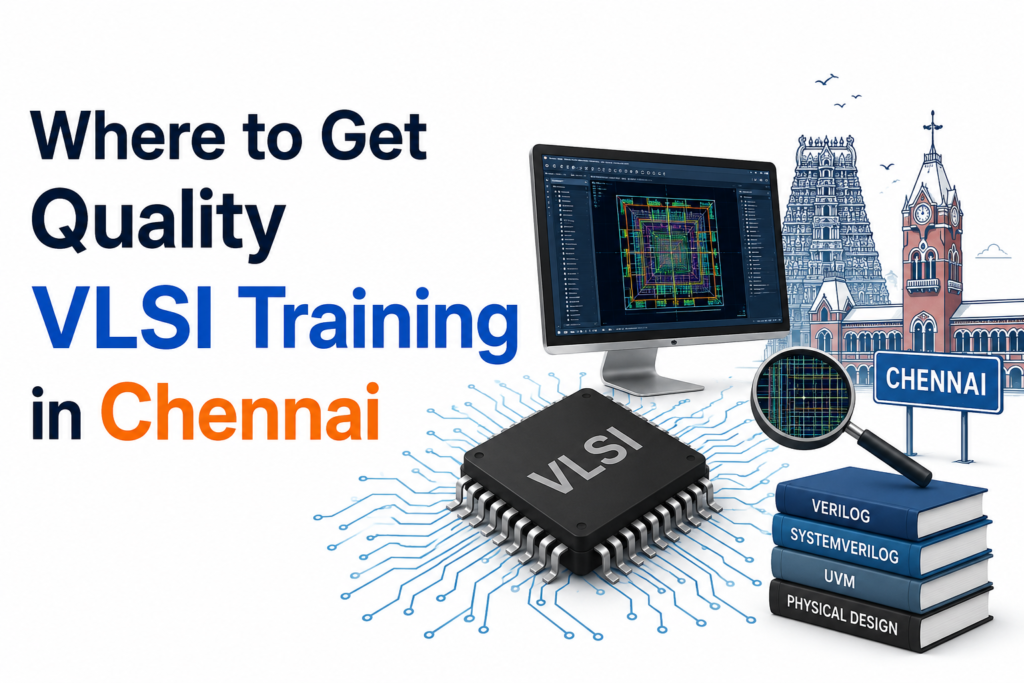
A strong local job market only helps if there’s a way to build the right skills for it, and this is where Chennai holds another advantage. The city has developed a solid base of VLSI training in Chennai through dedicated institutes offering hands-on exposure to industry-standard EDA tools, RTL coding, verification methodologies like UVM, and physical design flows.
What makes this valuable isn’t just the availability of a vlsi course in Chennai — it’s the proximity to the industry itself. Training centres here are often plugged into the local hiring ecosystem, which means course content tends to stay aligned with what companies are actually looking for, rather than being purely theoretical. When you’re learning in the same city where the jobs exist, feedback loops between training and hiring tend to be tighter, and instructors are more likely to have real design-floor experience to draw from. That combination — practical training plus local industry access — is hard to replicate in cities where VLSI companies are thin on the ground.
How to Get a Job in VLSI From Chennai
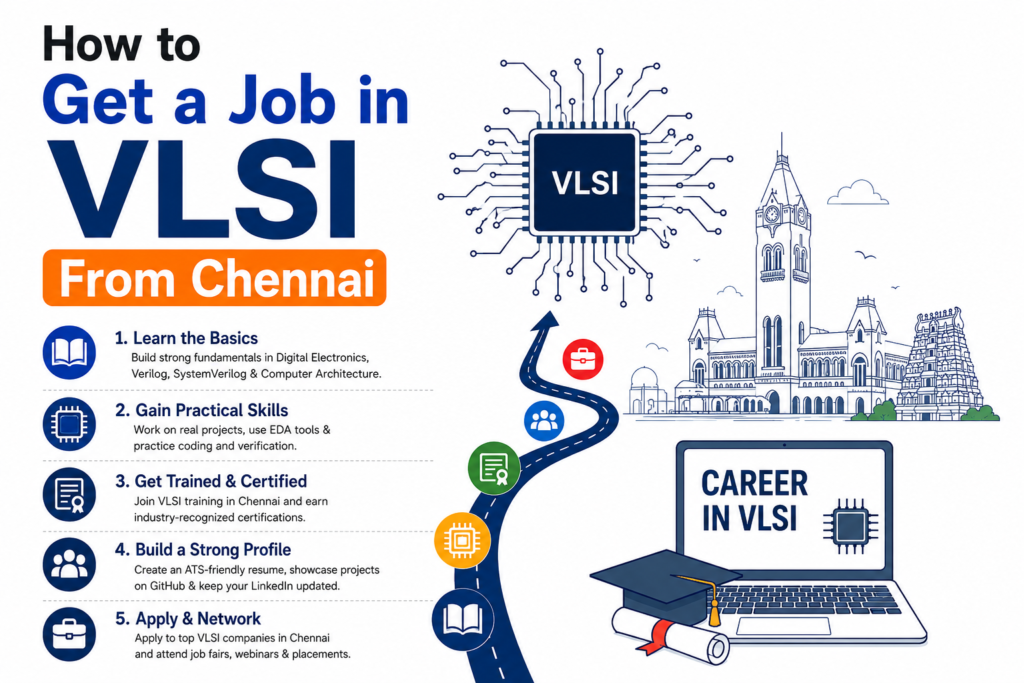
Breaking into chip design can feel intimidating from the outside, but the path is more structured than it looks once you understand how the industry hires. Most companies look for a working knowledge of digital logic, a programming or scripting language like Python or Perl, and familiarity with hardware description languages such as Verilog or SystemVerilog. Beyond that, what really moves the needle is demonstrable project work — things like a mini RTL design, a small verification testbench, or a synthesis flow you’ve run end-to-end.
If you’re wondering how to get a job in VLSI without prior industry experience, the honest answer is that consistency beats credentials. Recruiters in this space often care more about whether you can explain your design decisions and debug a waveform than which college you graduated from. Building a portfolio of small, well-documented projects, practicing common interview problems around timing analysis and logic design, and staying updated on tools like Cadence and Synopsys design suites will do more for your prospects than chasing a “perfect” resume. Chennai’s dense company base also means more walk-in drives, referrals, and direct networking opportunities than you’d find in cities with a smaller semiconductor footprint.
The Emerging Opportunities Reshaping VLSI Careers

The chip design world isn’t standing still, and Chennai’s positioning matters even more when you look at where the industry is headed. Demand is rising fast in areas like AI accelerators, RISC-V based processor design, chiplet architecture, automotive electronics, high-speed networking, and advanced packaging. These aren’t niche specializations anymore — they’re becoming core to how the next generation of semiconductors gets built, and companies are actively hiring for them.
With India’s semiconductor mission channeling massive investment into design, fabrication, and packaging capabilities, and Tamil Nadu positioning itself as a design-and-innovation hub rather than just a manufacturing base, Chennai-based engineers are well placed to move into these emerging domains without needing to relocate. Government-backed centres, growing collaboration with academic institutions, and a steady stream of new industrial approvals all point toward sustained, long-term demand rather than a short hiring cycle.
Conclusion
Chennai’s advantage in VLSI isn’t built on hype — it’s built on a combination of policy support, an established base of design and testing companies, accessible training options, and a growing pipeline of next-generation semiconductor work. For anyone serious about a long career in chip design, that mix of stability and forward momentum is hard to find elsewhere in India right now.
If you’re mapping out your next move in this field, Chennai deserves to be on your shor
1. Why is Chennai the best place to learn VLSI?
Chennai offers top VLSI training institutes, experienced mentors, industry-focused courses, and strong placement support for freshers.
2. Is Chennai a good city for VLSI jobs?
Yes. Chennai is home to leading semiconductor companies, design centers, and growing demand for skilled VLSI engineers.
3. Which VLSI companies are in Chennai?
Chennai has design centers of Qualcomm, Intel, AMD, Synopsys, Siemens EDA, and other semiconductor companies hiring VLSI talent.
4. Can freshers get VLSI jobs in Chennai?
Yes. Freshers with hands-on VLSI projects, RTL, Verification, or Physical Design skills have good job opportunities in Chennai.
5. Which VLSI course is best in Chennai?
Choose a VLSI course that covers RTL Design, Verification, Physical Design, DFT, EDA tools, and includes real-world projects.