


How Investors Are Reacting To Navitas Semiconductor (NVTS) Wider Losses, Stronger Guidance and New SiC Partnership

Wall Street loves a comeback story, but it hates uncertainty even more, and Navitas Semiconductor just gave investors a heavy dose of both in the same week. Shares of the power semiconductor maker swung sharply after the company reported a much larger headline loss than expected, even as its underlying business showed real signs of momentum.
The result is a stock caught between two competing narratives. One side points to shrinking revenue from legacy markets and a massive GAAP net loss. The other highlights double-digit sequential growth, expanding margins, a fresh silicon carbide partnership, and guidance that points toward a stronger back half of 2026. Here is what actually happened, and why investors are struggling to agree on what it means.
Behind the Wider GAAP Loss: What Actually Happened
Navitas reported second quarter 2026 revenue of roughly $10.5 million, up 22% sequentially from the first quarter, though still below year-ago levels as the company continues winding down its mobile and consumer business. The number that grabbed headlines was the GAAP net loss of $228.2 million, a figure that looks alarming on the surface but tells a different story once you look under the hood.
The overwhelming majority of that loss, more than $203 million, came from a single non-cash accounting item: the final remeasurement of earnout liabilities tied to a past transaction. Strip that out, and the picture looks far less dramatic. On a non-GAAP basis, the net loss was closer to $9.3 million, roughly in line with prior quarters and consistent with a company still scaling a young high-power product line.
This distinction matters for anyone trying to make sense of the sell-off. Headline loss figures make for dramatic news coverage, but they can obscure the operational reality that gross margin actually improved, expenses stayed within guided ranges, and cash on hand grew to more than $557 million. For a company mid-transition, that balance sheet strength buys time that many smaller semiconductor names simply don’t have.
Q3 2026 Guidance: Why Wall Street Still Sees Upside

Guidance is often where a stock’s real story gets told, and Navitas used its outlook to lean hard into optimism. Management guided third quarter revenue to $13.5 million, plus or minus $500,000, which represents roughly 28% sequential growth if it lands as expected. Non-GAAP gross margin guidance came in around 39.7%, continuing a steady climb, while operating expenses are expected to land between $15.5 million and $17.5 million as the company keeps investing in its high-voltage roadmap.
What stands out is the pattern behind these numbers. Navitas has been shifting away from mobile chargers and low-margin consumer electronics toward AI data centers, grid infrastructure, and industrial electrification, a strategy the company internally calls Navitas 2.0. Leadership has pointed to high-power segments growing more than 50% year over year, a figure that supports the argument that this pivot is not just a slide in an investor deck but something showing up in actual order flow.
Analysts have generally reacted to the guidance with cautious approval. The growth trajectory is encouraging, but the scale is still small relative to the company’s cash burn and its ambitious multi-billion-dollar market opportunity target by the end of the decade. Investors are essentially being asked to trust that a $13 million quarter today can compound into something far larger, and that patience is exactly where sentiment gets divided.
The Magnachip SiC Partnership and What It Means for Navitas’s High-Voltage Strategy
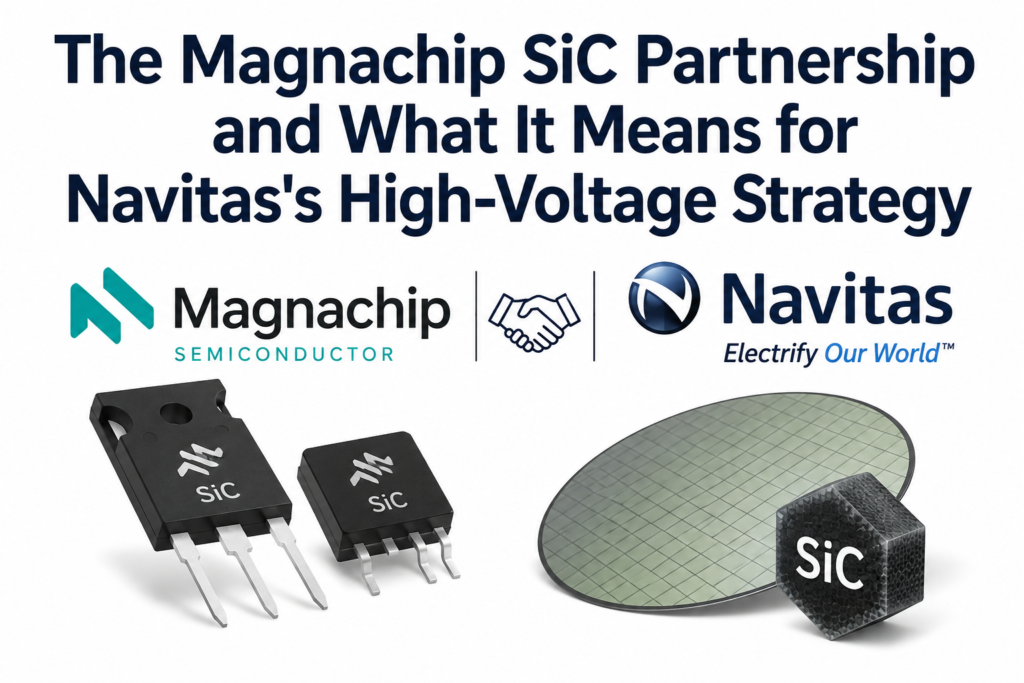
Just days before earnings, Navitas announced a partnership that may end up mattering more long-term than the quarterly numbers themselves. The company signed a licensing agreement with Magnachip Semiconductor, giving Magnachip access to Navitas’s GeneSiC Trench-Assisted Planar silicon carbide technology across 1,200V, 2,300V, 3,300V, and higher voltage platforms.
Under the deal, Magnachip will manufacture the licensed technology at its own fab in South Korea, while gaining access to Navitas’s broader supply chain and materials ecosystem. For Navitas, this is a capital-light way to extend the reach of its high-voltage silicon carbide portfolio without having to build out additional manufacturing capacity on its own. For Magnachip, it’s an entry point into ultra-high-voltage markets like grid infrastructure, energy storage, and industrial electrification, areas where demand is expected to keep climbing alongside global electrification and AI-driven power needs.
This partnership arrives alongside other product milestones, including a newly launched ultra-high-voltage SiC package and plans for third-generation 6.5kV silicon carbide technology later in the year. Together, these moves reinforce a consistent theme: Navitas is betting its future on higher voltage, higher margin applications rather than the commoditized consumer segment it built its early reputation on. Whether that bet pays off depends heavily on how quickly design wins convert into shipped volume.
How Investors and Analysts Are Reacting to NVTS Stock
The market’s immediate reaction was blunt. Shares fell roughly 10% in the session following the earnings release as traders zeroed in on the eye-catching net loss figure before digesting the non-cash nuance behind it. That kind of knee-jerk move is common for smaller-cap semiconductor stocks, where headline numbers often drive short-term price action more than the details buried in a footnote.
Zooming out, the picture looks less alarming. Revenue beat consensus estimates for the fourth straight quarter, and adjusted losses per share matched expectations. Longer-term investors appear more focused on the trajectory of the high-power business, the strength of the balance sheet, and the credibility of new partnerships like the Magnachip deal than on a single accounting-driven loss figure.
Skeptics still have valid points. Revenue remains modest for a company valued well above typical sales multiples in the semiconductor space, and the timeline for 800-volt architecture adoption in AI infrastructure remains genuinely uncertain. Bulls counter that a growing backlog, an expanding customer base, and a strengthening cash position give Navitas enough runway to prove out its strategy without needing to raise capital again anytime soon.