



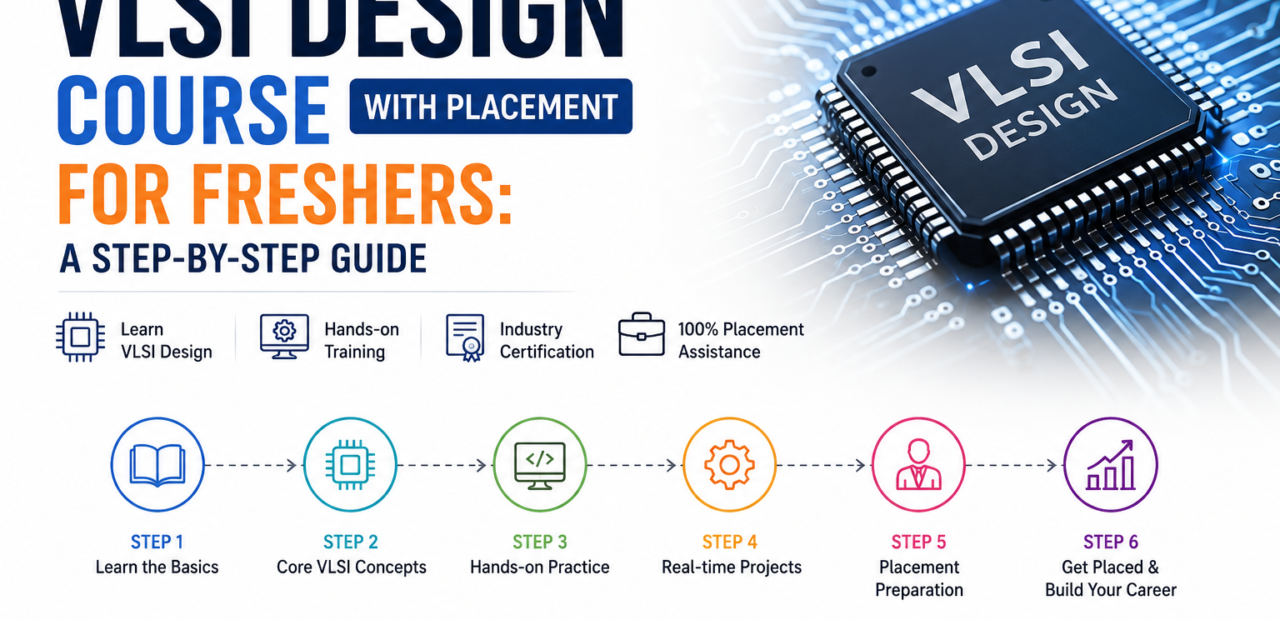
VLSI Design Course with Placement for Freshers: A Step-by-Step Guide

Imagine building the tiny chip that powers your smartphone, your car’s dashboard, or the AI model running in a data center — and getting paid well to do it from day one. That’s the real promise behind a career in chip design, and it’s closer than most people think.
Every phone, laptop, electric vehicle, and AI server depends on a chip that someone designed, verified, and signed off before it ever reached a factory. That’s where a well-structured VLSI design course with placement comes in — it takes someone with zero hardware background and turns them into a job-ready chip design professional. This guide walks through exactly how that transformation happens, step by step, so you know what to look for before enrolling in any program.
1. Understanding What VLSI Design Actually Involves
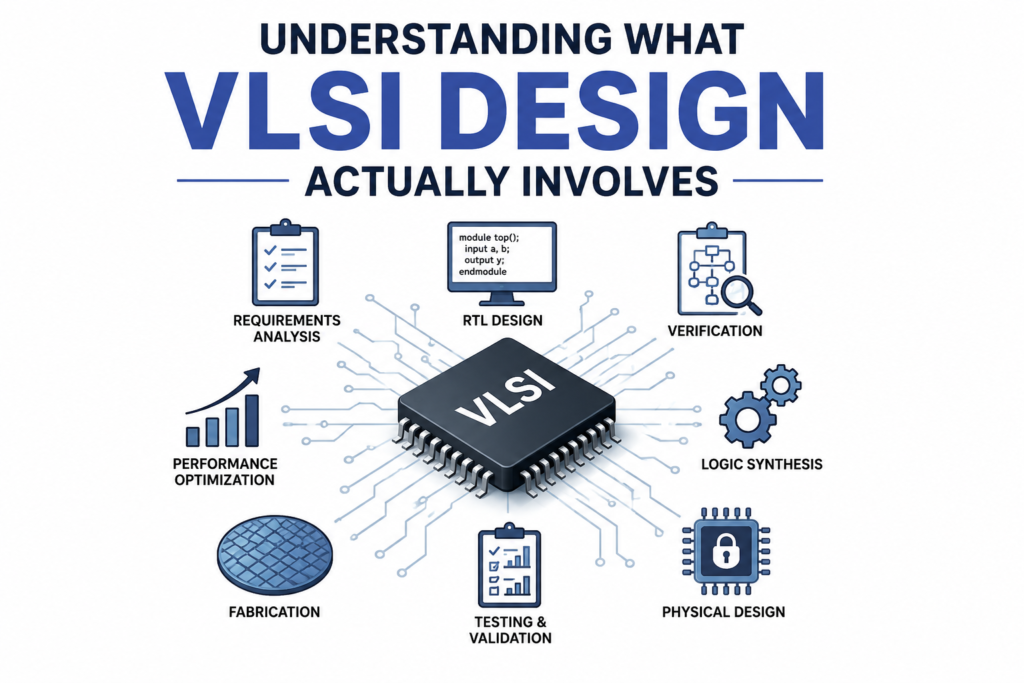
VLSI stands for Very Large-Scale Integration — the process of packing billions of transistors onto a single silicon chip to create the integrated circuits found in nearly every electronic device today. Before jumping into any training, it helps to understand the three broad stages of chip creation: front-end design (writing the logic using hardware description languages like Verilog or SystemVerilog), verification (catching bugs before manufacturing begins), and back-end or physical design (converting the verified logic into an actual physical layout ready for fabrication).
A good vlsi design course for beginners doesn’t throw all three at once. Instead, it builds a foundation first — number systems, digital logic, CMOS fundamentals, and basic scripting — before moving into specialized tracks. Understanding this roadmap early helps you evaluate whether a program is genuinely structured or just bundling buzzwords together to look impressive on a brochure.
It also helps to know why this field carries a reputation for a steep learning curve. Unlike software, where a bug simply gets patched after release, a flaw in a chip design discovered post-fabrication can mean scrapping an entire production run worth millions. That’s exactly why the industry places so much weight on rigor, simulation, and repeated verification at every stage — and why a training program that skips straight to flashy tool demos without grounding you in these fundamentals is setting you up to struggle later, no matter how confident the marketing sounds.
2. Choosing Between Front-End, Verification, and Physical Design Specializations
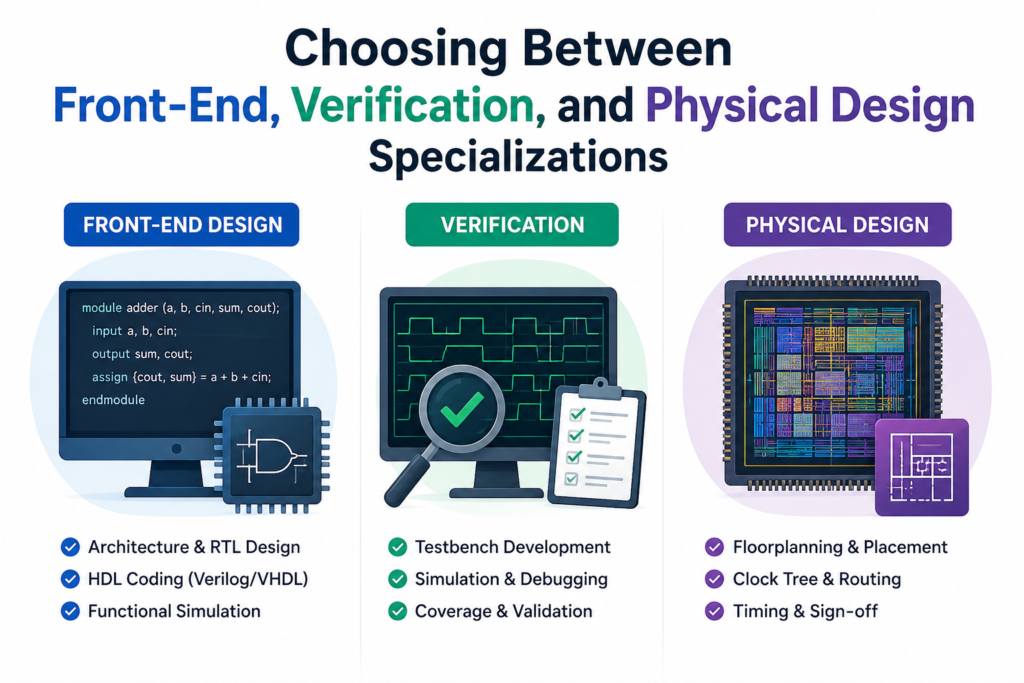
Once the basics are covered, every serious training path splits into specializations, and picking the right one shapes your entire career trajectory:
- RTL/Front-End Design — writing and optimizing the logic that defines chip behavior. This is often the most natural entry point for beginners.
- Verification — using methodologies like UVM to hunt for design flaws before tape-out. Verification roles are currently among the highest in demand because a single missed bug can cost a company millions.
- Physical Design (Back-End) — handling floorplanning, placement, routing, and timing closure to convert a verified design into a manufacturable layout. This specialization tends to command strong salaries due to the depth of tool expertise required.
- Analog/Mixed-Signal Design — a niche but lucrative path involving transistor-level design, useful for those who enjoy deeper circuit-level thinking.
A quality vlsi design training program will help you sample these areas early through mini-projects rather than forcing a decision on day one. Choose based on what genuinely interests you — chip design is a long game, and passion sustains it far better than chasing whichever specialization sounds trendiest that month.
3. What “Placement Support” Should Actually Mean
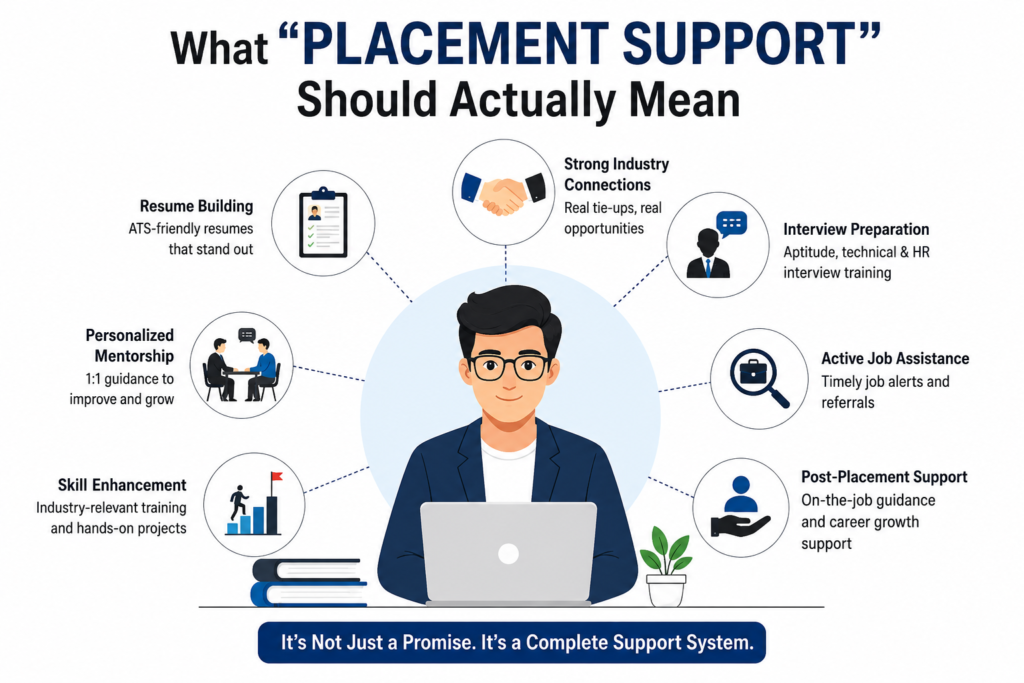
The phrase “placement assistance” gets used loosely, so it’s worth breaking down what real support looks like versus what’s just marketing language:
- Mock interviews with industry professionals, not just internal trainers repeating textbook answers.
- A tape-out level or near-industry project you can speak about confidently in interviews — this single project often becomes the centerpiece of every technical discussion you’ll have with recruiters.
- Direct referrals or hiring tie-ups with semiconductor companies and design service firms, not just a shared list of job postings anyone could find online.
- Resume and LinkedIn profile building specifically tailored to hardware roles, which look very different from typical software resumes.
Before enrolling in any vlsi design course with placement, ask for verifiable outcomes — how many recent batches were placed, at which companies, and in which specific roles. A program that hesitates to share this data is telling you something important on its own.
4. Tools, Hands-On Labs, and Building a Portfolio That Gets Noticed

Theory alone won’t get anyone hired in this field — recruiters want to see tool fluency and real project work. Industry-standard EDA tools from major vendors form the backbone of daily work in chip design teams, and hands-on exposure to these tools during training makes a measurable difference during interviews.
Look for a curriculum that includes:
- A complete RTL-to-GDSII flow project, even a simplified one, so you understand the full pipeline end-to-end.
- Weekly lab sessions rather than occasional demos, since tool fluency comes from repetition, not observation.
- A capstone project you actually own — something you designed decisions around, not a copy-paste exercise everyone in the batch submits identically.
- Exposure to low-power design techniques, since power efficiency has become a central concern across mobile, EV, and edge-AI chips.
This portfolio becomes your strongest asset. In interviews, being able to walk through your own design choices, trade-offs, and debugging stories carries far more weight than listing tool names on a resume.
Beyond the project itself, keep a running log of the problems you hit and how you solved them — a timing violation you traced back to an unrealistic constraint, or a verification gap that let a bug slip through your first testbench. Interviewers at chip design companies often care less about a perfect final result and more about how methodically you diagnosed the problem. That habit of documenting your own troubleshooting turns an ordinary training project into a genuine talking point.
5. Staying Relevant: Emerging Trends Reshaping the Chip Design Job Market

The semiconductor industry is going through one of its biggest expansion phases in years, driven by a few converging trends worth understanding before you commit to a training path:
- AI accelerator chips are creating entirely new categories of design work, as custom silicon for machine learning workloads becomes standard across major tech companies.
- Electric vehicles and autonomous systems demand power-efficient, safety-critical chip designs, opening dedicated automotive-silicon career tracks.
- Chiplet-based and heterogeneous integration approaches are changing how physical design engineers think about packaging and system-level architecture.
- National semiconductor investment programs in multiple countries, including large-scale initiatives in India, are actively funding new design centers, which translates directly into fresh hiring pipelines.
- Verification complexity is rising faster than design complexity, meaning skilled verification engineers remain consistently in short supply relative to demand.
A training program that folds these trends into its curriculum — rather than teaching a static syllabus untouched for years — gives you a real edge. Ask any prospective institute directly how recently their course content was updated and whether it reflects current industry hiring patterns, not just foundational theory.
6. Career Growth and Long-Term Opportunities in the Field

The path doesn’t end at the first job offer. Entry-level roles in RTL design, verification, or DFT typically lead within a few years to senior design or verification engineer positions, and eventually to architecture-level or team-lead roles for those who keep building expertise. Salary growth in this field tends to be steep for professionals who continuously update their skills, particularly in high-demand areas like low-power design, advanced verification, and AI-accelerator chip design.
India’s semiconductor sector is expanding well beyond design services alone, with fabrication, packaging, and testing facilities creating parallel career tracks that didn’t exist at this scale even a few years ago. Government-backed incentives for semiconductor manufacturing are accelerating this growth further, which means the demand for trained engineers is likely to remain strong for years to come rather than being a short-term spike.
For anyone starting out, the long-term opportunity is less about chasing the highest starting salary and more about picking a specialization, going deep into it, and staying current as tools and methodologies evolve. That approach consistently produces the strongest long-term career outcomes in this field.
There’s also growing room to move sideways within the industry once a strong foundation is built. Someone who begins in RTL design can transition into verification or architecture roles, while someone in physical design can move toward advanced packaging or low-power specialization as the ecosystem diversifies. This flexibility is part of what makes a career built on solid vlsi design training so resilient — the underlying fundamentals stay relevant even as the specific tools and job titles around them keep changing.
Bringing It All Together
Breaking into chip design isn’t about memorizing tool shortcuts or chasing the flashiest-sounding institute. It’s about following a deliberate sequence: build strong fundamentals, choose a specialization that fits your interests, get genuine hands-on project experience, and partner with a program that offers verifiable placement outcomes rather than vague promises.
The semiconductor industry’s current growth phase means the timing is genuinely favorable for newcomers willing to put in structured effort. A well-chosen vlsi design course with placement compresses years of self-directed learning into a focused, guided path — but the quality of that path depends entirely on the questions you ask before signing up. Use this guide as your checklist, and you’ll walk into your first chip design interview prepared, confident, and ready to talk about work you actually built yourself.
1. What is a VLSI design course with placement?
A VLSI design course with placement teaches chip design, verification, and EDA tools while providing placement support to help freshers start their careers.
2. Can freshers join a VLSI design course?
Yes. Freshers from ECE, EEE, E&I, and related engineering branches can join a VLSI design course and prepare for semiconductor careers.
3. Which VLSI course is best for freshers?
The best VLSI course includes RTL Design, Verification, Physical Design, DFT, hands-on projects, EDA tools, and placement assistance.
4. Does a VLSI course guarantee placement?
No course guarantees placement, but quality VLSI training with projects, interview preparation, and industry support improves job opportunities.
5. How long does it take to learn VLSI?
Most VLSI design courses take 3–6 months, depending on the specialization, learning pace, and practical training included.
6. What are the eligibility requirements for a VLSI course?
B.E./B.Tech students or graduates in ECE, EEE, E&I, or related fields are generally eligible for most VLSI design courses.
7. Which VLSI specialization has the highest demand?
RTL Design, Design Verification, Physical Design, DFT, and Analog Layout remain among the most in-demand VLSI specializations.