

Real-World Applications of Embedded Systems in IoT

The Internet of Things (IoT) has rapidly transformed from a futuristic concept into an invisible digital backbone powering modern infrastructure, homes, and global industries. At the absolute heart of this transformation sits the embedded system—a specialized combination of microcontrollers, dedicated software, and real-time processing capabilities designed to execute singular tasks with relentless reliability. Without embedded hardware to collect sensor data, process logic at the edge, and communicate across networks, the concept of interconnected “smart” devices simply could not exist.
As computing needs evolve toward lower latency, enhanced edge intelligence, and strict energy efficiency, understanding real-world embedded deployments becomes vital for engineers and technology leaders alike. Rather than relying on distant cloud servers for every basic decision, modern embedded architecture processes critical workloads locally to optimize system performance. From life-saving medical monitors to autonomous factory floors, exploring how embedded electronics integrate into connected ecosystems reveals why this hardware-software synergy remains the ultimate engine of real-world IoT innovation.
Embedded Systems Across IoT Domains
| Application Sector | Key Hardware Components | Primary Communication Protocols | Core Operational Objective |
| Smart Home Automation | Low-power MCUs, environmental sensors, relays | Wi-Fi, BLE, Zigbee, Thread | Consumer convenience, local automation, energy management. |
| Industrial IoT (IIoT) | Rugged SoMs, vibration/thermal sensors, actuators | Industrial Ethernet, CAN bus, Modbus, MQTT | Predictive maintenance, high reliability, deterministic control. |
| Healthcare & Wearables | Ultra-low-power MCUs, bio-sensors, secure elements | BLE, NFC, Cellular IoT (NB-IoT) | Continuous vital monitoring, patient safety, low power draw. |
| Connected Automotive | Automotive-grade ECUs, vision processors, CAN controllers | CAN, LIN, Ethernet, 5G / C-V2X | Real-time vehicle safety, telematics, autonomous driving support. |
1. Smart Homes That Actually Think for Themselves
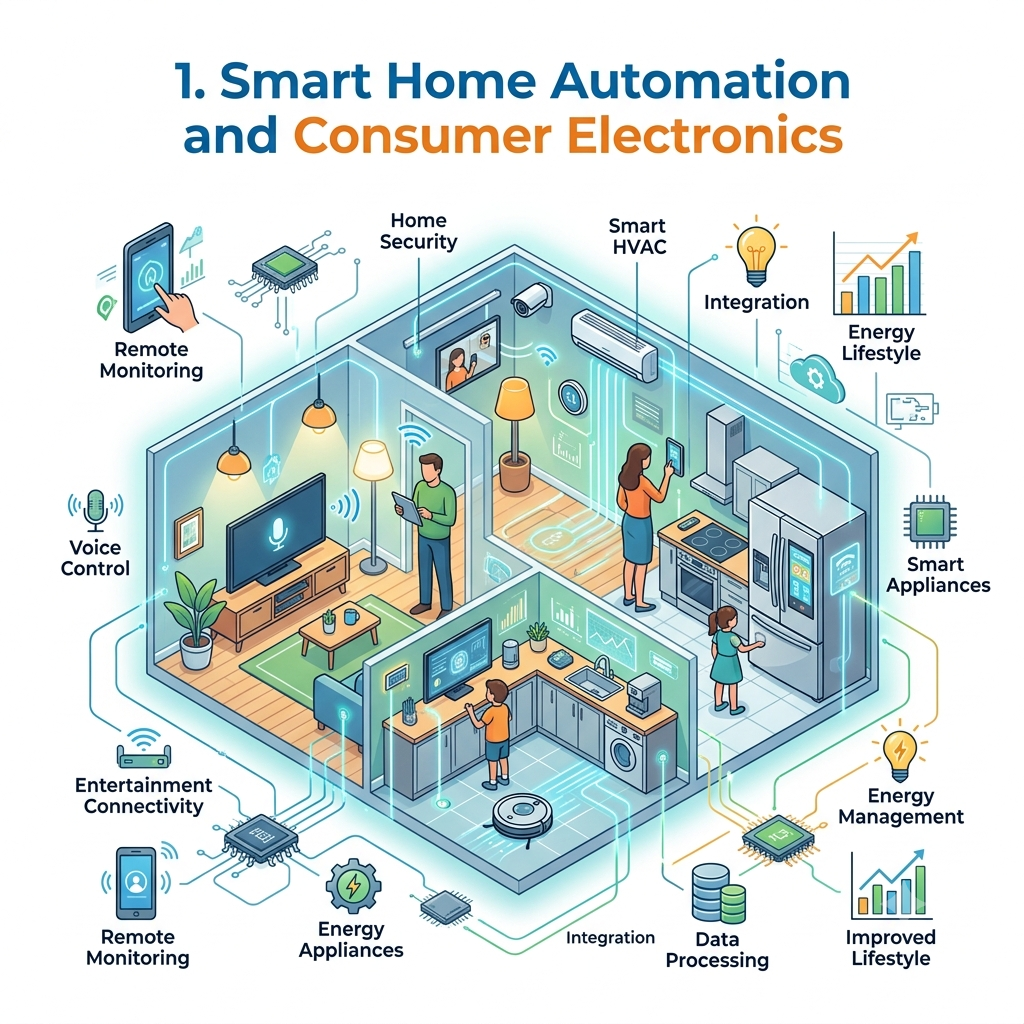
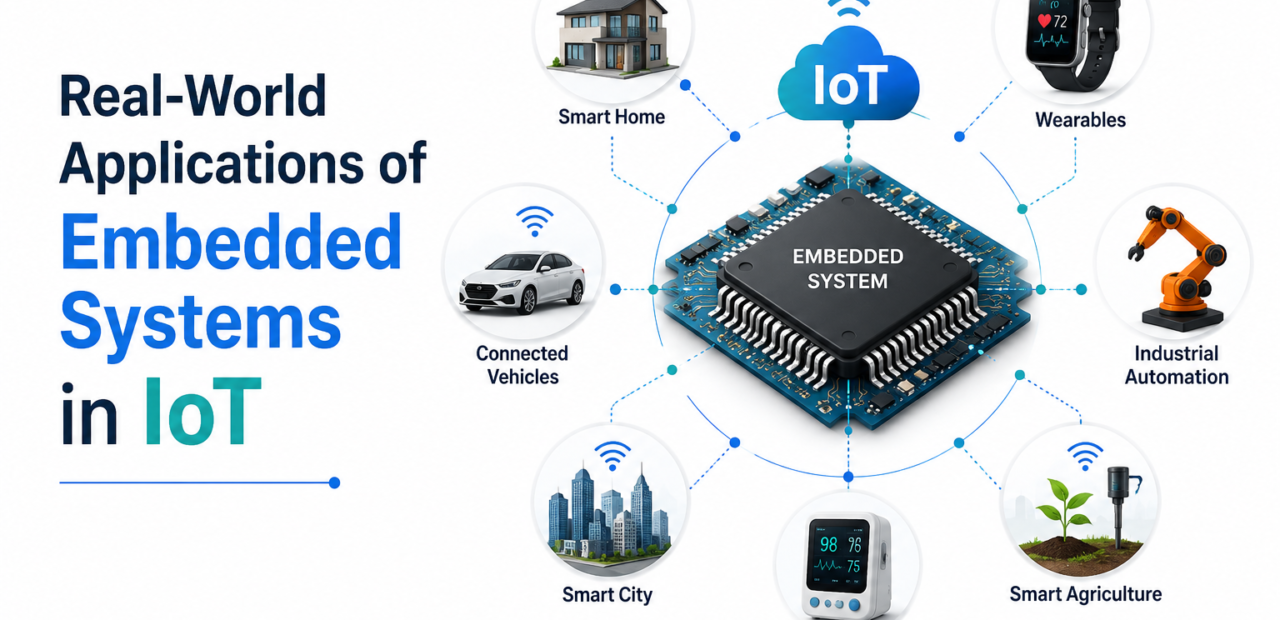
Smart home environments represent the most visible intersection of embedded engineering and consumer IoT, turning everyday domestic appliances into interconnected, intelligent endpoints. At the core of devices like learning thermostats, automated lighting controllers, and security nodes are low-power microcontrollers running lightweight real-time operating systems (RTOS). These embedded units continuously poll ambient environment sensors—detecting temperature shifts, motion, or light levels—and execute instantaneous actuation local commands while simultaneously syncing status updates to the cloud using protocols like Zigbee, Wi-Fi, or Thread.
Beyond basic user convenience, embedded IoT design in smart consumer electronics focuses heavily on energy management and hardware-level security. Modern smart appliances utilize hardware root-of-trust modules and encrypted microcontrollers to prevent unauthorized network access through physical or wireless attack vectors. Furthermore, by executing local control loops directly on the embedded processor, these systems maintain core functionality—such as keeping a home secure or maintaining HVAC safety limits—even when external internet connectivity is temporarily lost.
2. Industrial IoT (IIoT) and Smart Manufacturing
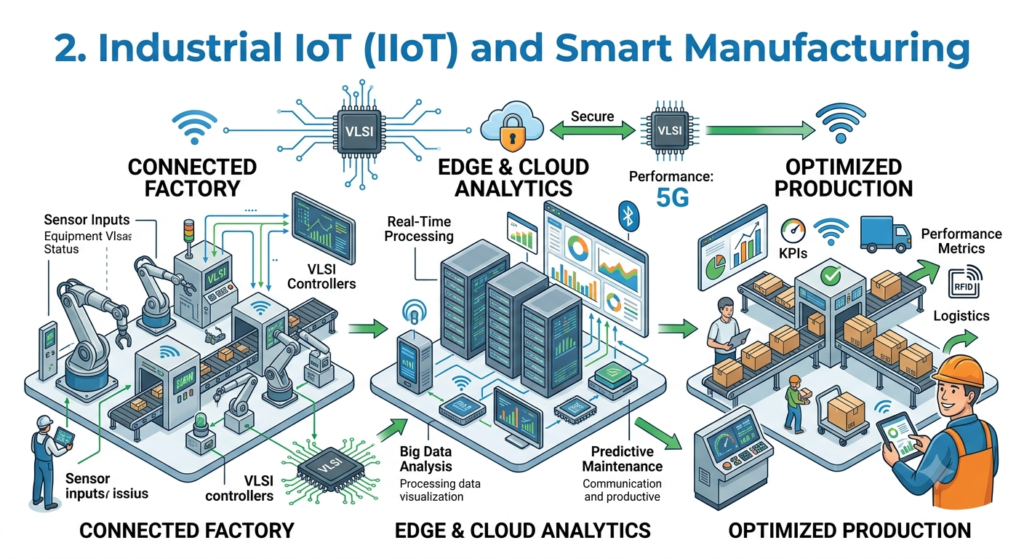
In modern Industry 4.0 production environments, embedded IoT architectures drive predictive maintenance, automated assembly lines, and factory-wide asset monitoring. Factory machinery relies on industrial-grade embedded nodes equipped with specialized sensors that record real-time vibration metrics, thermal signatures, and operational stress levels. Microprocessors running deterministic edge algorithms analyze these streams locally, identifying microscopic mechanical anomalies long before catastrophic equipment failure occurs and minimizing costly factory downtime.
Because industrial environments present extreme noise, high temperatures, and strict safety requirements, IIoT embedded systems are engineered for ultra-high reliability and deterministic timing. Devices utilize ruggedized System-on-Modules (SoMs) and industrial fieldbus protocols to maintain low-latency communication between machinery and edge gateways. By offloading immediate decision-making to local embedded processors rather than relying entirely on remote cloud servers, smart factories achieve the split-second response times required for automated robotics and safety-critical shutoff mechanisms.
Read more: Arduino vs ESP32: Which Is Best for Embedded Systems Beginners
3. Factories That Predict Their Own Breakdowns
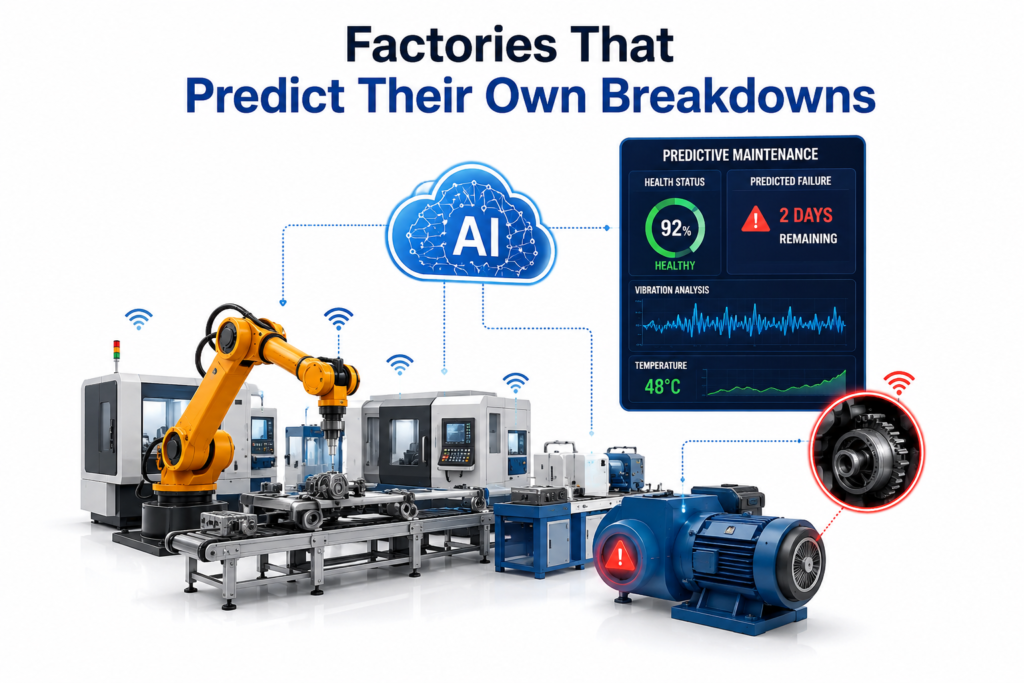
Industrial IoT, often shortened to IIoT, is one of the clearest examples of embedded systems delivering measurable business value. Sensors embedded in motors, conveyor belts, and robotic arms constantly monitor vibration, temperature, and pressure. Instead of waiting for a machine to fail, embedded processors analyze this data on the spot and flag early warning signs, a practice known as predictive maintenance.
This approach saves manufacturers enormous amounts of money by preventing unplanned downtime, which is often far costlier than the repair itself. Modern industrial hardware increasingly combines specialized processors with dedicated AI accelerators, allowing factories to run inspection and defect-detection models directly on the equipment rather than sending every frame of video to a distant data center. As open hardware architectures gain traction, manufacturers also get more freedom to build custom chips tailored exactly to their production lines, cutting both cost and complexity.
4. Vehicles That Sense the Road Before You Do
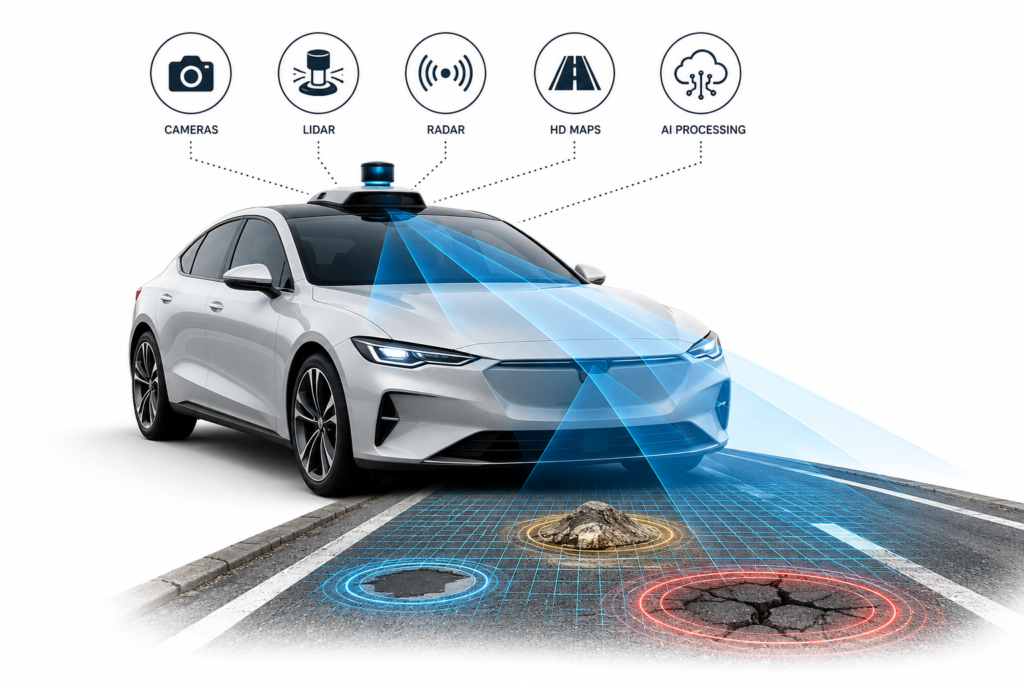
Modern cars are essentially rolling networks of embedded systems. Dozens of microcontrollers manage everything from engine timing and braking to infotainment and climate control, while advanced driver assistance features rely on embedded sensors to detect lane drift, following distance, and pedestrians. Even electric vehicles depend heavily on embedded battery management systems that constantly balance charge levels, monitor temperature, and protect against overheating.
As vehicles become more autonomous, the demand for embedded chips capable of processing camera and radar data in real time keeps climbing. Automotive-grade processors are increasingly built on flexible, open instruction-set architectures that allow manufacturers to customize performance for safety-critical tasks without depending on a single chip supplier. This flexibility is becoming especially valuable as automakers race to add more sensing and automation without ballooning costs or development timelines.
5. Cities and Farms Getting Quietly Smarter
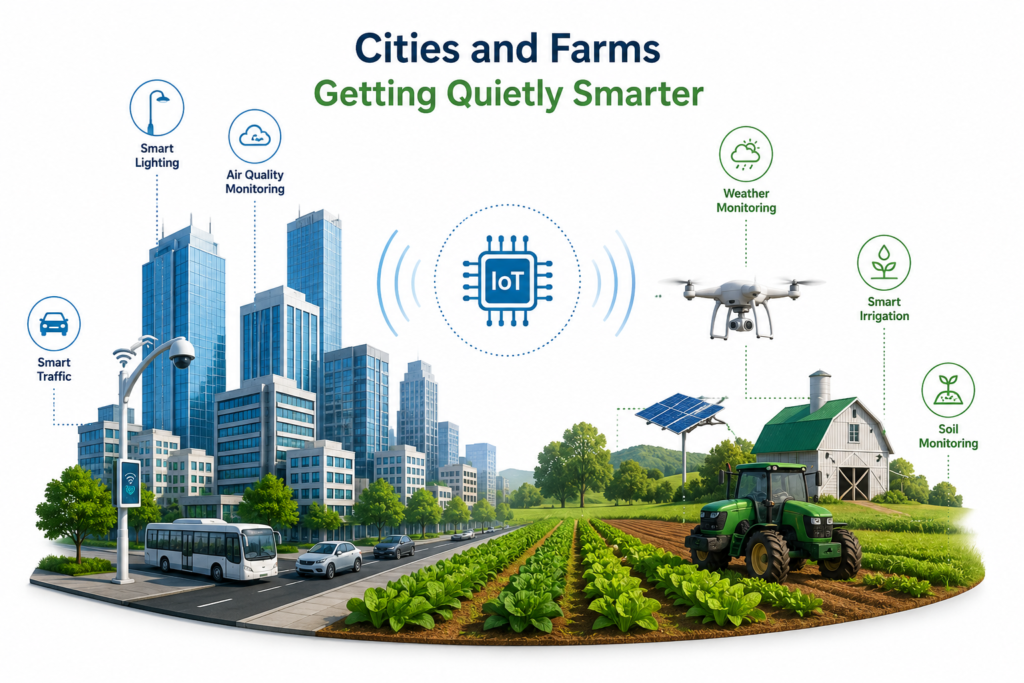
Beyond homes and factories, embedded systems are reshaping entire environments. Smart streetlights adjust their brightness based on foot traffic, embedded sensors in water pipes detect leaks before they become floods, and air-quality monitors scattered across a city feed real-time data to public health systems. In agriculture, soil sensors embedded in fields measure moisture and nutrient levels, feeding irrigation systems that water crops only when and where it’s actually needed.
What ties these examples together is efficiency. A city or farm generates enormous amounts of data, and it’s simply not practical to send every reading to a faraway server. Embedded chips process information right where it’s collected, sending only meaningful insights onward. As low-power, long-lasting sensor hardware becomes cheaper to produce, expect this kind of ambient intelligence to spread into places we don’t even think of as “connected” today, from streetlights to soil.
Conclusion
What makes embedded systems so central to IoT is that they solve a problem cloud computing alone never could: the need for instant, reliable, and efficient decision-making at the exact point where data is generated. As the number of connected devices worldwide continues climbing toward the tens of billions, the pressure is shifting away from simply connecting more things and toward making each connected thing smarter, more power-efficient, and more secure right at the source.
The next few years will likely bring embedded hardware that runs increasingly capable AI models locally, chips built on open and customizable architectures instead of one-size-fits-all designs, and devices that sip power so efficiently they can run for years on a single small battery. Embedded systems may never get the spotlight that flashy apps and platforms do, but they remain the quiet foundation making the connected world actually work — one small, purposeful chip at a time.
1. What are embedded systems in IoT?
Embedded systems are dedicated hardware and software that control IoT devices, enabling real-time sensing, processing, communication, and automation.
2. Where are embedded systems used in IoT?
Embedded systems power smart homes, healthcare devices, industrial automation, connected vehicles, agriculture, wearables, and smart cities.
3. Why are embedded systems important for IoT?
They process sensor data, control devices in real time, reduce power usage, and enable reliable communication across IoT networks.
4. What are examples of embedded systems in IoT?
Examples include smart thermostats, fitness trackers, security cameras, smart meters, medical monitors, and industrial sensors.
5. How do embedded systems improve IoT devices?
They increase efficiency, enable automation, reduce latency, optimize power consumption, and provide reliable real-time performance.
6. How is hardware security implemented in embedded IoT systems?
Modern embedded microcontrollers integrate hardware-based secure elements, cryptographic coprocessors, secure bootloaders, and memory protection units. These features prevent unauthorized firmware tampering, protect encryption keys, and secure wireless communications against cyber threats.
7. Which wireless communication protocols are most commonly used by embedded IoT nodes?
Depending on range, bandwidth, and power constraints, embedded IoT platforms utilize short-range protocols like Bluetooth Low Energy (BLE), Wi-Fi, and Zigbee/Thread for smart home use, or long-range low-power protocols like LoRaWAN, NB-IoT, and 5G for industrial and agricultural tracking.