



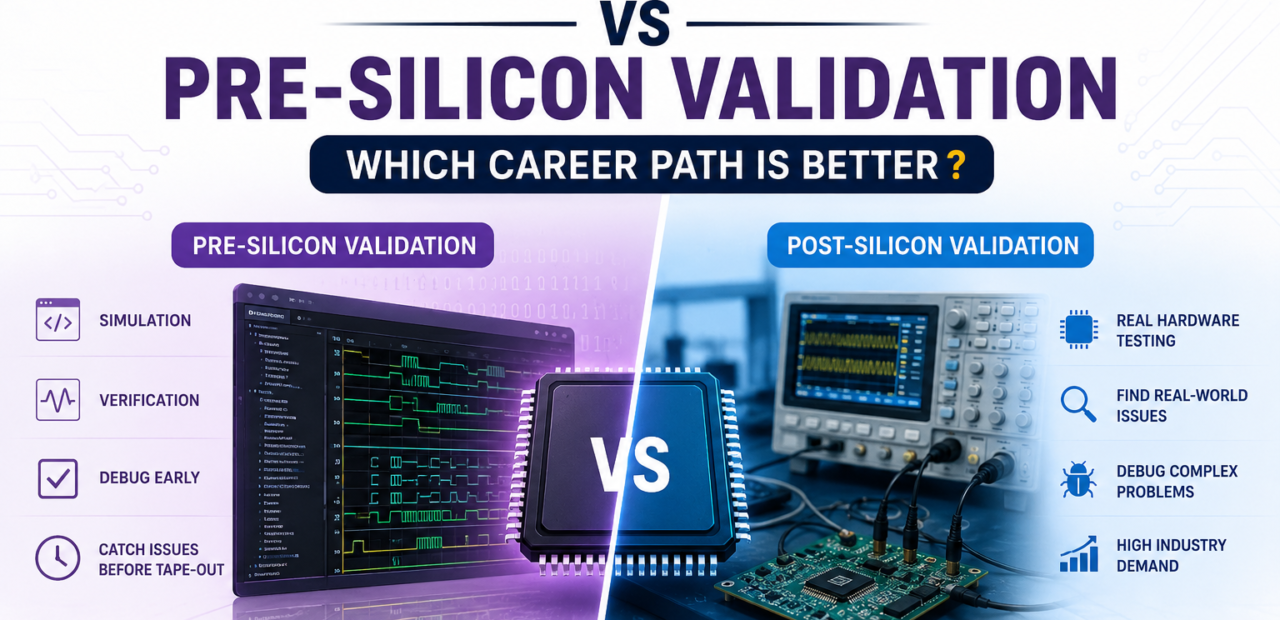
Post Silicon Validation vs Pre-Silicon Validation: Which Career Path Is Better?

Chip design has one dirty secret: almost every processor that ends up in your phone or laptop was broken at some point before it reached you. Somewhere between a design idea and a working device, a small army of validation engineers caught thousands of bugs that would have otherwise turned into recalls, warranty claims, or worse. That silent, high-stakes work is where two very different careers live — pre-silicon validation and post-silicon validation — and picking between them can shape the next decade of your professional life.
Both paths sit inside the semiconductor industry, both are in constant demand, and both pay well. But the day-to-day work, the skill sets, and the long-term growth look surprisingly different. If you are trying to decide where to invest your time and energy, this comparison will walk you through what each field actually involves, how they differ, and which one might fit your strengths better.
What Is Pre-Silicon Validation?
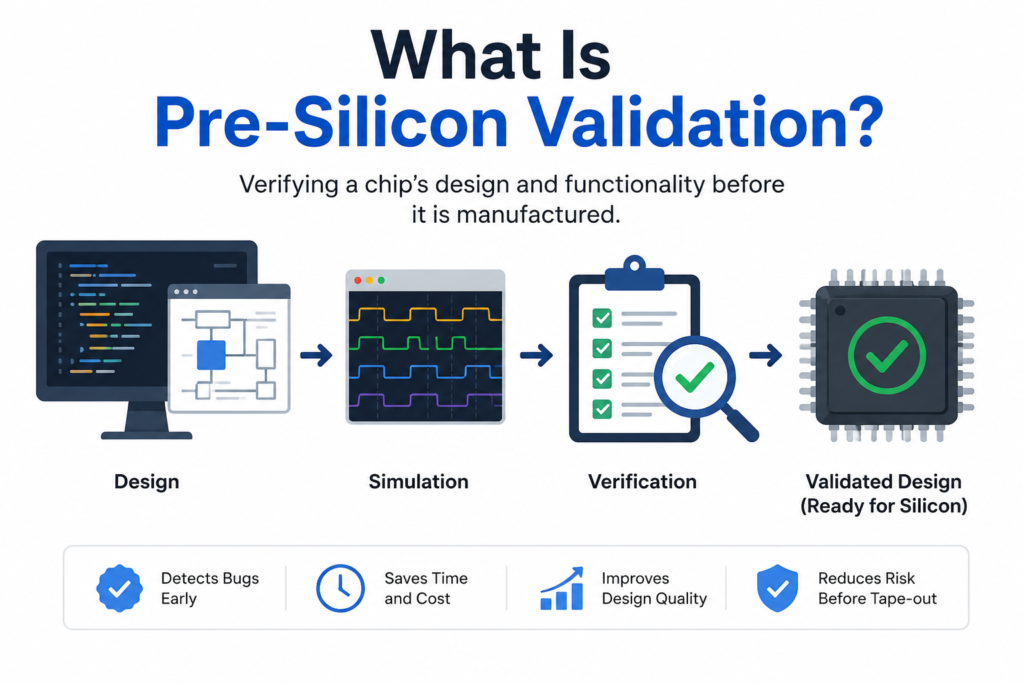
Pre-silicon validation happens before a chip is manufactured. At this stage, the design exists only as code — RTL (Register Transfer Level) descriptions, simulation models, and architectural specifications. Engineers in this field write testbenches, build simulation environments, and run millions of test cases to catch logical errors before a single transistor is ever fabricated.
Think of it as quality control for blueprints rather than the finished building. Tools like UVM (Universal Verification Methodology), formal verification techniques, and simulation platforms such as Cadence or Synopsys suites are the daily bread and butter here. The goal is simple in concept but brutal in execution: prove that the design behaves exactly as intended under every possible condition, because once the design is sent for fabrication, fixing a bug becomes exponentially more expensive.
This field rewards people who enjoy deep logical thinking, scripting, and methodical debugging. It is largely a desk-and-simulation job, meaning most of the work happens on a computer, running test suites and analyzing waveforms rather than handling physical hardware.
What Is Post-Silicon Validation?
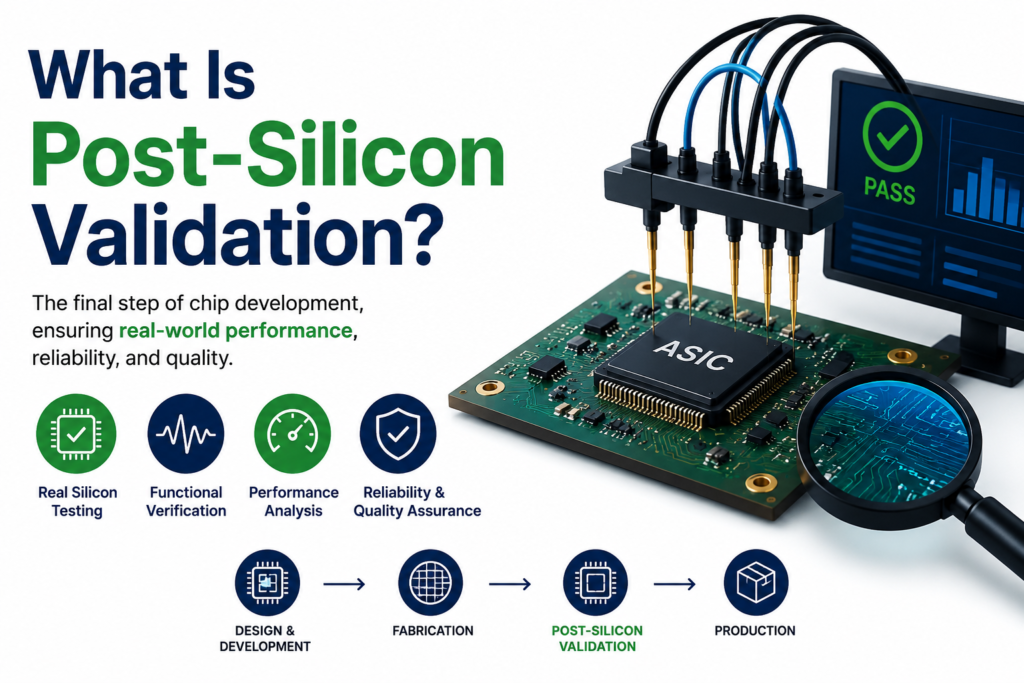
Post-silicon validation begins after the chip has actually been manufactured. This is where the real, physical silicon meets reality for the first time. Engineers bring up early prototype boards, connect real hardware, and test the chip under actual operating conditions — voltage variations, temperature extremes, real-world software workloads, and edge cases that no simulation could fully predict.
This work is hands-on. It involves lab equipment, oscilloscopes, debug probes, and a lot of troubleshooting when something behaves unexpectedly on real hardware but worked fine in simulation. Post-silicon engineers often collaborate closely with firmware and software teams, since many issues only appear once actual code runs on actual silicon.
There is a certain thrill to this role that pre-silicon work doesn’t offer — you are literally the first person to see how a brand-new chip behaves in the real world. Bugs found here can be costly to fix through workarounds or firmware patches, which makes speed and precision essential.
Key Differences Between Pre-Silicon and Post-Silicon Validation
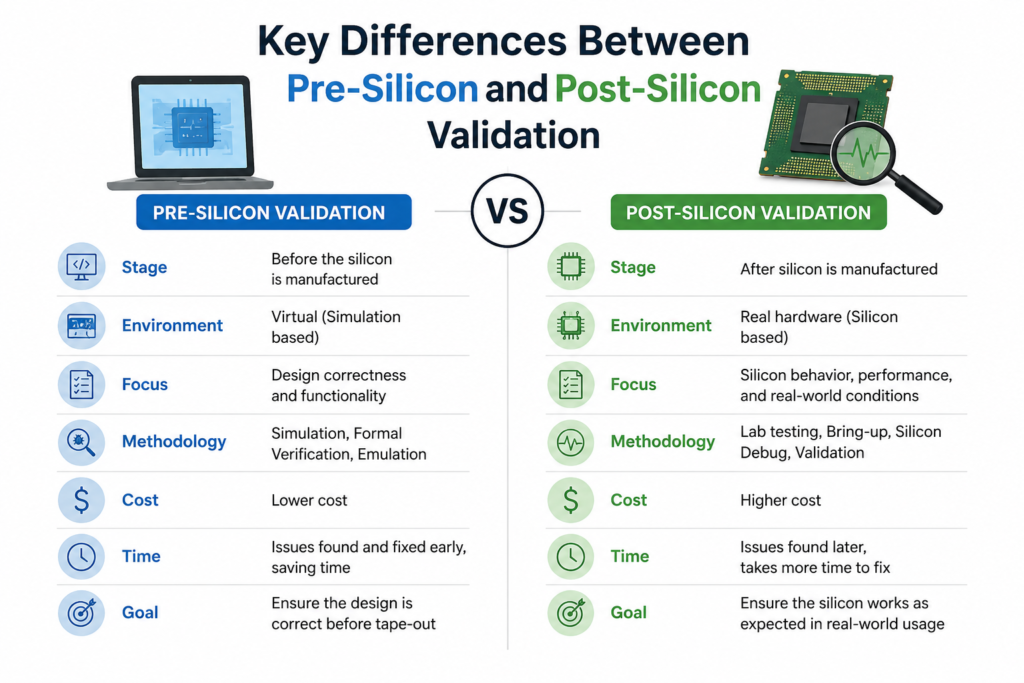
While both fields share the same end goal — shipping a reliable chip — the way they get there is very different.
- Stage of involvement: Pre-silicon happens entirely before manufacturing; post-silicon starts the moment the first chips come back from the fab.
- Tools used: Pre-silicon relies on simulation software and formal verification tools; post-silicon depends on lab equipment, debuggers, and physical test setups.
- Nature of work: Pre-silicon is simulation-heavy and code-driven; post-silicon is hands-on and hardware-driven.
- Bug complexity: Pre-silicon catches logical and architectural bugs early; post-silicon uncovers real-world issues like power inconsistencies, thermal behavior, and timing problems that simulations can miss.
- Team collaboration: Pre-silicon teams work closely with RTL designers; post-silicon teams work closely with firmware, software, and manufacturing teams.
Neither field is “easier” than the other — they simply demand different mindsets. Pre-silicon rewards patience with abstraction and code; post-silicon rewards comfort with ambiguity and physical debugging under time pressure.
How to Start Your Career in Post Silicon Validation
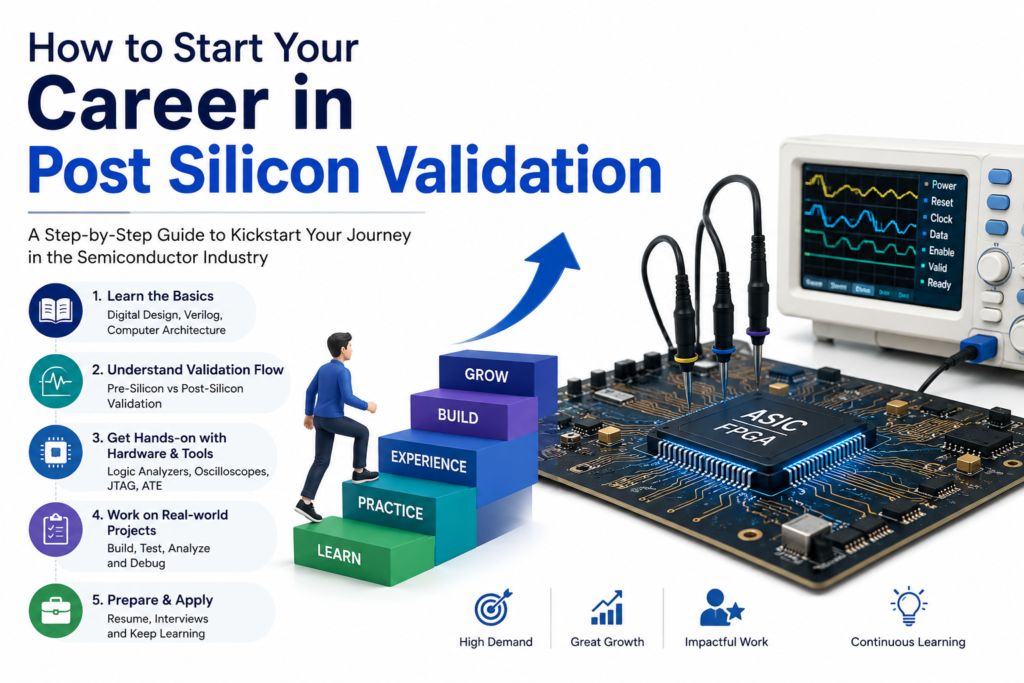
If the hands-on, high-pressure world of post-silicon work appeals to you, here’s a practical roadmap to get started.
1. Build a strong foundation in digital electronics and computer architecture. Understanding how processors, memory, and buses actually function is non-negotiable. You don’t need to memorize every architecture, but you should be comfortable reading datasheets and understanding signal behavior.
2. Get hands-on with lab tools early. Familiarity with oscilloscopes, logic analyzers, JTAG debuggers, and basic soldering or board-level troubleshooting will set you apart. Many aspiring engineers underestimate how much physical skill matters in this field.
3. Learn scripting for automation. Python and Perl are widely used to automate test execution, log parsing, and result analysis in post-silicon labs. Even basic scripting ability makes you significantly more valuable.
4. Consider a focused post silicon validation course. A structured post silicon validation course can compress years of scattered learning into a few months of guided, practical training — covering chip bring-up, debug methodologies, protocol testing (like PCIe, USB, or DDR), and real lab exercises. Choosing a course that includes hands-on lab access, rather than just theory, makes a measurable difference when you start applying for roles.
5. Get comfortable with real silicon debug case studies. Reading and understanding how past silicon bugs were diagnosed — power issues, clock domain crossing failures, thermal throttling problems — builds the intuition that separates a good post-silicon engineer from a great one.
6. Network within the semiconductor community. Attend webinars, join forums, and follow chip design companies’ engineering blogs. This industry is smaller and more connected than people expect, and referrals carry real weight here.
Which Career Path Should You Choose?

There is no universal right answer — it depends on what kind of problem-solver you are.
Choose pre-silicon validation if you enjoy deep logical puzzles, are comfortable spending long hours writing and debugging code, and prefer predictable, simulation-based environments. This path often offers a smoother entry point since it overlaps heavily with programming and verification methodology, skills that are easier to build through self-study and simulation practice.
Choose post-silicon validation if you’re energized by hands-on problem-solving, enjoy working with physical hardware, and don’t mind the pressure of debugging issues that could delay a product launch. This path tends to offer faster exposure to real products and closer visibility into how a chip actually performs once it leaves the design phase, which many professionals find more rewarding in the long run.
In terms of career growth, both paths lead to strong senior roles — verification architects on the pre-silicon side, and silicon bring-up leads or system validation architects on the post-silicon side. Compensation in both fields tends to track closely, though post-silicon roles sometimes command a premium in companies where chip bring-up speed directly affects product timelines.
Final Thoughts
The debate between post silicon validation and pre-silicon validation isn’t really about which one is “better” in absolute terms — it’s about which one matches your natural way of thinking. If you like proving things work in theory before they exist physically, pre-silicon is your world. If you like watching real silicon come alive and solving problems no simulation could predict, post-silicon is where you’ll thrive.
Whichever direction you choose, the semiconductor industry rewards depth over breadth. Pick one path, go deep, build real project experience, and let your expertise — not just your job title — do the talking when opportunities come knocking.
1. What is the difference between Pre-Silicon and Post-Silicon Validation?
Pre-Silicon Validation verifies chip designs before fabrication, while Post-Silicon Validation tests real silicon after manufacturing for functionality and performance.
2. Which is better: Pre-Silicon or Post-Silicon Validation?
It depends on your interests. Pre-Silicon focuses on simulation and verification, while Post-Silicon emphasizes hardware debugging and real-chip testing.
3. Is Pre-Silicon Validation a good career?
Yes. Pre-Silicon Validation offers high demand, excellent salaries, and opportunities in Design Verification using SystemVerilog, UVM, and simulation tools.
4. Is Post-Silicon Validation a good career?
Yes. Post-Silicon Validation is ideal for engineers interested in lab testing, debugging, silicon bring-up, and hardware performance optimization.
5. Which validation role pays more?
Both roles offer competitive salaries. Pay depends on skills, experience, company, and expertise in verification methodologies or silicon debugging.