

Nvidia and Japanese Robotics Firms Collaborate to Shape the Future of AI

What happens when the world’s most valuable chipmaker joins forces with the country that invented modern manufacturing? Tokyo just found out. Nvidia CEO Jensen Huang stood in front of Japan’s biggest industrial names this week and declared that the next industrial revolution won’t be built in a lab in California. It will be built on factory floors in Japan.
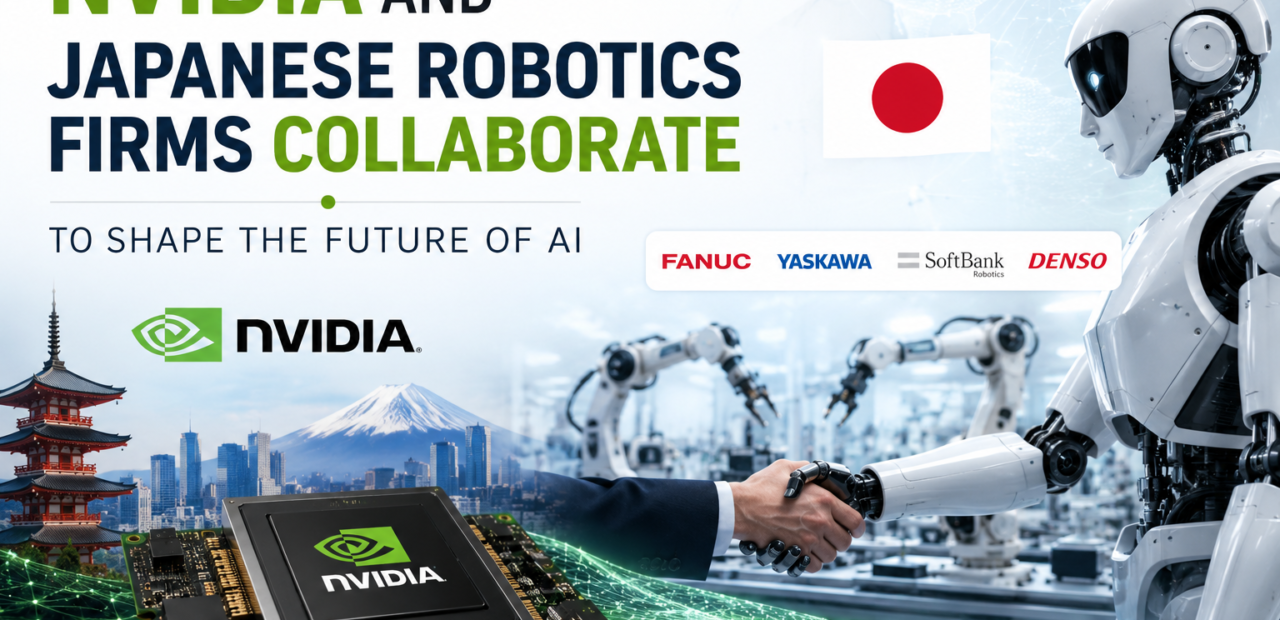
This isn’t a small partnership announcement buried in a press release. Nvidia has locked arms with Fanuc, Yaskawa Electric, Kawasaki Heavy Industries, Fujitsu, Honda R&D, Hitachi, Sony, SoftBank, and dozens of other Japanese powerhouses to push what the company calls “physical AI.” The idea is simple to say and hard to build: machines that don’t just crunch data but actually see, reason, and act in the real world. Here’s what this collaboration really means, and why it matters far beyond Japan.
Why Nvidia Chose Japan for Its Physical AI Push
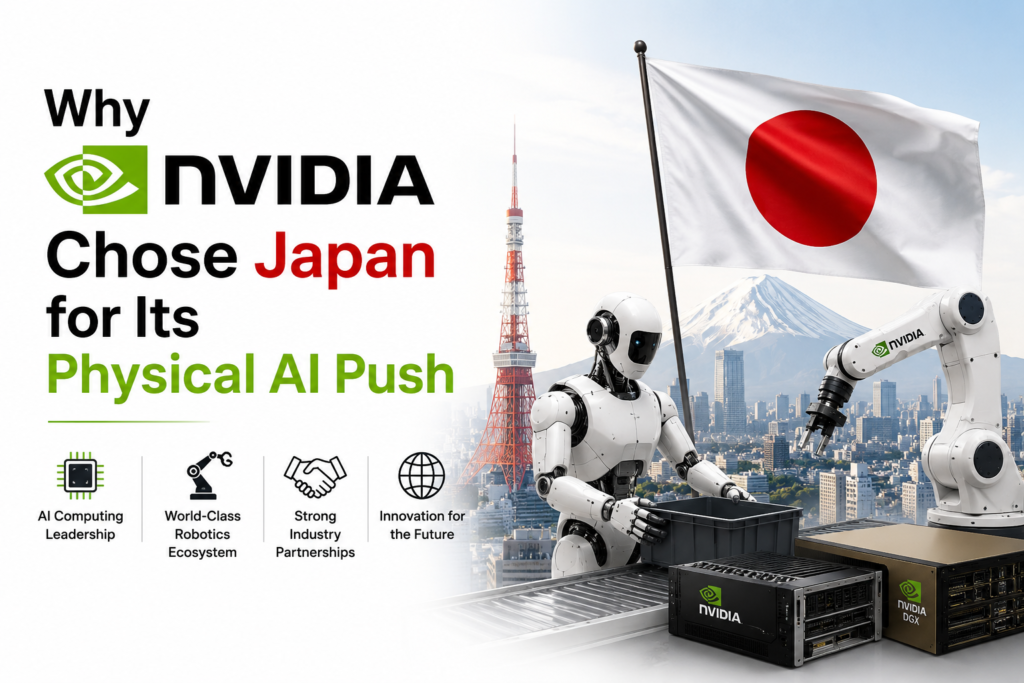
Japan has a problem that most advanced economies eventually face: a shrinking, aging workforce. Factories that once ran on abundant skilled labor are now struggling to find enough hands, and the gap is only widening. At the same time, Japan is home to some of the most sophisticated robotics companies on the planet. Fanuc and Yaskawa aren’t newcomers chasing a trend; they’ve been building industrial robots at scale for decades, deployed across automotive plants, electronics factories, and logistics hubs worldwide.
Huang put it plainly during the Tokyo announcement, saying Japan has the manufacturing heritage but was missing the new technology layer, and that the missing piece is physical AI. Pairing decades of precision engineering with Nvidia’s compute stack is a bet that machines can fill the labor gap while making Japanese industry more competitive globally. It’s a partnership built on complementary strengths rather than a one-sided rollout.
The Companies and Platforms Driving the Partnership
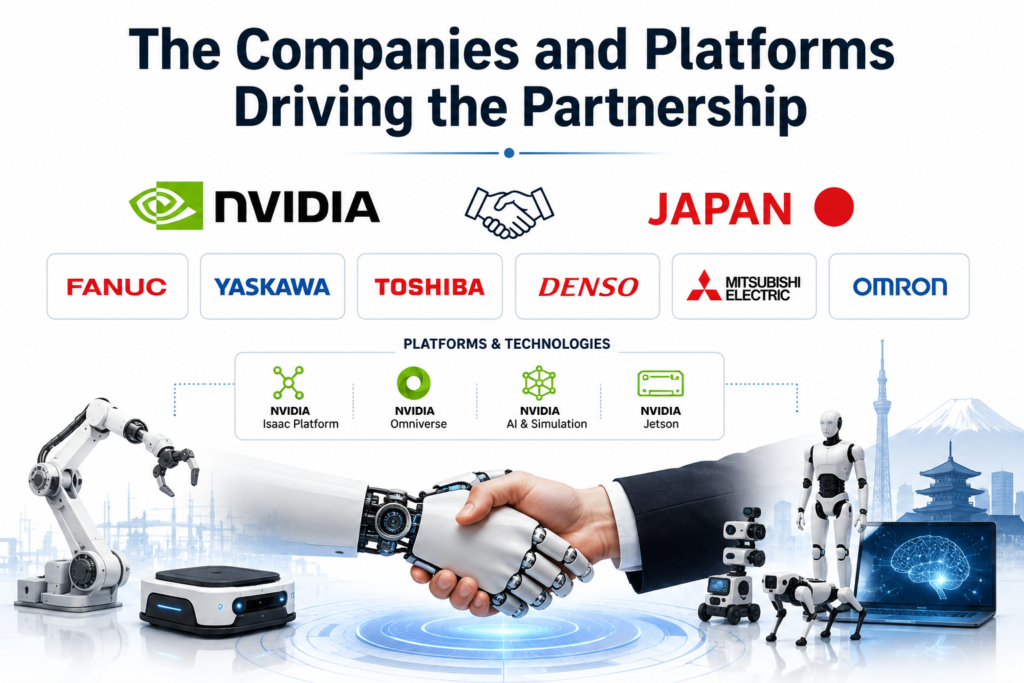
The scale of this ecosystem is what makes it stand out. Nvidia’s announcement lists an unusually long roster of Japanese collaborators, including AIRoA, Fujitsu, Groove X, Hitachi, Honda R&D, Kawasaki Heavy Industries, Kubota, Mitsubishi, Mitsui, NEC, Preferred Networks, SoftBank, Sony, Telexistence, TIER IV, Turing, and Yaskawa Electric, among others.
These companies are building on four core Nvidia platforms: Cosmos for world modeling and simulation, Isaac for robotics development, Metropolis for vision AI, and Jetson for edge computing hardware. Fujitsu is leading the charge on a collaborative control platform meant to stitch these tools together into one coherent stack. Kawasaki Heavy Industries is applying Isaac and Holoscan to hospital robots like FORRO and NURABOT, designed to support surgical teams and hospital staff. Meanwhile, Canon, Omron, and Hitachi are adopting Nvidia’s Metropolis platform for vision AI applications across manufacturing and infrastructure. This isn’t a single flagship product; it’s an entire industrial ecosystem shifting toward a shared AI foundation at the same time.
Cosmos 3 Edge and the Push Toward Real-Time Robot Intelligence
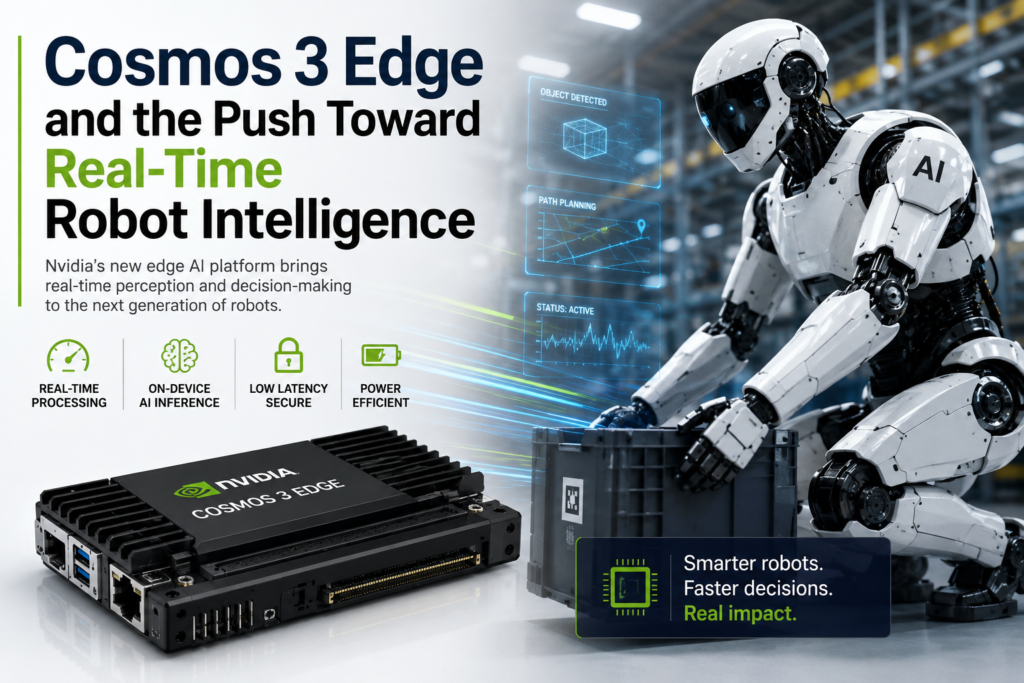
One of the more technical but genuinely important pieces of this announcement is Cosmos 3 Edge, a new addition to Nvidia’s Cosmos world model family. It’s a compact model, built on Nvidia’s Nemotron architecture, designed specifically to run on Jetson edge computers rather than in a distant data center. That distinction matters a lot for robotics, where a delay of even a fraction of a second between sensing and acting can mean the difference between a robot avoiding an obstacle and colliding with it.
Cosmos 3 Edge is built to help robots and vision AI systems interpret their surroundings, reason through a situation in real time, and generate the next action locally, without waiting on a round trip to the cloud. Developers using the open Cosmos framework can reportedly adapt the model to a specific robot, vehicle, sensor, or environment in about a day, which is a dramatic drop from the weeks or months such customization has traditionally required. If that timeline holds up in practice, it could meaningfully speed up how quickly new physical AI applications reach real factories and hospitals.
Beyond Manufacturing: Healthcare, Finance, and the Bigger Picture
While robotics is the headline story, the collaboration stretches into other corners of Japan’s economy as well. On the healthcare side, Japanese pharmaceutical leaders including Astellas, Daiichi Sankyo, and Ono Pharmaceuticals are using Nvidia’s BioNeMo platform for AI-driven drug discovery, with Astellas already running BioNeMo’s Agent Toolkit to give AI agents autonomous access to its life sciences research stack. Separately, a government-backed company called Noetra, backed in part by Sony, announced plans to purchase 27,500 Nvidia Rubin chips to build out physical AI infrastructure, with construction slated to begin in 2027.
This spread across healthcare, finance, and manufacturing shows that Nvidia isn’t just selling chips to one industry. It’s positioning itself as the infrastructure layer underneath Japan’s broader AI transformation, from hospital robots to drug discovery agents to financial systems. For a country facing demographic pressure and looking for a new growth engine, that kind of full-stack bet carries real weight, and it also gives global investors a clearer picture of how seriously traditional industrial giants are now treating AI as core infrastructure rather than an experimental side project.