

AI Chips Update: AI Semiconductor Market Poised for Major Growth by 2035

Picture a single chip inside a data center rack quietly deciding how fast the next breakthrough in medicine, language, or robotics arrives — that is the kind of influence AI semiconductors already hold, and the numbers around them are only getting bigger. What used to be a niche corner of the chip industry has turned into the single biggest force reshaping global electronics.
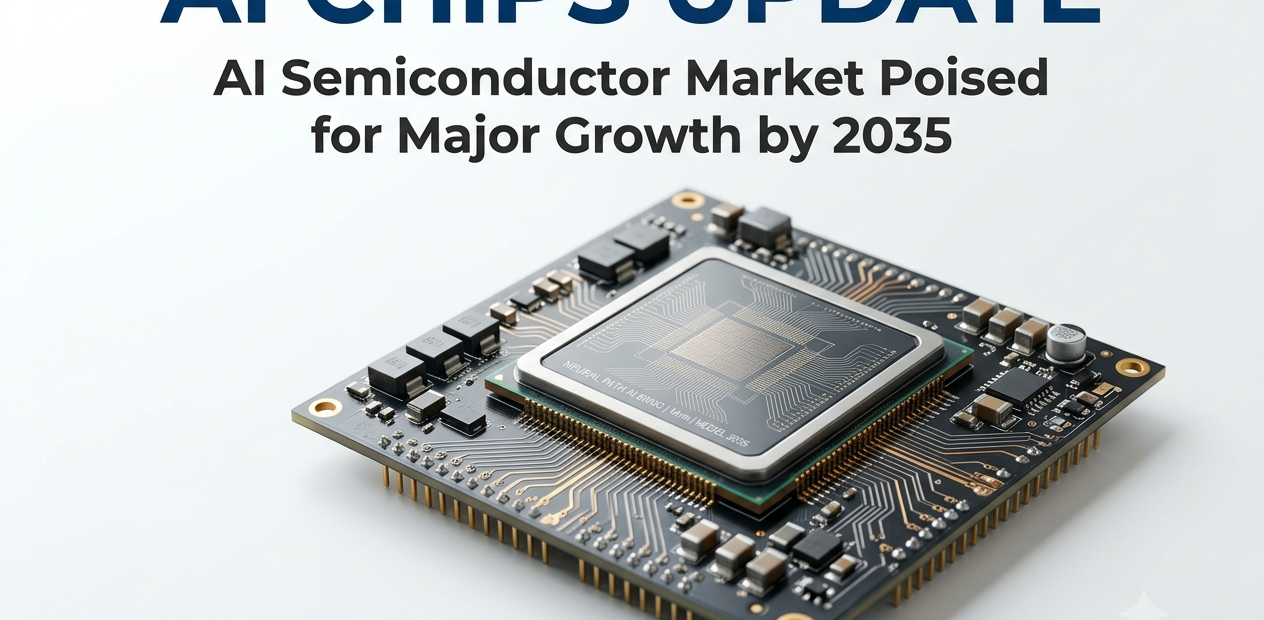
Analysts now peg the AI semiconductor space to grow from roughly 65 billion dollars in 2025 toward figures ranging from 250 billion to well over a trillion dollars by 2035, depending on how narrowly or broadly the category is defined. Whatever number ends up closest to reality, one thing is clear — the next decade of chip design, manufacturing, and deployment will be shaped almost entirely around artificial intelligence workloads.
1. Where the AI Semiconductor Market Stands Today
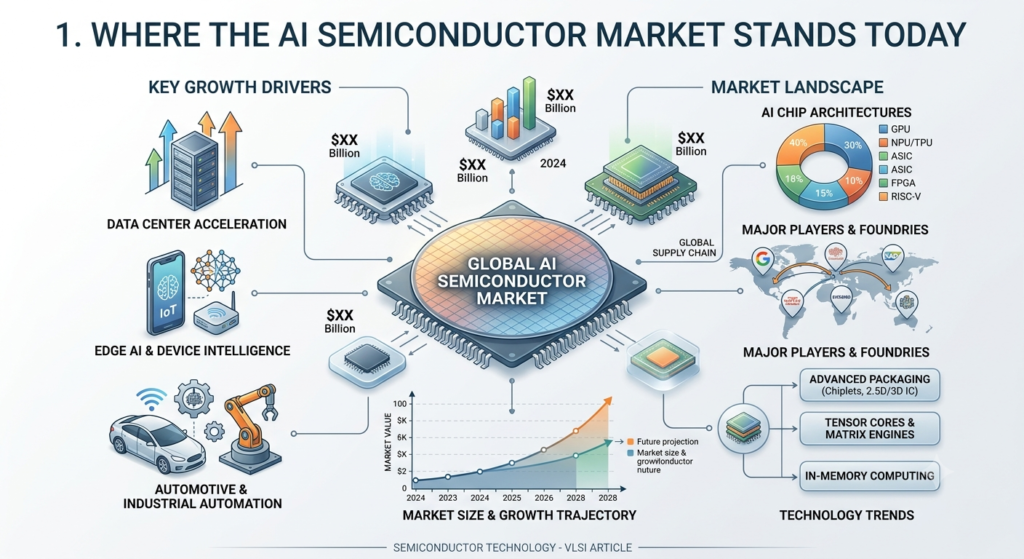
The foundation for this growth is already visible in 2026 earnings reports and capacity announcements. Taiwan Semiconductor Manufacturing Company, the world’s largest contract chipmaker, posted a July revenue jump of nearly 45 percent year over year, with high-performance computing — the segment that covers AI accelerator production — now making up around two-thirds of its total business. That single data point captures how quickly AI has moved from a side project to the core revenue engine of the entire foundry industry.
To keep pace, TSMC has raised its 2026 capital spending plan to a range of 60 to 64 billion dollars and committed an additional 100 billion dollars toward expanding manufacturing in Arizona. This is not an isolated move. Cloud providers, GPU designers, and memory makers are all pouring capital into leading-edge nodes at a pace rarely seen in semiconductor history, and advanced-node capacity below 5 nanometers is reportedly sold out well into the future.
2. What’s Actually Driving This Growth
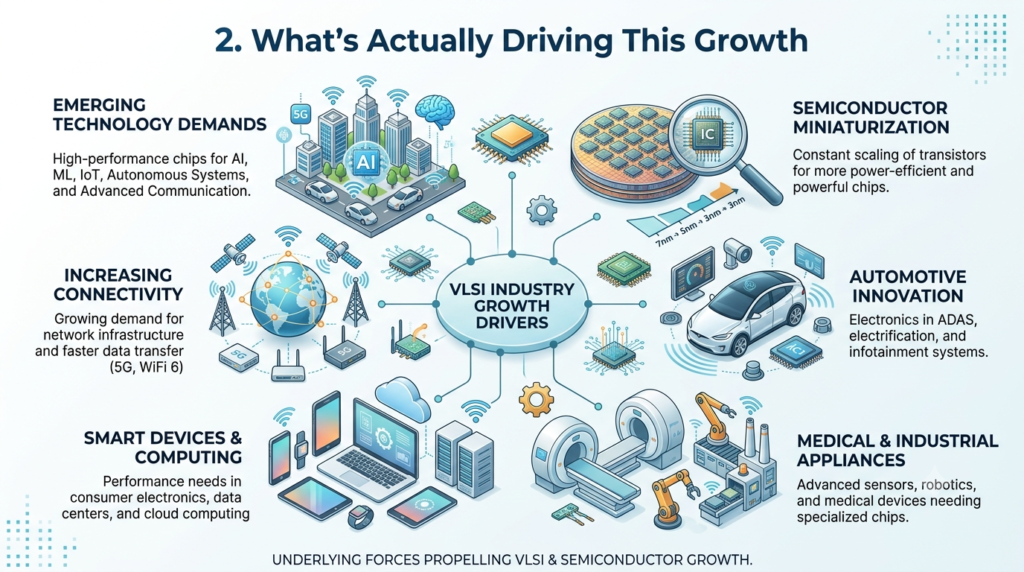
A few forces stand out when you look past the headline numbers. Hyperscale data centers remain the biggest demand engine, as cloud giants keep expanding infrastructure to train and run increasingly large AI models. Every generation of large language model requires more compute, more memory bandwidth, and more specialized silicon than the last, and that appetite shows no sign of slowing.
Edge AI is the second major driver. Instead of sending every task to a distant data center, more devices — phones, cars, cameras, industrial sensors — are now expected to process AI workloads locally for speed and privacy reasons. This is pushing demand for smaller, power-efficient chips alongside the massive accelerators used in the cloud.
A third factor is diversification beyond traditional GPUs. Custom AI accelerators, neural processing units, and application-specific chips are being designed by cloud companies themselves, not just by the traditional chip vendors. This broadens the market and creates new competitive dynamics across the supply chain, from design houses to packaging specialists.
3. Market Size Projections: Reading Between the Numbers
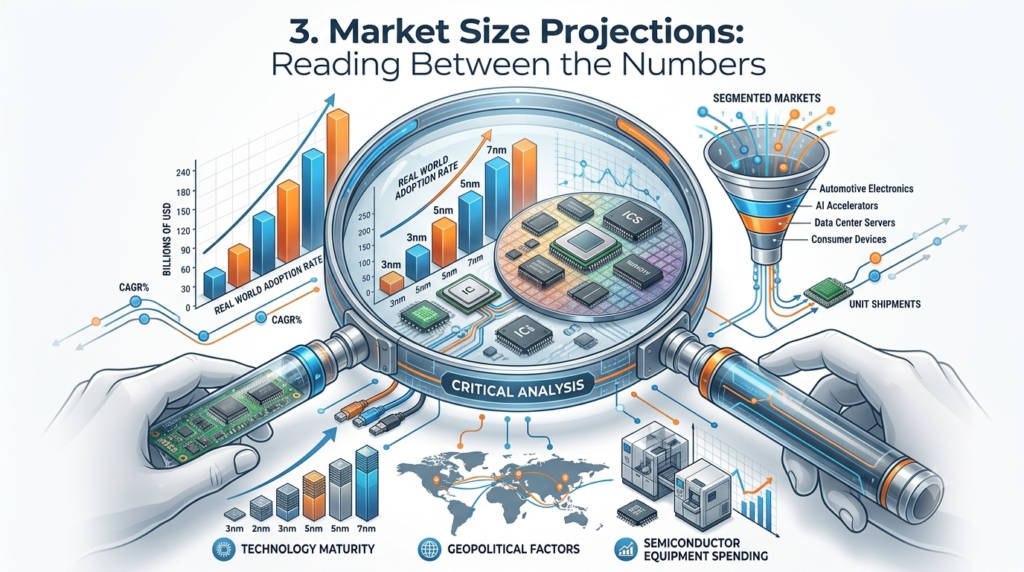
Market research firms don’t fully agree on the exact size this industry will reach by 2035, and that’s worth understanding rather than glossing over. Some reports place the narrower “AI in semiconductor” category around 250 to 260 billion dollars by 2035, growing at a compound annual rate near 14 to 15 percent. Other estimates that define the AI chip market more broadly — including accelerators, memory, and related infrastructure — put the figure above a trillion dollars, with growth rates in the high 20s to low 30s percent range.
The gap between these numbers usually comes down to definition. A tighter scope counts only chips explicitly marketed as AI accelerators, while a broader scope includes the memory, networking silicon, and packaging that support AI systems end to end. Either way, the direction is identical: sustained double-digit growth, year after year, through the next decade.
4. The Companies and Moves Shaping the Next Decade
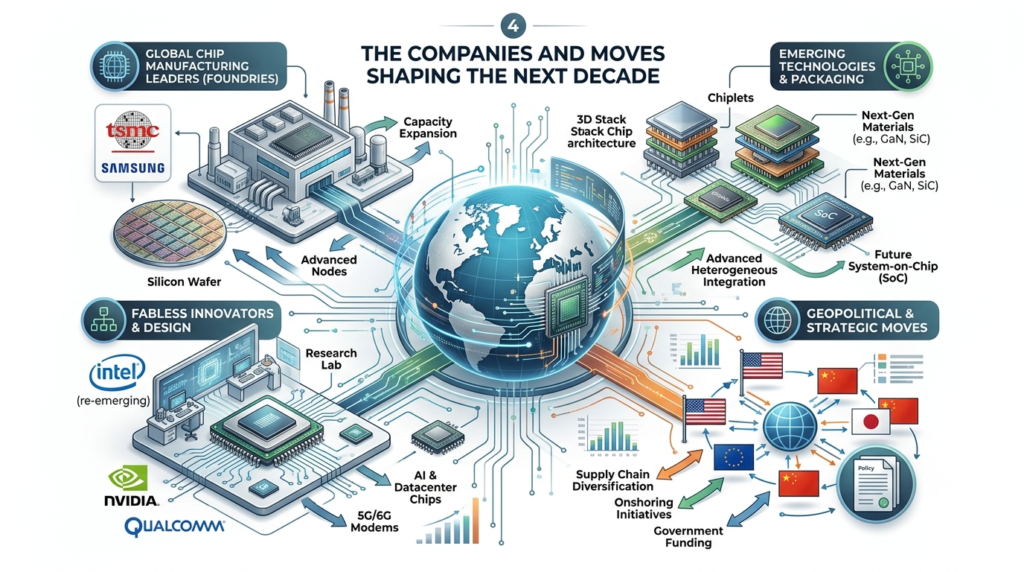
No conversation about this market is complete without Nvidia and TSMC, but the story extends further. Nvidia recently arranged financing commitments exceeding 500 billion dollars from major asset managers to support AI data center buildouts, effectively locking in demand for chip manufacturing capacity years in advance. That kind of structural commitment gives foundries the confidence to keep expanding, since the orders behind it are backed by real capital rather than speculation.
TSMC, in turn, continues to work closely with Nvidia and other partners to bring AI itself into the chip-making process — using accelerated computing to speed up lithography simulation, defect detection, and yield optimization inside its own fabs. This creates a feedback loop where AI helps build better AI chips, faster.
Beyond the two biggest names, companies like AMD, Broadcom, Qualcomm, and several memory manufacturers are racing to secure their share of this expansion. Broadcom and Nvidia are both exploring TSMC’s newer optical interconnect technology to handle the massive data movement needs inside AI clusters, a sign that even the connections between chips are becoming a competitive battleground.