



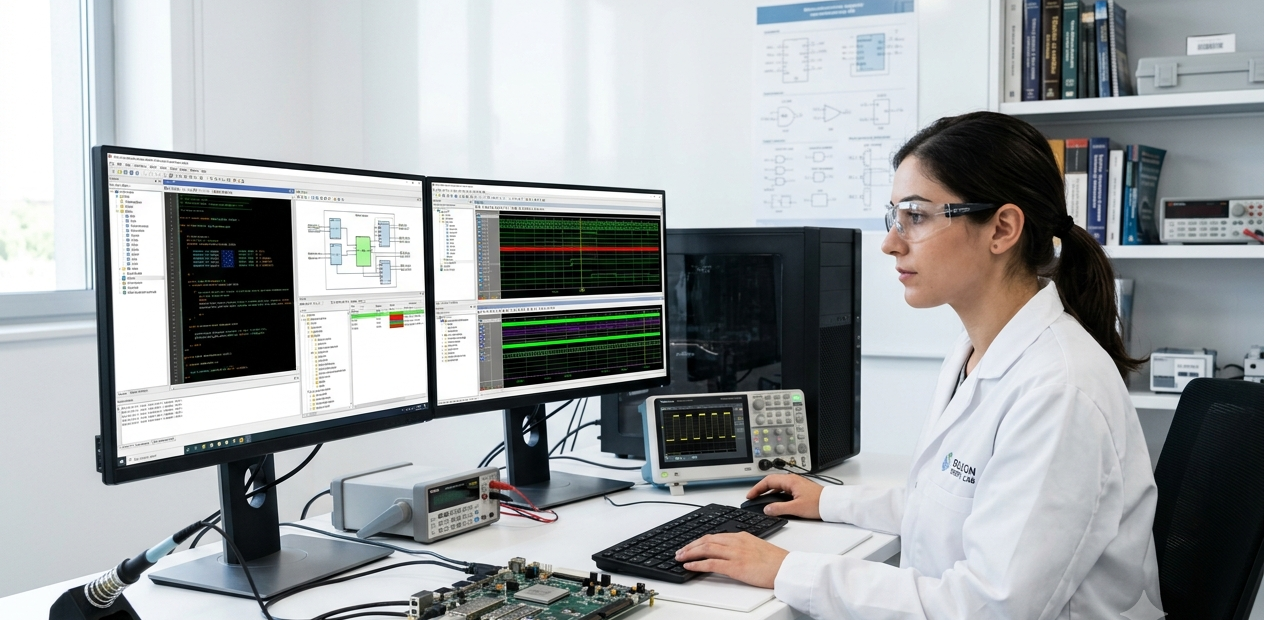
Top Simulation Tools Used in VLSI Verification

A single missed bug in a chip with billions of transistors can cost tens of millions of dollars in silicon re-spins and set project timelines back by months. In the modern semiconductor industry, there are no second chances once a design goes to the foundry. This high-stakes reality makes functional verification the most time-consuming phase of chip development, often consuming up to 70% of total project resources. At the center of this critical safety net sit VLSI simulation tools—the software engines that execute, stress-test, and debug complex designs on screen long before physical silicon ever powers on.
As integrated circuits grow more intricate, choosing the right simulation platform becomes a make-or-break technical decision. From handling complex Universal Verification Methodology (UVM) testbenches to executing night-long regression runs, verification teams rely on specialized software to ensure functional correctness. Today’s landscape spans industry-standard commercial giants and high-speed open-source alternatives, each offering distinct trade-offs in compilation speed, runtime throughput, and debug visibility. Understanding how these simulation tools fit into modern verification flows is essential for building reliable chips on time and within budget.
Quick Comparison: Top VLSI Simulation Tools
| Simulator | Vendor / License | Key Technical Strengths | Primary Industry Use Case |
| Synopsys VCS | Synopsys (Commercial) | Industry-leading execution speed, native UVM acceleration, Verdi integration | Enterprise SoC regressions, signoff verification, constrained-random testing |
| Cadence Xcelium | Cadence (Commercial) | Multi-core parallel engine, seamless JasperGold & Palladium integration | Large multi-core SoCs, mixedsignal, low-power & hardwareassisted emulation |
| Siemens Questa | Siemens EDA (Commercial) | Robust VHDL/SV mixed-language support, deep UPF low-power debug | Complex multi-language IP, powerintent validation, DFT verification |
| Verilator | Open-Source (C++) | Compiles SV to fast C++/SystemC models, zero license costs | CI/CD pipelines, early inner-loop logic checks, RISC-V development |
| ModelSim / Icarus | Siemens / OpenSource | Low overhead, fast setup, lightweight interactive debugging | Academic education, FPGA design verification, basic block-level testing |
The Role of Simulation in the VLSI Verification Lifecycle

Simulation serves as the primary line of defense in modern chip design, catching functional bugs on screen before tape-out. Because fabricating physical silicon is an expensive and irreversible step, verification engineers spend up to 70% of the project cycle running dynamic tests. By applying randomized inputs and monitoring outputs against specified logic rules, software simulators validate complex edge cases early. This pre-silicon testing prevents multi-million dollar re-spins, ensures specs are met, and lays the foundation for reliable hardware.
Industry-Standard Commercial Simulators: VCS, Xcelium, and Questa
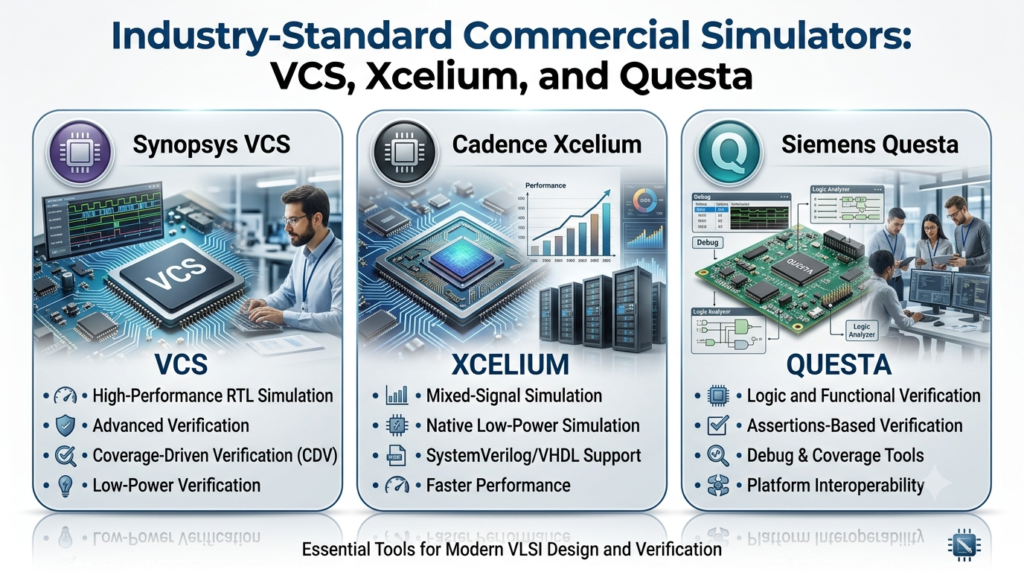
The commercial EDA market is anchored by three major platforms: Synopsys VCS, Cadence Xcelium, and Siemens Questa. These tools are built to execute multi-million gate designs and massive UVM testbenches with high runtime speed. VCS excels in raw constraint solver speed and tight Verdi debug integration, Xcelium leverages parallel multi-core execution engines for large SoCs, and Questa stands out for its robust mixed-language support across VHDL and SystemVerilog. Together, they form the cornerstone of enterprise tape-out signoff.
The Rise of Open-Source Simulators: Verilator & Icarus Verilog
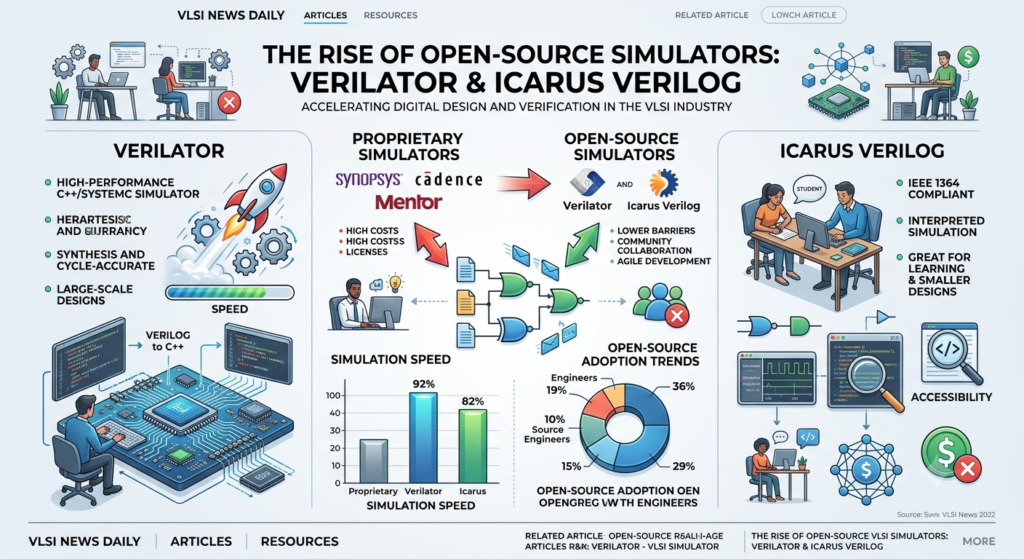
Beyond commercial giants, open-source simulators have gained significant momentum in software-driven verification workflows. Verilator leads this space by compiling Verilog and SystemVerilog code directly into high-speed C++ or SystemC models, making it exceptionally fast for cycle-accurate unit testing. Meanwhile, Icarus Verilog paired with GTKWave offers a lightweight setup ideal for quick debugging and education. These tools allow engineering teams to scale automated CI/CD regression suites in the cloud without incurring high licensing costs.
Event-Driven vs. Cycle-Based Simulation: Choosing the Right Engine
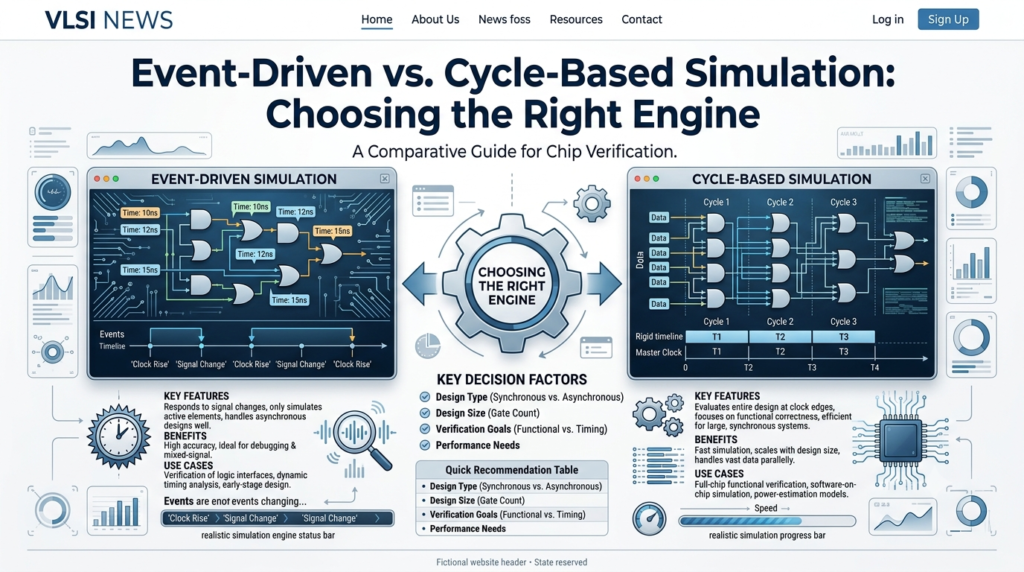
Understanding the architectural distinction between event-driven and cycle-based simulation engines is key to optimizing test speed. Event-driven simulators track every signal change and timing delay, providing maximum accuracy for asynchronous logic, setup/hold checks, and gate-level netlists. In contrast, cycle-based simulators evaluate states strictly on active clock edges, skipping intra-cycle timing to deliver massive speedups. Verification teams typically balance both methods depending on whether they need deep timing debug or fast functional throughput.
Key Evaluation Metrics for Selecting a Simulation Tool
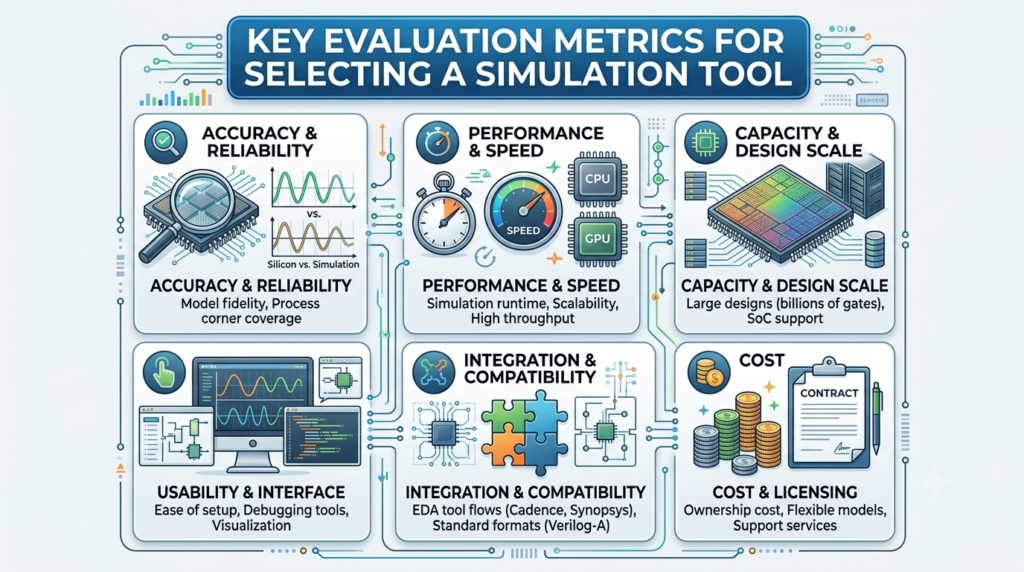
Selecting the right simulator requires evaluating several technical factors beyond basic license pricing. Teams assess constraint solver efficiency, compilation speed, and multi-threaded scaling performance during heavy regression runs. Advanced debug visibility—such as full-signal tracing and automated root-cause analysis—drastically reduces triage time. Additionally, seamless handling of Unified Power Format (UPF) for low-power intent and comprehensive coverage metrics ensures the tool can drive a project all the way to signoff.
Q1: What is the main difference between event-driven and cycle-based simulation?
Event-driven simulators evaluate logic whenever any signal changes state, allowing them to accurately track timing delays, setup/hold checks, and asynchronous logic. Cycle-based simulators, like Verilator, only evaluate logic on active clock edges. This skips intra-cycle timing details to deliver significantly faster execution speeds during functional testing.
Q2: Why are Synopsys VCS, Cadence Xcelium, and Siemens Questa considered
industry standards? These commercial EDA tools are engineered to handle multi-million gate designs and complex Universal Verification Methodology (UVM) environments. They offer advanced constraint solvers, high-speed regression throughput, specialized low-power (UPF) tracking, and native integrations with powerful debuggers like Synopsys Verdi and Cadence SimVision.
Q3: Can open-source tools like Verilator completely replace commercial
simulators? No, open-source simulators generally serve a complementary role rather than a total replacement. While Verilator is exceptionally fast for cycle-accurate C++ logic checks and continuous integration (CI/CD) pipelines, it lacks complete support for full SystemVerilog UVM testbenches, 4-state logic (X/Z propagation), and commercial coverage signoff tools.
Q4: How do teams decide when to move from simulation to hardware emulation?
Software simulation becomes a bottleneck when verifying full System-on-Chip (SoC) designs, booting operating systems, or running software drivers that require billions of clock cycles. When simulation runtimes become too slow, teams scale up to hardware emulation systems like Cadence Palladium or Synopsys ZeBu to run tests thousands of times faster.
Q5: What key metrics should verification teams evaluate when choosing a
simulator? Teams should look at compilation time, constraint solver performance for randomized testing, multi-core scaling capabilities, and debugging visibility. Additionally, support for Assertion-Based Verification (ABV), Unified Power Format (UPF) validation, and functional coverage closure reporting are essential for driving a project to final tape-out.
6. What is the difference between simulation and formal verification? Simulation
relies on dynamic stimulus testing, where specific test vectors are applied to a design over a sequence of clock cycles. Formal verification uses mathematical algorithms to prove or disprove specific properties across all possible design states simultaneously without running explicit test cases.
7. Why do large semiconductor companies use hardware emulation alongside
software simulation? As chip designs grow into billions of transistors, running software simulations for long-running tests—such as booting an operating system or running full application software—becomes extremely slow. Hardware emulation systems (like Cadence Palladium or Synopsys ZeBu) accelerate execution by orders of magnitude, allowing teams to run billions of cycles in hours rather than weeks.