



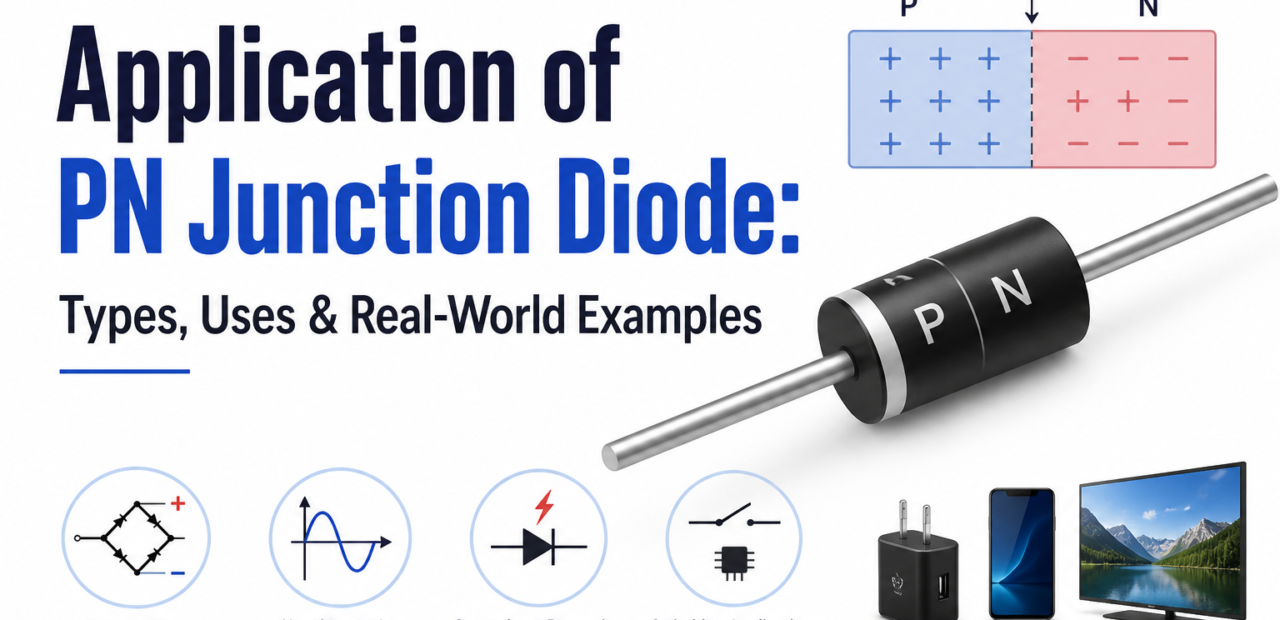
Application of PN Junction Diode: Types, Uses & Real-World Examples

A PN junction diode is a fundamental semiconductor device that allows electric current to flow in only one direction. Created by joining p-type and n-type silicon or germanium layers, it forms a built-in potential barrier at the boundary. This unique property enables the diode to act as an electronic one-way valve, making it an essential building block across all modern electrical and digital circuits.
Understanding diode applications is essential for grasping how daily electronics manage power, process signals, and protect sensitive components. From converting alternating current into usable direct current to emitting light in displays, diodes play a vital role. This guide explores the core types, practical uses, and real-world implementations of PN junction diodes in modern technology systems.
Comparison of Major PN Junction Diode Types
| Diode Type | Primary Mechanism | Key Operational Characteristic | Typical Real-World Applications |
| Standard Signal/Rectifier | Basic PN Junction | Allows unidirectional current flow; converts AC to DC | Power adapters, battery chargers, reverse-polarity protection |
| Zener Diode | Controlled Reverse Breakdown | Maintains constant voltage across reverse breakdown | Voltage regulators, surge suppressors, reference circuits |
| Light Emitting Diode (LED) | Electroluminescence | Emits light photons during forward-biased recombination | Display screens, interior/exterior lighting, indicator lamps |
| Photodiode | Photoelectric Effect | Generates current when exposed to ambient light/photons | Fiber optic receivers, solar cells, light sensors |
1. Rectification: Converting AC to DC Power

Rectification is the primary function of standard PN junction diodes in power supply units. Since mains power is supplied as alternating current (AC), electronics require direct current (DC) to operate safely. Diodes permit current flow during positive half-cycles while blocking negative half-cycles, efficiently converting AC inputs into steady DC outputs needed for chargers and adapters.
Half-wave and full-wave bridge rectifiers demonstrate how diodes handle power conversion across different circuit scales. Full-wave bridge rectifiers use four arranged diodes to utilize both halves of the AC waveform, reducing voltage ripple and maximizing energy efficiency. These setups remain standard in consumer electronics, industrial motor drives, and grid power distribution equipment.
2. Voltage Regulation with Zener Diodes

Zener diodes are specially designed PN junction devices that operate reliably in the reverse breakdown region. Unlike standard diodes that risk damage under high reverse voltage, Zener diodes maintain a constant, stable reference voltage once their breakdown threshold is reached. This unique behavior makes them essential for precision circuit regulation.
In electronic power supplies, Zener diodes shield sensitive microcontrollers and integrated circuits from unexpected voltage spikes and power surges. By dumping excess current safely to ground, they act as simple, cost-effective voltage regulators. They are widely deployed in automotive control units, industrial sensors, and consumer hardware protections.
Read More: Capacitor vs Inductor: Key Differences Explained with Examples
3. Signal Demodulation in Communication Systems
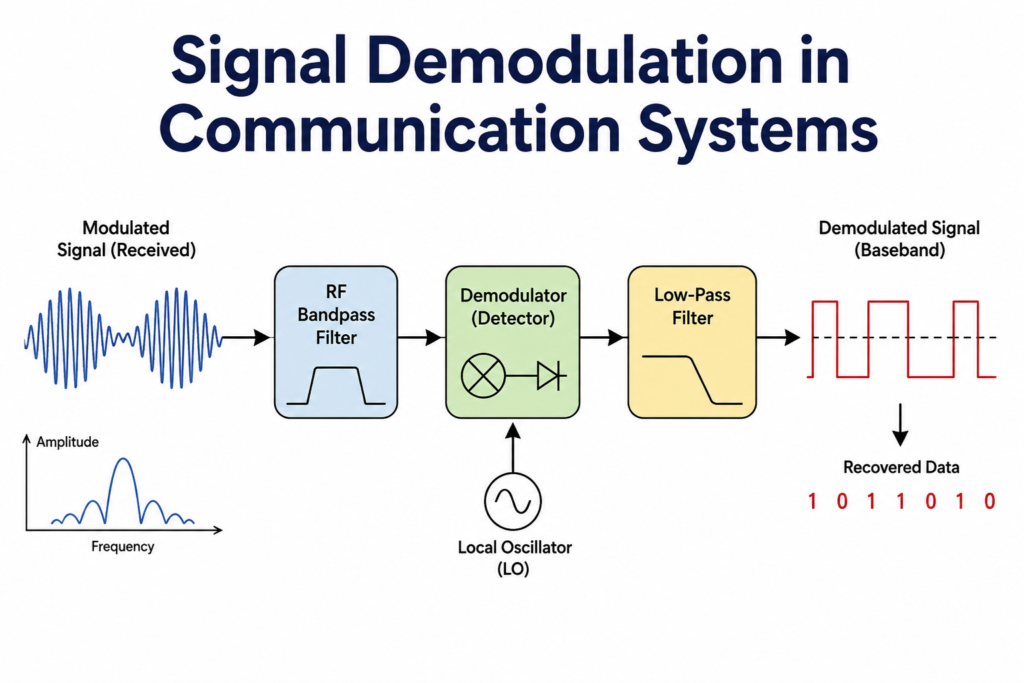
Long before digital processors took over most tasks, diodes were already doing the heavy lifting in radio and communication circuits. In AM radio receivers, a diode is used to demodulate the signal — stripping away the carrier wave to recover the original audio information.
This process, known as envelope detection, relies on the diode’s ability to allow current in only one direction, effectively acting as a simple but reliable signal extractor. Even today, diode-based demodulation principles show up in RF identification systems, wireless charging modules, and short-range communication devices, proving that this decades-old application still has relevance in modern wireless technology.
4. Diodes in Solar Panels and Renewable Energy Systems

Solar technology has grown rapidly, and PN junction diodes sit right at the center of it — quite literally, since a solar cell is itself a large-area PN junction that converts light energy into electrical energy. Beyond the core photovoltaic effect, diodes also play a protective role inside solar panel assemblies.
Bypass diodes are placed across groups of solar cells to prevent “hot spot” damage when a portion of the panel is shaded or underperforming. Blocking diodes, on the other hand, stop reverse current flow at night, preventing batteries from discharging back into the panel. As rooftop solar and off-grid energy systems continue expanding worldwide, these diode-based safeguards have become a standard part of reliable solar panel design, quietly extending the lifespan of the entire system.
5. Power Electronics in Electric Vehicles and Fast Charging

One of the fastest-growing applications of diode technology today is in electric vehicles and high-speed charging infrastructure. Modern EV charging stations rely on rectifier diodes to convert grid AC power into the DC power required to charge lithium-ion battery packs efficiently.
Beyond charging, diodes are used within onboard power converters, battery management systems, and regenerative braking circuits, where they help control current direction and prevent damaging back-flow of energy. With the shift toward faster charging speeds and higher power density, manufacturers are increasingly turning to advanced diode materials like silicon carbide, which handle higher voltages and temperatures far better than traditional silicon diodes. This shift is quietly reshaping how efficiently electric vehicles charge and perform, making diode innovation a key part of the clean energy transition.
Conclusion
It’s easy to overlook a component as small as a diode when circuit boards are packed with processors, sensors, and wireless modules. But almost every one of those advanced components depends on stable, correctly-directed power — and that stability begins with a PN junction diode doing its job somewhere in the circuit.
From the charger on your desk to the solar panel on a rooftop, from radio signals to electric vehicle battery packs, this simple semiconductor junction continues to be one of the most reused, dependable building blocks in electronics. As power systems become more efficient and renewable energy adoption grows, diode technology — especially newer materials and designs — is likely to keep evolving quietly in the background, doing what it has always done: letting current flow exactly where it needs to go, and nowhere else.
Understanding these real-world applications makes it clear that the PN junction diode isn’t just a concept confined to circuit diagrams. It’s an active, essential part of the technology shaping how we generate, store, and use electricity every single day.
1. What are the applications of a PN junction diode?
PN junction diodes are used in rectifiers, signal detection, clipping, clamping, voltage regulation, switching, and circuit protection across electronic devices.
2. Where is a PN junction diode used in real life?
PN junction diodes are found in mobile chargers, TVs, radios, power supplies, LED lighting, solar systems, automotive electronics, and industrial equipment.
3. What are the main types of PN junction diodes?
Common types include rectifier, Zener, Schottky, PIN, avalanche, photodiode, and LED, each designed for specific electronic applications.
4. Why is a PN junction diode important in electronics?
A PN junction diode controls current flow in one direction, making it essential for rectification, signal processing, protection, and voltage control.
5. What is the most common use of a PN junction diode?
The most common use is converting AC into DC using rectifier circuits in power supplies for electronic devices.
6. What is the advantage of using Schottky diodes over standard PN junction diodes?
Schottky diodes use a metal-semiconductor junction instead of a standard PN junction. This results in a much lower forward voltage drop (~0.2V to 0.3V compared to ~0.7V) and near-instantaneous switching speeds, making them ideal for high-efficiency power supplies and high-frequency RF systems.
7. Can a photodiode generate electricity like a solar cell?
Yes, solar cells are essentially large-area silicon photodiodes optimized for power generation. When sunlight strikes the depletion region of the PN junction, it frees electrons and creates electron-hole pairs, generating usable direct current electricity via the photovoltaic effect.