




India’s Semiconductor Industry: Key to Future Growth and Global Supply Chain Leadership

India’s semiconductor ambitions are no longer confined to theoretical blueprints; they are reshaping the global technology ecosystem. Under the India Semiconductor Mission (ISM 2.0), the nation is rapidly building domestic fabrication, advanced packaging, and Very Large Scale Integration (VLSI) design hubs. Driven by strategic government incentives and strong private-sector investments, India is securing its digital future while establishing itself as an essential player in the global semiconductor supply chain.
The semiconductor industry forms the backbone of artificial intelligence, 5G/6G communications, automotive technology, and defense systems. By converting its vast engineering talent into domestic intellectual property and physical manufacturing capability, India is mitigating global supply chain risks. This shift from total reliance on chip imports to local semiconductor production represents a fundamental transformation in the country’s industrial roadmap.
Policy Catalysts: The Evolution of the India Semiconductor Mission (ISM 2.0)
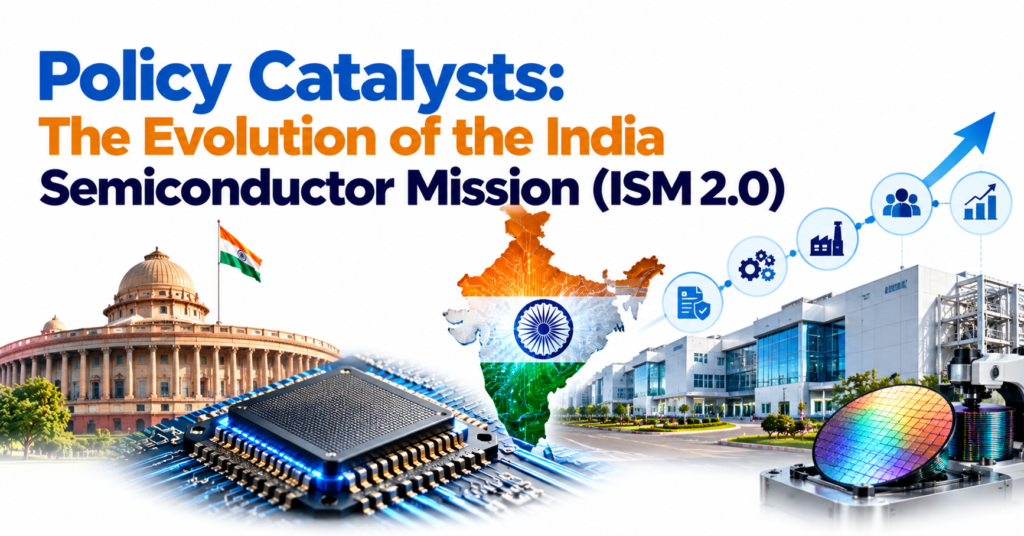
The launch of the India Semiconductor Mission marked a turning point in the nation’s high-tech manufacturing policies. The second phase, ISM 2.0, expands fiscal support beyond foundational fabrication plants to cover upstream materials, specialized machinery, and advanced R&D hubs. By sharing capital risks with global and domestic investors, India has created an attractive ecosystem for long-term investments in silicon wafer fabs and compound semiconductors.
Government initiatives such as the Design Linked Incentive (DLI) scheme provide crucial backing to VLSI design startups and domestic chip makers. Shared EDA tool centers and centralized prototype fabrication access allow young engineering firms to scale innovation quickly without excessive capital costs. These policy efforts ensure that policy momentum translates directly into commercial chip production across major industrial clusters.
Bridging the Gap: OSAT and Advanced Packaging Capabilities

Building commercial silicon fabrication facilities requires significant capital and multi-year construction timelines. To build immediate operational momentum, India has prioritized Outsourced Semiconductor Assembly and Test (OSAT) and Assembly, Testing, Marking, and Packaging (ATMP) facilities. OSAT facilities bridge raw wafer production and final market integration, providing an efficient route to high-volume manufacturing.
Advanced packaging techniques—such as 2.5D/3D heterogeneous integration and Fan-Out Wafer-Level Packaging (FOWLP)—are now as critical to performance as transistor scaling. Commercial OSAT operations in states like Gujarat and Assam allow India to deliver market-ready chips for AI hardware, consumer electronics, and automotive engines, strengthening its position in global supply networks.
VLSI Design Strength: Capitalizing on Human Resource Expertise
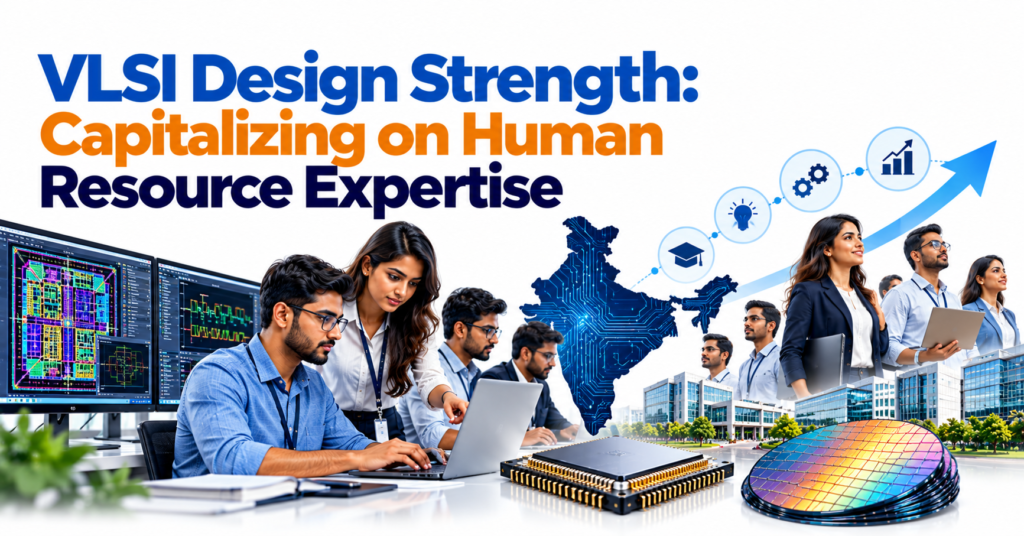
India has long served as a major global hub for VLSI design talent, housing chip design centers for leading multinational semiconductor companies. Historically, Indian engineers designed complex integrated circuits that were fabricated and packaged overseas. Today, the focus is shifting toward creating domestic IP, custom system-on-chip (SoC) architectures, and open-source RISC-V processors.
The integration of domestic VLSI design expertise with local fabrication capabilities creates a closed-loop technology ecosystem. Up-skilled engineering workforces and industry-aligned academic programs ensure a steady pipeline of hardware design talent, giving India a distinct competitive advantage as global demand grows for AI chips and low-power IoT hardware.
Diversifying Global Supply Chains and Geopolitical Resilience

Recent global supply disruptions exposed vulnerabilities in geographically concentrated chip supply chains. International technology firms and governments actively seek trusted, resilient partners to diversify production away from single-region risks. India’s stable economic backdrop, strong legal frameworks, and vast domestic market make it an attractive location for supply chain diversification.
Bilateral chip partnerships with tech-leading nations—including the US, Japan, Singapore, and European Union partners—have accelerated technology transfer and raw material access. By integrating into international supply networks, India helps stabilize global supply chains against natural disasters, geopolitical friction, and logistics bottlenecks.
Strategic Infrastructure, Clean Energy, and Fab Readiness

Semiconductor fabrication demands uninterrupted high-purity water, ultra-stable clean energy, and complex chemical supply chains. Indian industrial zones, such as Dholera in Gujarat and specialized tech corridors in Odisha and Uttar Pradesh, have developed tailored infrastructure to meet these rigorous fab manufacturing standards.
Sustaining a modern semiconductor ecosystem requires significant investments in renewable energy and green manufacturing practices. By aligning microelectronics industrial zones with dedicated solar and wind power networks, India ensures high reliability while helping technology manufacturers hit their global carbon-neutrality targets.