



Two Independent Studies Push Semiconductor Qubits Towards Practical Scales

For years, the quantum computing race looked like a two-horse contest between superconducting circuits and trapped-ion systems, with silicon-based “spin qubits” sitting quietly on the sidelines. That has just changed. Two separate research groups, working thousands of kilometers apart, have each cracked a piece of the puzzle that was keeping semiconductor qubits from growing into real, usable machines — and they published their results on the very same day.
What makes this moment stand out isn’t just the individual results. It’s that two teams, using completely different approaches, converged on the same underlying insight: the real bottleneck was never the qubit itself, but everything surrounding it — the wiring, the control electronics, and the physical distance between one qubit and the next.
The improvement in reliability tells its own story. Just three years ago, a two-qubit spin system running at scale had an error rate hovering around 4 percent for certain measurements. The new devices are now operating with error rates closer to 0.2 percent — a jump that moves silicon spin qubits from a scientific curiosity into a genuine contender for large-scale, fault-tolerant quantum hardware.
Why Semiconductor Qubits Were Stuck
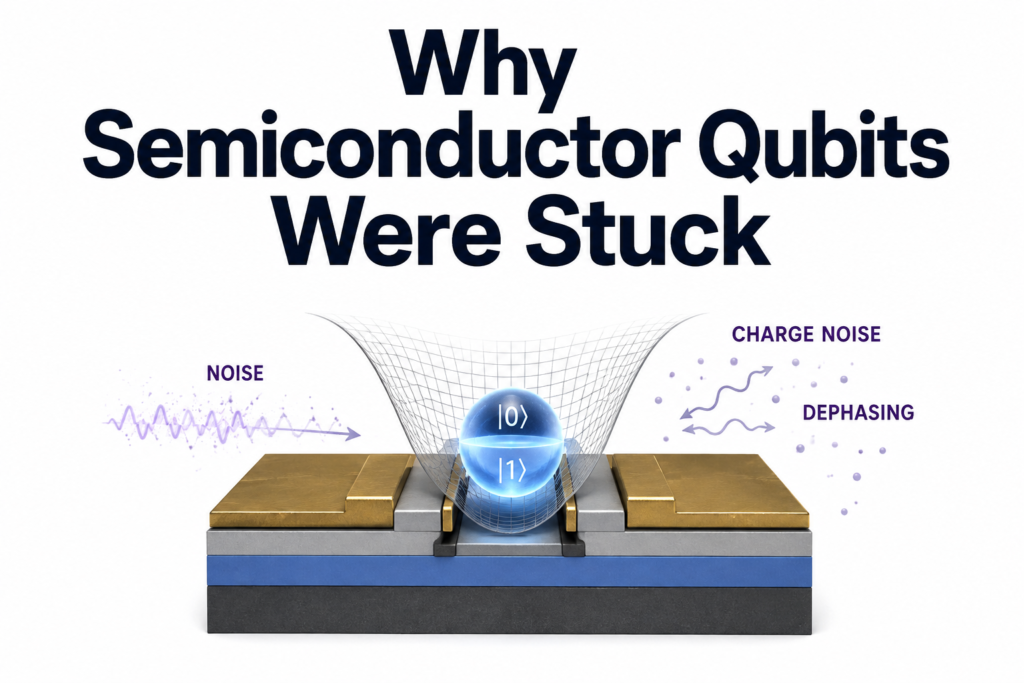
Semiconductor spin qubits work by trapping a single electron inside a tiny structure called a quantum dot, carved directly into a silicon wafer using the same lithography techniques that produce ordinary computer chips. That’s the appeal: because the manufacturing process already exists at industrial scale, spin qubits should, in theory, be far easier to mass-produce than exotic superconducting loops or laser-trapped atoms.
The catch is physics. The interactions that let two electrons perform a quantum operation only work over extremely short distances, so quantum dots have to sit almost touching one another. Pack enough of them together and there’s simply no physical room left to route the control wiring each qubit needs. Every additional qubit made the wiring problem worse, and for a long time, that limited spin-qubit devices to just a handful of working units — nowhere near what’s needed for a computer that solves real problems.
Delft’s Solution: Move the Qubit, Not the Wires
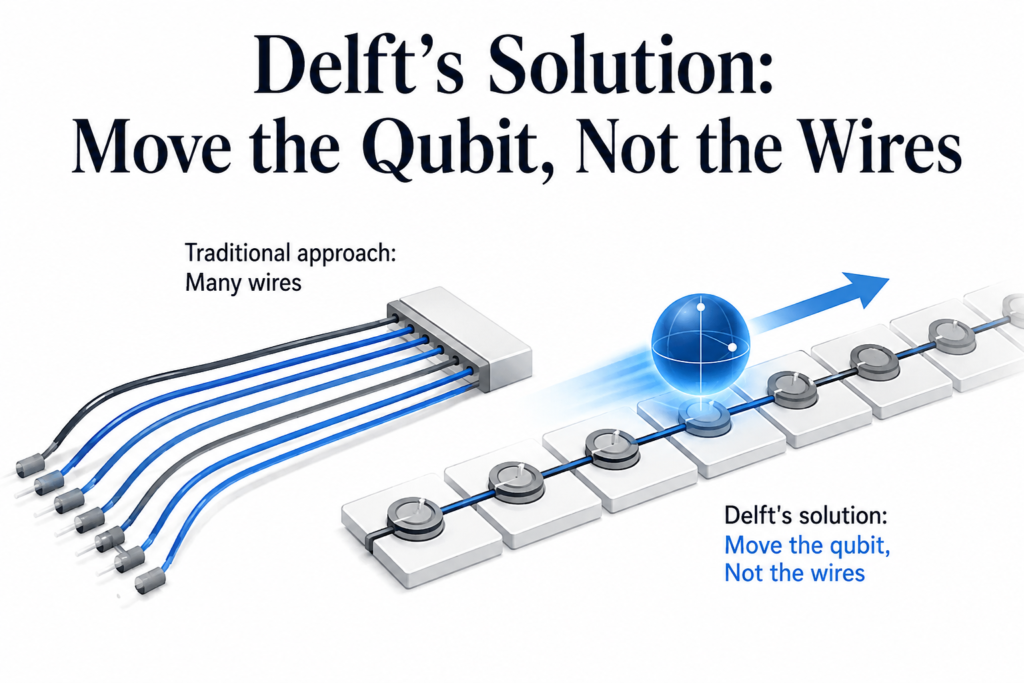
At Delft University of Technology, a team led by physicist Lieven Vandersypen took a different approach to the connectivity problem: instead of adding more wiring, they moved the qubit itself. Their device physically shuttles a single electron back and forth across a tiny span of roughly 1.2 micrometers, allowing it to interact with several neighboring qubits it wouldn’t normally be able to reach.
This shuttling mechanism effectively acts as a bus, ferrying quantum information between distant parts of the chip without needing a dedicated wire for every possible connection. Using this technique, the Delft group demonstrated a 53-qubit device capable of performing what’s known as a weight-four parity check — a measurement pattern that’s central to detecting and correcting errors in a quantum system. Getting this kind of check to work reliably at low error rates is considered a meaningful step toward the kind of error correction that any large-scale quantum computer will eventually depend on.
HRL’s Self-Governing Processor
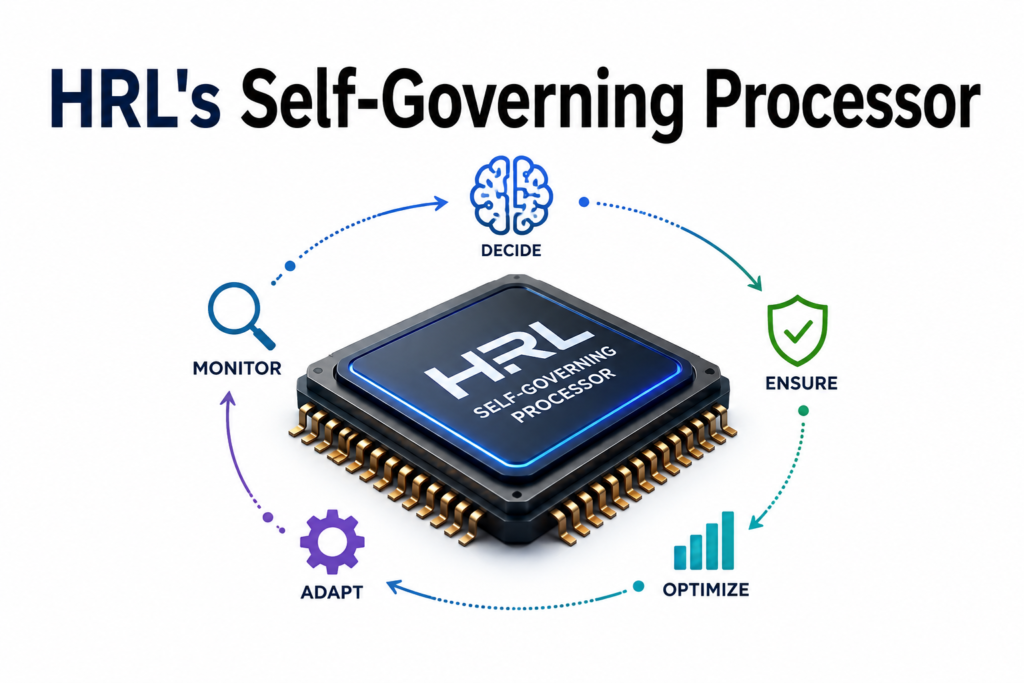
On the other side of the Atlantic, a team at HRL Laboratories in California tackled the same underlying challenge from a completely different angle: instead of moving qubits closer together, they moved the control electronics closer to the qubits. Their 18-qubit silicon device is built around a custom cryogenic control chip that operates at 4 Kelvin, sitting directly inside the refrigerator alongside the qubits themselves.
That’s a genuinely difficult engineering feat. Even electronics designed to run “cold” generate more heat than a spin qubit can tolerate, so keeping a controller functioning at cryogenic temperatures without disturbing the fragile quantum states nearby required a specialized ribbon cable capable of carrying hundreds of control signals while barely transferring any heat. The payoff is a processor that runs error-detection and repetition codes autonomously, without needing constant instructions relayed from room-temperature equipment outside the fridge — removing one of the most stubborn scaling bottlenecks in the field.
The significance of this work goes beyond the lab bench. HRL’s underlying qubit architecture is now being folded into a larger industrial effort, with the company’s silicon spin-qubit technology set to feed into a dedicated 300mm quantum wafer foundry. That’s a strong signal that this isn’t just an academic exercise — it’s being treated as a manufacturing blueprint.
What This Means for Practical Quantum Computing
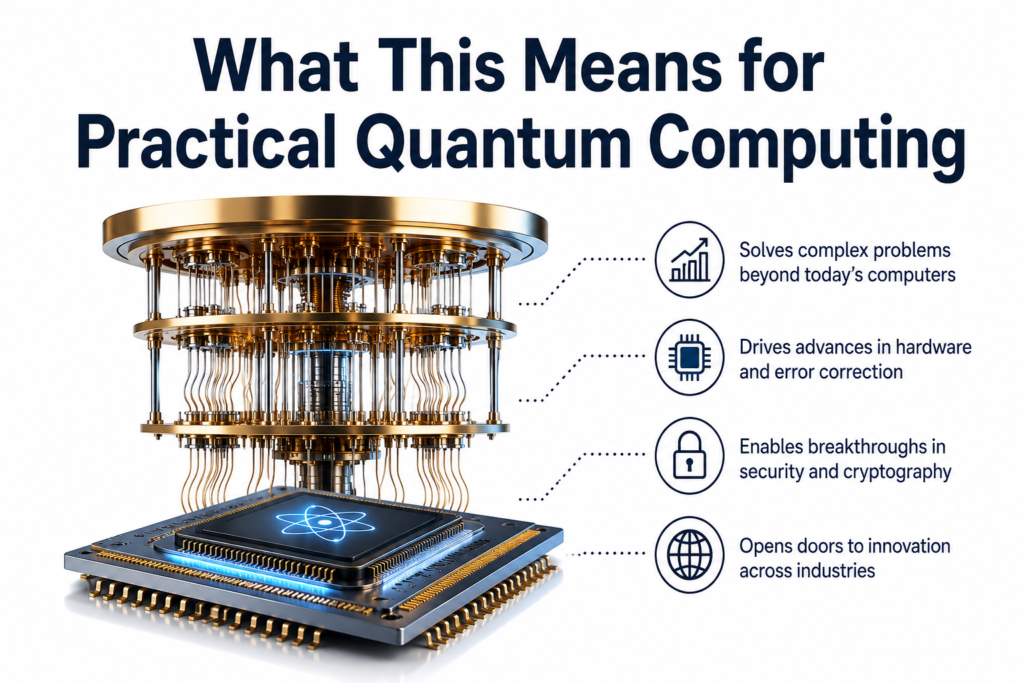
Neither of these devices is anywhere close to the scale needed for genuinely useful quantum computation, which will likely require thousands or even millions of interconnected qubits. Superconducting systems still lead on raw qubit count, and neutral-atom platforms have already reached the thousands. But qubit count was never the whole story. What both of these studies demonstrate is that the two hardest engineering problems in semiconductor quantum computing — long-distance connectivity and manageable control wiring — are solvable using ideas that borrow directly from decades of conventional chip manufacturing.
That’s the real headline here. Spin qubits have always had a structural advantage: they’re built the same way as the transistors already inside every smartphone and laptop. What was missing was proof that this advantage could actually be engineered around the connectivity and wiring problems at scale, rather than just promised on paper. These two results, arriving independently and on the same day, offer exactly that proof.
For the semiconductor and quantum computing industry, this shifts the conversation. Spin qubits are no longer just a theoretically elegant idea — they’re now backed by working hardware that addresses the specific engineering hurdles that used to make them a long-shot bet. Expect more foundries, chipmakers, and quantum hardware companies to start taking silicon spin qubits seriously as a scalable path forward, not just an interesting alternative to the more established platforms.