



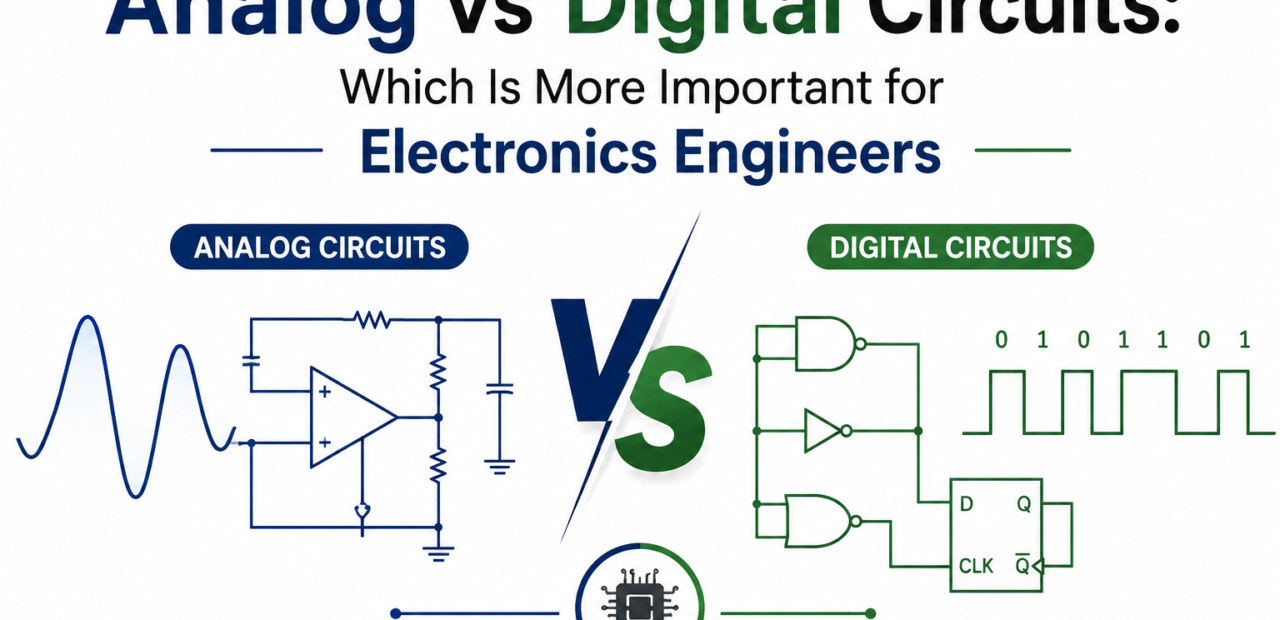
Analog vs Digital Circuits: Which Is More Important for Electronics Engineers

In modern hardware development, choosing between specializing in analog or digital engineering is rarely a simple binary choice. While digital logic powers complex computing, the physical universe remains inherently continuous and analog. Understanding the unique demands, design workflows, and real-world interactions of both domains allows electronics engineers to make informed career decisions and build complete, functional hardware systems.
Every real-world electronic device relies on a harmonious relationship between continuous signal processing and discrete computing power. Without analog circuits, digital processors would be blind to real-world inputs like sound, heat, and RF waves. Conversely, without digital circuits, processing real-world data efficiently would be impossible. Master both domains to unlock the true potential of modern chip design.
Analog vs. Digital Circuits: Comparison Overview
| Feature / Metric | Analog Circuits | Digital Circuits |
| Signal Type | Continuous waveforms (infinite values within a range) | Discrete binary levels (logic 0 and logic 1) |
| Primary Focus | Signal conditioning, amplification, power, RF | Logic operations, data processing, computation |
| Noise Susceptibility | High (sensitive to thermal noise and parasitic effects) | Low (high noise margin tolerance) |
| High manual layout & physics-level tuning | High HDL automation & logic synthesis | |
| Core Components | Op-amps, transistors, inductors, capacitors | Logic gates, flip-flops, microcontrollers, FPGAs |
Signal Processing: Continuous Waveforms vs. Discrete Logic
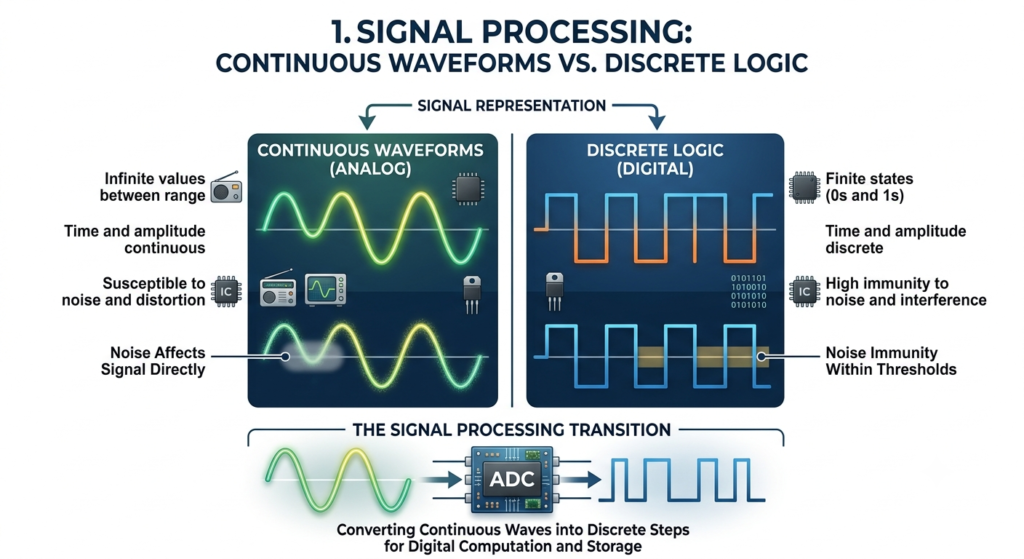
The fundamental difference between analog and digital circuits stems from how they represent physical data. Analog circuits operate on continuous signals that vary smoothly over time, mapping directly to physical quantities like sound, temperature, and light. Because these circuits work with precise voltage and current gradients, even minuscule variations affect system performance, requiring careful noise management and circuit layout techniques.
Digital circuits simplify continuous physical reality by quantizing data into discrete logic states represented by binary ones and zeros. By ignoring minor voltage fluctuations within specified threshold limits, digital systems achieve exceptional noise immunity and repeatable execution. This binary abstraction enables engineers to construct ultra-complex computational architectures, including multi-core processors and dense memory blocks, with deterministic behavior.
Design Methodologies: Transistor-Level Physics vs. HDL Automation
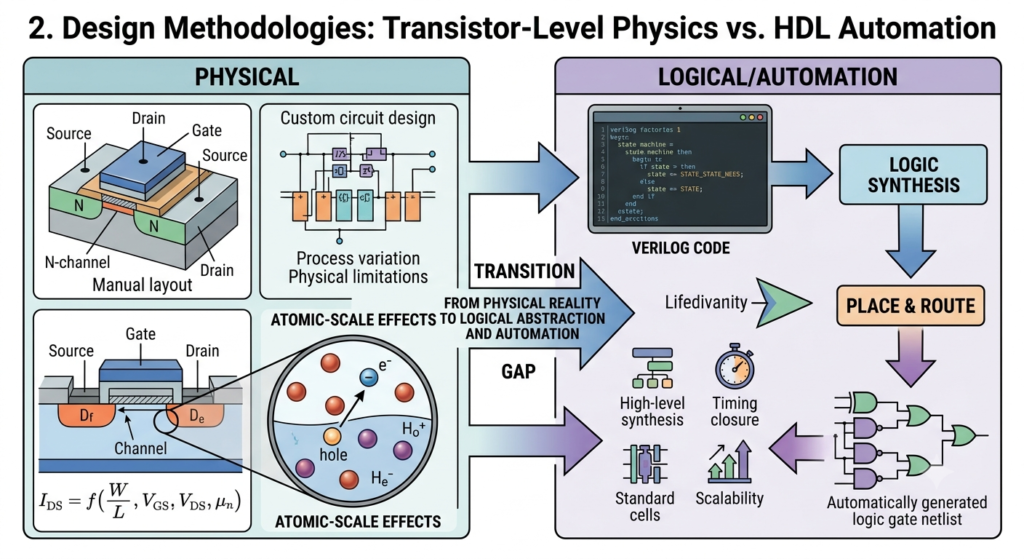
Analog circuit design is a heavily hands-on, physics-driven discipline centered on transistor-level behavior. Engineers must account for dynamic non-linearities, temperature shifts, power supply variations, and parasitic capacitance during physical layout. Because automated tools cannot fully predict these continuous physical interactions, analog design relies on manual sizing, symmetrical routing, and extensive SPICE simulations.
Digital circuit design relies heavily on automated, high-level abstraction using Hardware Description Languages (HDLs) like SystemVerilog and VHDL. Synthesis tools convert code into optimized gate-level netlists, while automated place-and-route software handles physical layout. Digital engineers focus primary effort on architecture optimization, timing closure, verification coverage, and high-level algorithmic logic.
Read More: How to Design a Linear Power Supply: Step-by-Step Tutorial
Mixed-Signal Design: Where Analog and Digital Meet
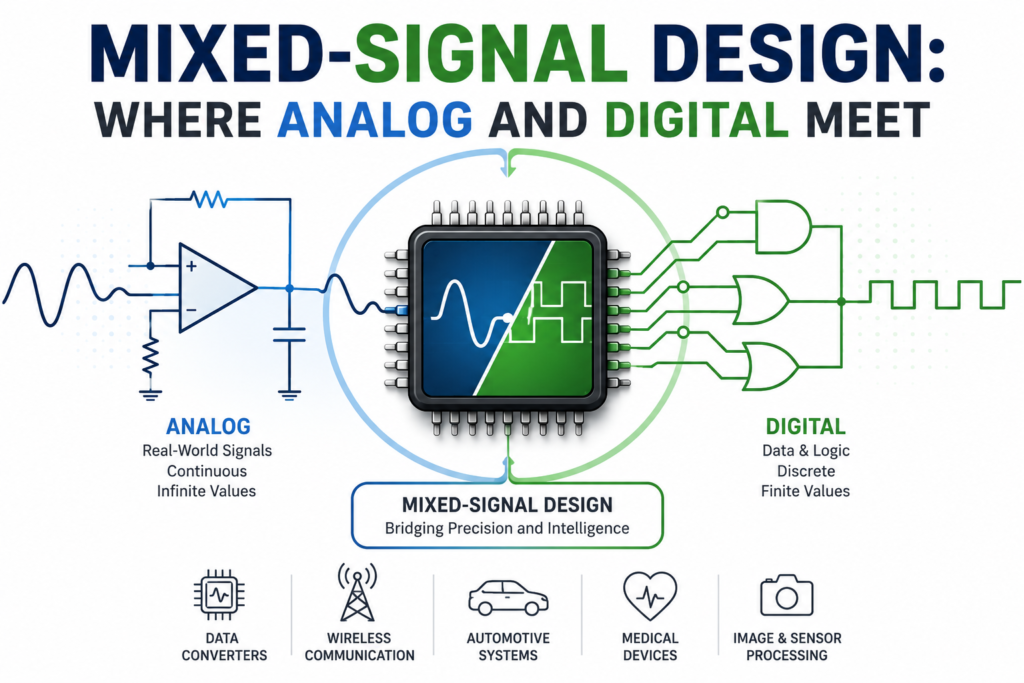
The most valuable ground in modern electronics is not analog or digital alone but the space where they meet. This is the world of mixed-signal and advanced VLSI design, where a single chip might contain a data converter, a power management block, and millions of digital logic gates working side by side.
Building these systems is genuinely difficult. Digital switching activity generates electrical noise that can bleed into sensitive analog sections nearby, so engineers use careful floor-planning, shielding, and isolation techniques to keep the two domains from interfering with each other. Getting this balance right is one of the more demanding skills in chip design, and it is increasingly what separates a mid-level design from a market-leading one.
As chips continue shrinking and devices demand tighter integration, the ability to design confidently across both domains has become a defining trait of strong engineering teams rather than a niche specialty. Companies building System-on-Chip products in particular tend to prize this cross-domain fluency, since a single weak block, analog or digital, can undermine the performance of the entire chip.
Real-World Applications Driving Demand

Look at where innovation is happening right now and you will find analog and digital circuits working in tandem almost everywhere. Electric vehicles rely on precise analog circuitry for battery monitoring, motor control, and power conversion, paired with digital systems handling navigation, diagnostics, and safety logic.
Wearable health devices depend on ultra-low-power analog front ends to pick up faint biological signals, which are then digitized and processed for real-time health tracking. Industrial sensors, autonomous systems, and smart infrastructure all follow a similar pattern: analog circuits sense and condition the physical world, while digital circuits interpret, store, and act on that information.
Even the rise of on-device artificial intelligence is reshaping this relationship. Many next-generation AI accelerators are being designed with mixed-signal elements specifically because analog computation can be remarkably efficient for certain low-precision tasks, reducing power consumption in ways purely digital approaches struggle to match. This shift is quietly pushing analog expertise back into the spotlight after years of digital dominance, and it is worth watching closely if you want to understand where the next wave of hardware innovation is headed.
Analog and Digital Electronics Career Opportunities
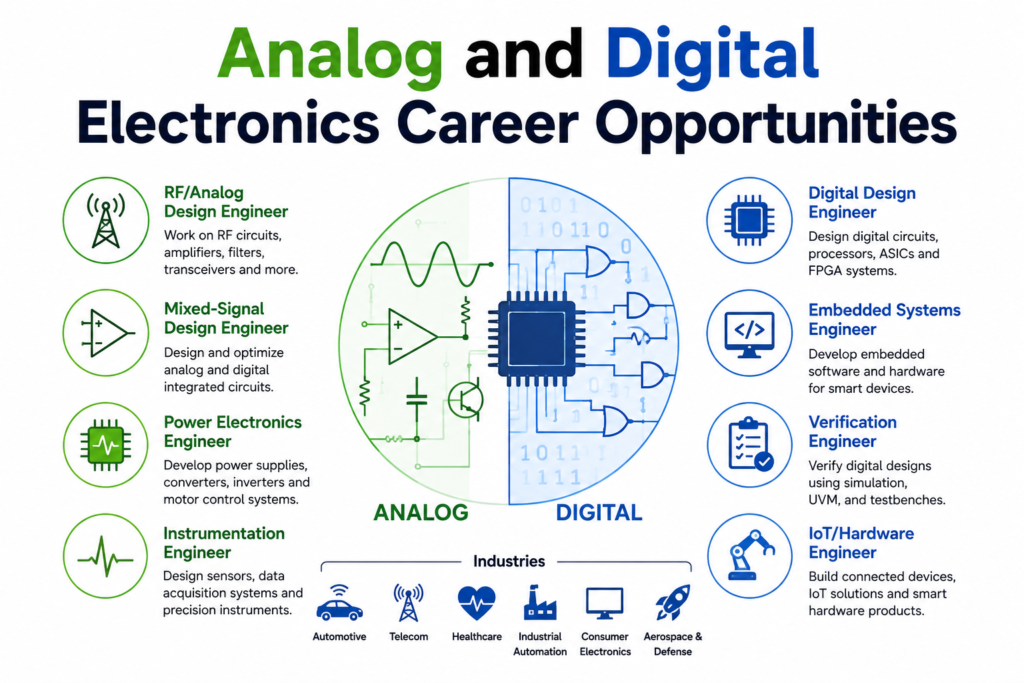
If you are weighing analog vs digital electronics for your next career move, the good news is that both paths are in strong demand, just for different reasons. Digital design offers a clear, tool-driven career path with strong demand in processor design, memory systems, and large-scale logic architecture. The learning curve is often more structured, supported by mature automation tools that shorten the path from concept to working chip.
Analog design, by contrast, offers a smaller but highly specialized talent pool. Because fewer engineers develop deep analog intuition, experienced analog designers are consistently sought after for power management, sensor interfaces, and radio-frequency work, often commanding strong compensation as a result of that scarcity.
The most future-proof position, however, belongs to engineers who understand both. As mixed-signal and VLSI design continues to grow across automotive, healthcare, and consumer electronics, professionals comfortable moving between analog intuition and digital rigor are becoming some of the most valuable people in the industry. Rather than choosing a lane early, building fluency in both domains tends to open the widest range of long-term opportunities and keeps a career resilient as the industry shifts.
1. Which is more important, analog or digital circuits for electronics engineers?
Both are important. Analog circuits handle real-world signals, while digital circuits process data and logic. Electronics engineers benefit from understanding both.
2. What is the main difference between analog and digital circuits?
Analog circuits process continuous signals, while digital circuits work with discrete binary values, usually 0 and 1, for computation, control, and data processing.
3. Should electronics engineers learn analog or digital electronics first?
Learning analog fundamentals first helps engineers understand voltage, current, and signals before moving to digital logic, processors, and advanced electronics.
4. Are analog circuits still important in modern electronics?
Yes. Analog circuits remain essential in sensors, amplifiers, power systems, RF devices, ADCs, and interfaces that connect digital systems to the real world.
5. Why are digital circuits important for electronics engineers?
Digital circuits form the foundation of processors, microcontrollers, memory, FPGA, and digital systems, making digital design a valuable skill for electronics engineers.
6. Which programming and design tools are essential for each field?
Analog engineers rely heavily on transistor-level simulation tools like Cadence Virtuoso, Synopsys HSPICE, and LTspice. Digital engineers use Hardware Description Languages (SystemVerilog, VHDL), logic synthesis tools (Design Compiler), and verification frameworks (UVM) along with EDA tools like Siemens Questa or Cadence Xcelium.
7. Should a student focus on analog or digital engineering for a successful career?
Students should build a solid foundation in basic circuit theory, operational amplifiers, and binary logic during early studies. Choosing a specialization depends on career preferences: pursue digital engineering if you enjoy coding, high-level logic, and computer architecture; choose analog engineering if you are passionate about physics, signal processing, and working closely with physical hardware.