


How to Become a Post-Silicon Validation Engineer (Step-by-Step Guide)

A single missed hardware bug caught after mass production can cost semiconductor manufacturers millions of dollars in foundry re-spins, product recalls, and severe schedule delays. While pre-silicon verification uses software simulations to model chip behavior mathematically, it can never fully predict how physical silicon reacts to real-world voltage fluctuations, heat, or high-speed workloads. This critical gap makes post-silicon validation engineers the ultimate gatekeepers of reliability before mass market release.
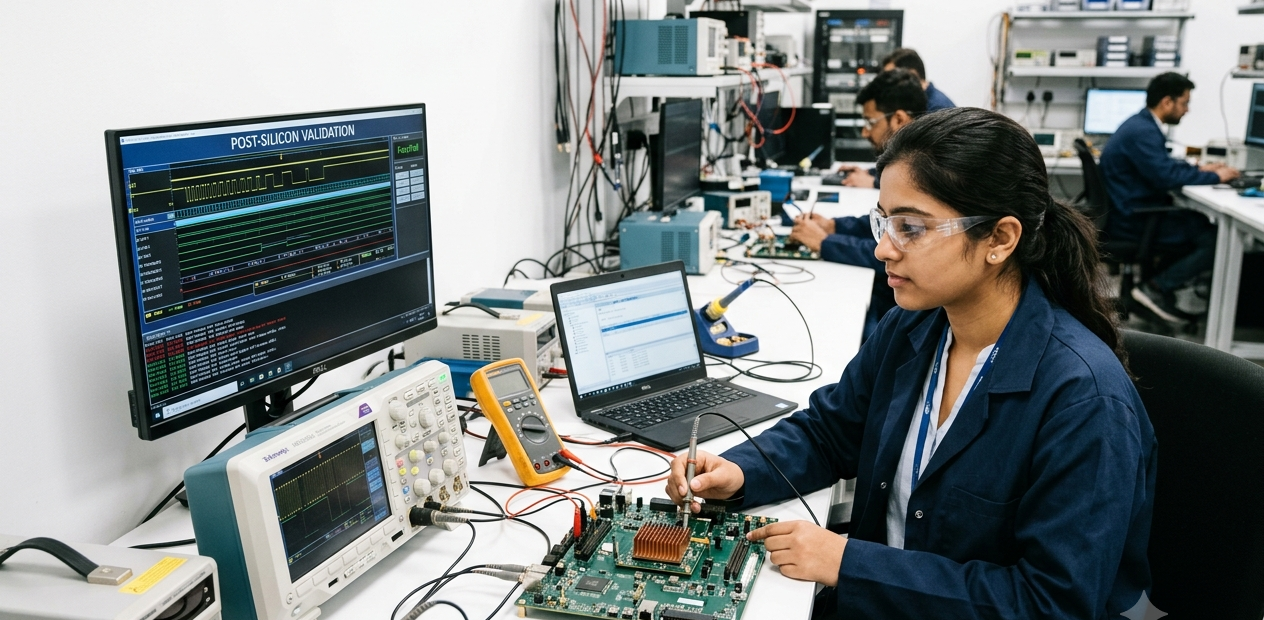
Sitting right at the intersection of hardware engineering, low-level programming, and detective-style system debugging, this career offers exceptional growth as complex System-on-Chips (SoCs) power modern computing platforms. Post-silicon validation engineers bring first-instance silicon to life in the laboratory, systematically stress-testing every IP block under real operating conditions. If you enjoy hands-on troubleshooting and hardware-software co-design, this step-by-step roadmap details everything required to build a career in the field.
1. Core Educational Foundations & Essential Technical Mindset
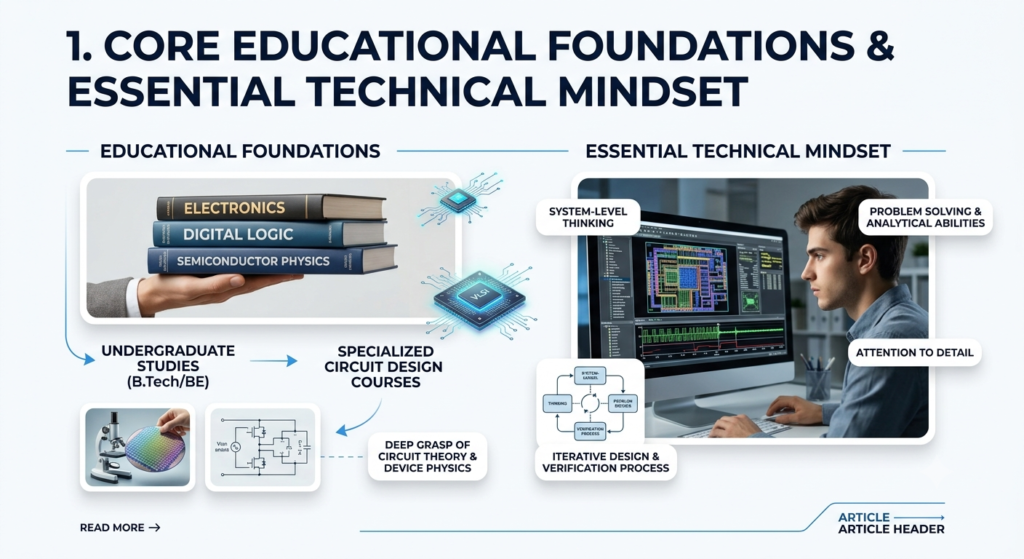
To excel as a post-silicon validation engineer, you need a strong background in Electrical Engineering, Computer Engineering, or Electronics & Communication. The foundation of this role requires a solid understanding of computer architecture, modern SoC structures, and digital logic design. You must understand how memory hierarchies (caches, DRAM) interact with processor cores, bus protocols (PCIe, AMBA, AXI), and system clock management. Beyond foundational hardware concepts, developing a systematic root-cause debugging mindset is essential; when a physical chip fails on the lab bench, a successful engineer must methodically isolate whether the issue stems from silicon logic, board design, power delivery, or low-level software.
2. Mastering the Technical Skill Set: Hardware, Firmware, and Software
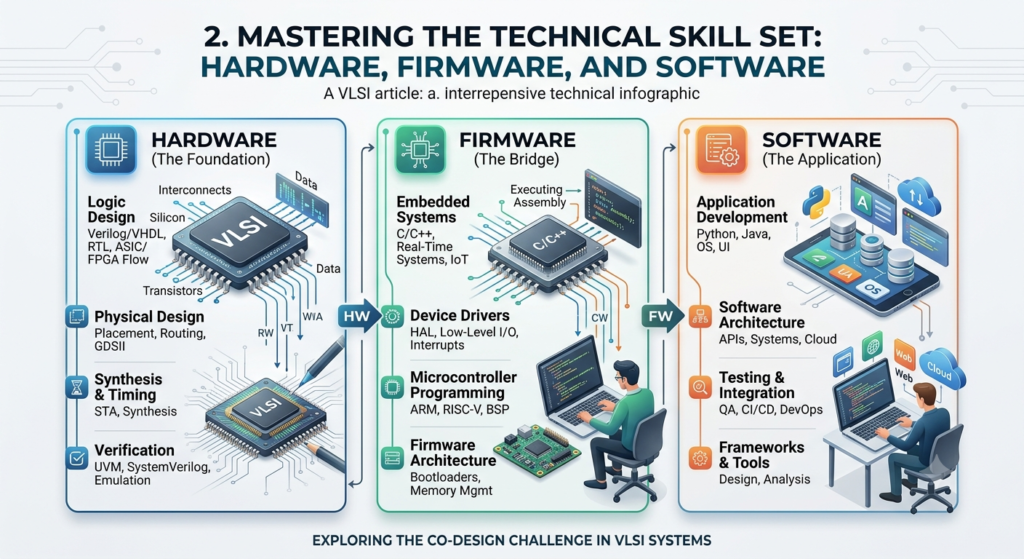
Post-silicon validation requires a balanced technical skill set spanning both hardware instruments and low-level code:
- Embedded Software & Firmware: Proficiency in bare-metal C and C++ is necessary to write direct hardware-driver tests, configure registers, and execute validation suites without relying on full operating systems.
- Test Automation & Scripting: Python or Perl skills are vital for building scalable test suites, automating data acquisition from lab instruments, and parsing large-scale execution logs across hundreds of regression runs.
- Lab Instrumentation & Hardware Tools: Hands-on experience with diagnostic equipment—such as high-speed oscilloscopes, logic analyzers, protocol analyzers, and JTAG/SWD debuggers—is required to measure real-world signals, trace bus states, and inspect hardware registers.
Read More: Post Silicon Validation vs Pre-Silicon Validation: Which Career Path Is Better?
3. Understanding the Validation Lifecycle: From Silicon Bring-Up to PVT Testing
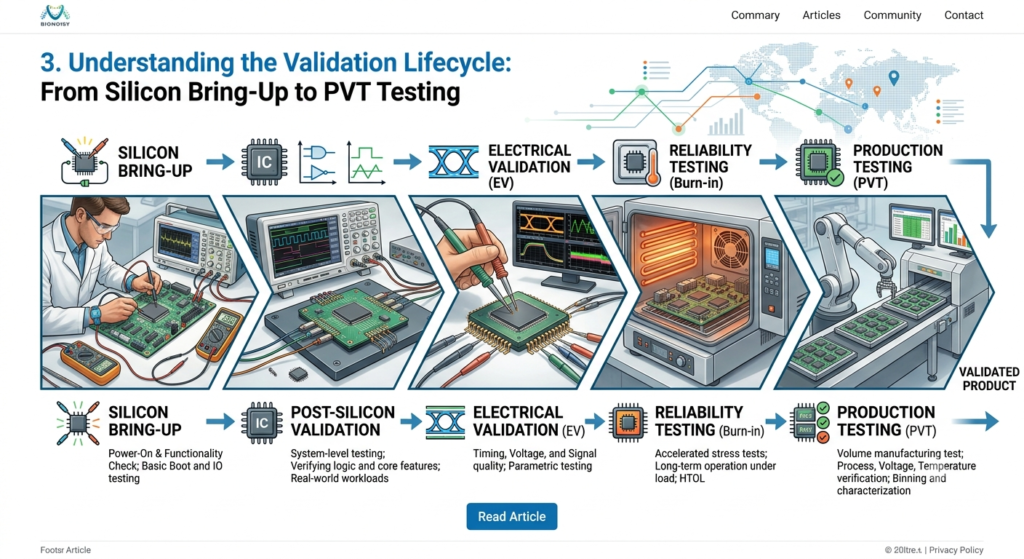
The validation journey follows a structured progression once physical wafers return from the foundry:
- First-Silicon Bring-Up: The initial phase involves carefully powering on the board, verifying power rails, locking PLL clocks, establishing JTAG communication, and loading the bootloader.
- Functional & Interface Validation: Engineers run targeted tests to verify peripherals and high-speed communication interfaces like USB, PCIe, MIPI, and Ethernet against strict protocol specifications.
- PVT (Process, Voltage, Temperature) Characterization: To ensure stability under extreme operating environments, validation engineers test silicon across varying voltage corners, clock frequencies, and thermal chambers to establish operating safety margins.
4. Gaining Practical Experience: Prototyping, Lab Projects, and Portfolios
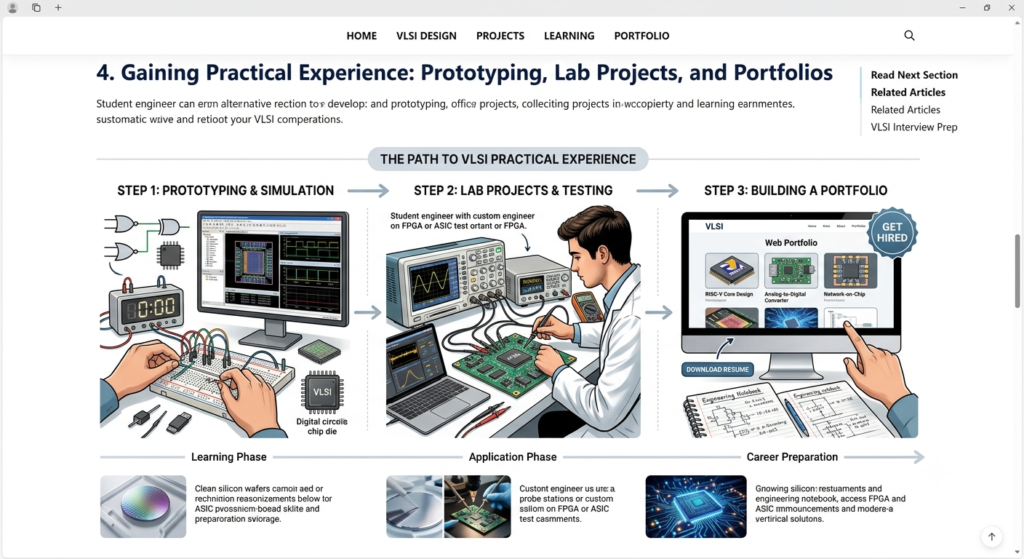
Transitioning from theory to entry-level employment requires hands-on demonstration of your debugging workflow. Working with development boards—such as ARM Cortex-M microcontrollers, RISC-V targets, or Xilinx/Intel FPGA development kits—lets you practice writing low-level drivers and configuring internal registers. Build a portfolio that demonstrates real bring-up or debug projects; for example, write a Python script that controls a digital multimeter to measure power rails while running heavy C-based workloads on a microcontroller board. Documenting how you reproduced an issue, isolated its root cause using a logic analyzer, and fixed it provides concrete proof of your capabilities to potential recruiters.
5. Career Roadmap, Job Titles, and Industry Pathways
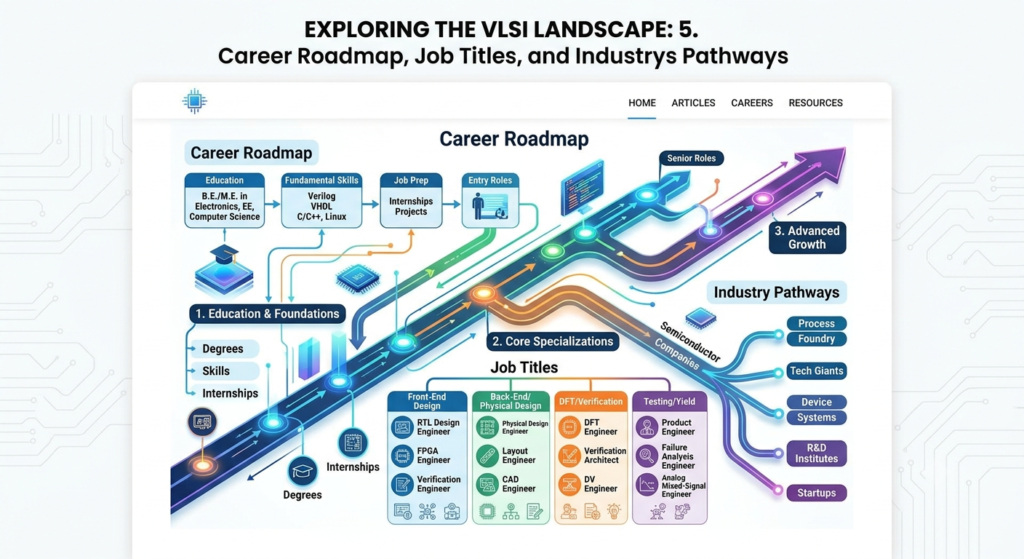
The career path typically starts with roles like Junior Validation Engineer, Hardware Debug Engineer, or Silicon Bring-Up Intern. Within two to four years, engineers usually transition into owning full SoC subsystem validation (such as power management, memory controllers, or high-speed IO). Senior career trajectories branch into Post-Silicon Validation Architecture, where you design company-wide validation strategies and test platforms, or specialization in System Debug & Characterization. As demand grows across AI accelerators, automotive SoCs, and edge computing, validation engineers remain highly sought-after across major fabless semiconductor firms, integrated device manufacturers (IDMs), and design services companies.
1. What is the main difference between pre-silicon verification and post-silicon validation?
Pre-silicon verification tests chip designs virtually using software simulation tools (like VCS or Questa) and formal methods before manufacturing. Post-silicon validation tests physical, manufactured silicon chips on real evaluation boards in a laboratory setting to verify real-world functionality, power, and performance.
2. Is coding required for a post-silicon validation engineer?
Yes, strong coding skills are essential. Post-silicon validation engineers write bare-metal C/C++ code to exercise hardware registers directly and use Python scripts extensively to automate laboratory test setups and analyze test results
3. What hardware tools do post-silicon validation engineers use daily?
Common lab instruments include high-speed oscilloscopes (for signal integrity), logic analyzers (for bus state tracing), protocol analyzers (for PCIe, USB, or MIPI conformance), multimeters, thermal chambers, and JTAG debuggers for on-chip diagnostics.
4. Can an entry-level engineer start directly in post-silicon validation?
Yes. Graduates with degrees in Electrical or Computer Engineering who possess hands-on lab experience, embedded C skills, Python scripting ability, and a strong grasp of digital design concepts can secure entry-level or internship roles in post-silicon validation.
5. How long does the post-silicon bring-up phase typically take?
Initial silicon bring-up—getting the chip to power on, lock clocks, and boot basic software—can take anywhere from a few days to a few weeks. However, complete functional validation and PVT characterization across all corners usually spans several months.
6. Why is Python so important in post-silicon validation?
Python is the industry standard for test automation. It enables engineers to write scripts that automatically control laboratory hardware instruments, send execution commands to test boards, execute thousands of automated regression runs overnight, and parse raw data files into clear coverage reports.
7. How do post-silicon validation engineers debug silicon failures?
Engineers follow a systematic process: they reproduce the bug consistently, isolate whether the fault is software or hardware, capture signal waveforms or trace logs using lab tools/JTAG, formulate hypotheses, test potential firmware or register workarounds, and collaborate with the design team to document or resolve the issue.