
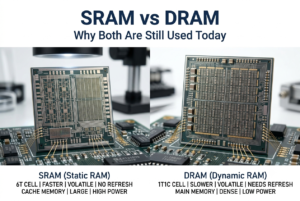


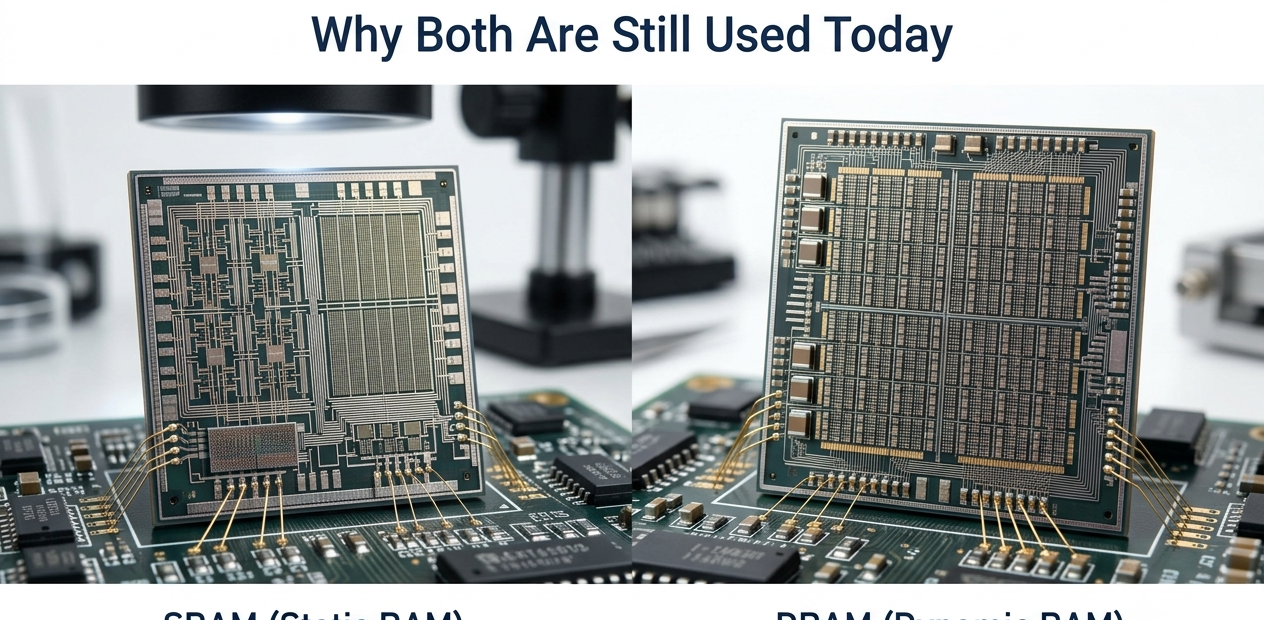
SRAM vs DRAM: Why Both Are Still Used Today

Every time you open an app, stream a video, or run an AI model, two very different memory technologies are quietly working behind the scenes. One is blisteringly fast but expensive to build. The other is slower but can hold enormous amounts of data at a fraction of the cost. Neither one has managed to push the other out, and heading through 2026, that balance is more relevant than ever.
SRAM and DRAM have shared space inside computer chips for more than five decades, and instead of one quietly fading out, both are getting fresh attention right now. Chipmakers building AI hardware are rethinking how much fast memory to place directly on a chip, while DRAM manufacturers are racing to keep pace with data center demand. Here’s why both memory types are still doing heavy lifting today.
1. The Core Difference: How They Actually Store Data
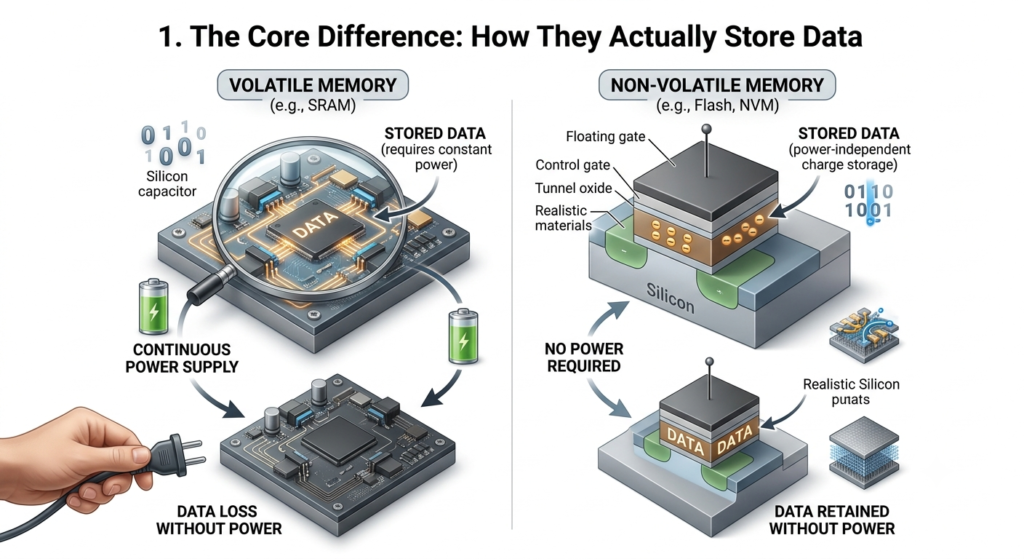
The split between SRAM and DRAM comes down to how each one holds onto a single bit of information. SRAM (Static RAM) stores data using a small loop of transistors arranged as a latch — usually six of them per memory cell. As long as power flows to the circuit, the data stays put, with no extra effort needed. That’s where the word “static” comes from.
DRAM (Dynamic RAM) takes a completely different approach. It stores each bit as a tiny electrical charge on a capacitor, paired with a single transistor that acts as a switch. Capacitors are simple and small, but they leak charge over time, so DRAM needs to be refreshed thousands of times a second to keep from losing data. That refresh cycle is the trade-off DRAM accepts in exchange for packing far more storage into the same physical space.
2. Speed vs Cost: The Trade-off That Never Goes Away
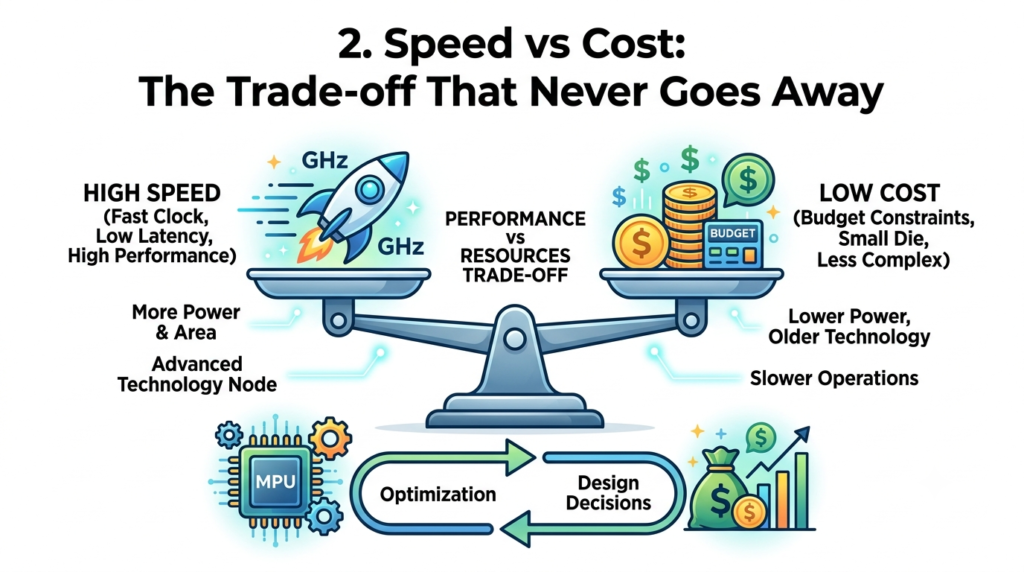
SRAM’s simplicity in operation comes at a cost in silicon area. A six-transistor cell simply takes up more room than a capacitor-transistor pair, which means SRAM can require five to ten times more chip area to store the same amount of data as DRAM. That translates directly into price: SRAM is considerably more expensive per bit.
What you get in return is speed. SRAM doesn’t need refresh cycles or complex timing, so it can be accessed almost instantly, with none of the latency that comes from DRAM’s read-write-precharge cycle. DRAM, meanwhile, wins on raw capacity and cost efficiency, which is exactly why a laptop can ship with many gigabytes of DRAM but only a few megabytes of on-chip SRAM. This isn’t a flaw in either technology — it’s a deliberate trade-off that engineers lean on depending on what a system actually needs.
Power consumption follows a similar pattern, though it’s less intuitive. SRAM draws very little power when it’s sitting idle, since there’s no refresh activity happening in the background. But the moment it’s active and switching states rapidly, it can draw more current than people expect. DRAM tends to consume more power overall because of constant refresh cycles, yet at the system level, its low cost per gigabyte usually makes it the practical choice for anything that needs large amounts of storage without draining a budget.
3. Where You’ll Actually Find Them

This trade-off explains why the two memories end up in completely different roles inside the same device. SRAM sits closest to the processor, forming the L1, L2, and often L3 cache layers that hold the data a CPU is about to use. Because it has to keep pace with the processor’s clock, speed matters far more here than capacity.
DRAM, on the other hand, serves as main system memory — the RAM modules in a PC, the memory chips in a smartphone, or the working memory in a server. It holds the much larger pool of data and instructions that don’t need to be accessed instantly but do need to be available quickly when called upon. Beyond computers, SRAM also shows up in registers, small buffers, and low-power embedded devices such as sensors, appliances, and industrial controllers, where its low power draw and simplicity outweigh its cost at small scale.
4. The 2026 Twist: AI Hardware Is Rewriting the Rules
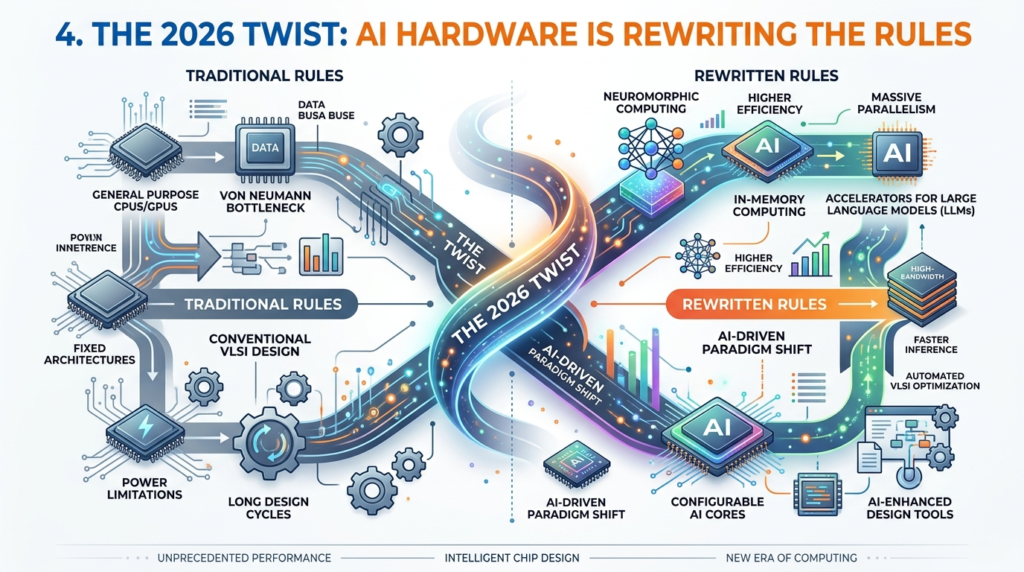
What’s changed recently is how much SRAM some chipmakers are willing to use. AI inference workloads depend heavily on fast access to model weights and intermediate results, and moving that data back and forth from external memory costs both time and power. In response, some newer AI accelerator designs are placing unusually large blocks of SRAM directly on the chip itself, cutting down on data movement instead of relying purely on external high-bandwidth memory stacks.
This shift has been visible across recent industry events, where several AI chip companies have discussed SRAM-centric architectures as an alternative to the GPU-plus-external-memory model that has dominated AI data centers. Some inference-focused chip designers have gone further, treating large pools of on-chip SRAM as a form of main memory rather than just a cache layer, specifically to deal with the huge intermediate data that language models generate while processing a request. Even so, most experts don’t expect SRAM to replace high-bandwidth DRAM technology outright — the two still serve different purposes, with SRAM handling the fastest, most latency-sensitive data and DRAM-based memory carrying the bulk of it.
At the same time, demand for AI memory has become so intense that a broader supply squeeze on DRAM has pushed prices up across laptops, phones, and tablets. Memory manufacturers have been redirecting a growing share of their production capacity toward AI-focused memory, leaving less available for everyday consumer devices, and some industry voices expect that imbalance to persist for several more years rather than resolve quickly.
5. What’s Coming Next: New Memory Tiers

Rather than one technology winning out, the industry seems to be settling into more layers of memory, each tuned for a specific job. Memory makers have been showcasing concepts that sit between ultra-fast stacked memory and high-capacity storage, aiming to combine large capacity with bandwidth closer to what DRAM offers. Packaging techniques that stack memory dies vertically are also improving how efficiently heat and power are managed as these systems get denser.
For everyday devices, this likely means more DRAM tucked closer to processors and smarter cache hierarchies designed to squeeze more performance out of existing SRAM budgets. For large-scale computing, it means memory architecture is becoming as important a design decision as the processor itself, rather than an afterthought bolted on at the end.
Conclusion
SRAM and DRAM aren’t competing for the same job — they’re solving two different problems that both matter. SRAM gives you speed where every nanosecond counts, and DRAM gives you the capacity to hold everything else affordably. That division of labor has held up for decades, and if anything, the demands of AI workloads are making it more relevant, not less. As long as computing keeps needing both instant access and massive storage, SRAM and DRAM will keep working side by side, each doing what the other simply isn’t built for.
1. What is the difference between SRAM and DRAM?
SRAM is faster and does not need constant refreshing, while DRAM is slower but cheaper and denser. SRAM is used for cache memory, while DRAM is widely used as main memory.
2. Why are both SRAM and DRAM still used today?
SRAM offers high speed and low latency, while DRAM provides greater capacity at a lower cost. Their different strengths make both essential in modern computing systems.
3. Which is faster, SRAM or DRAM?
SRAM is faster than DRAM because it uses flip-flop-based memory cells and does not require periodic refreshing, making it ideal for CPU cache and high-speed applications.
4. Why is DRAM cheaper than SRAM?
DRAM uses fewer transistors per memory cell than SRAM, allowing more bits to be stored on a chip. This makes DRAM more cost-effective for large-capacity memory.
5. Where is SRAM used?
SRAM is mainly used in CPU caches, microcontrollers, networking devices, and other applications where fast data access and low latency are important.