



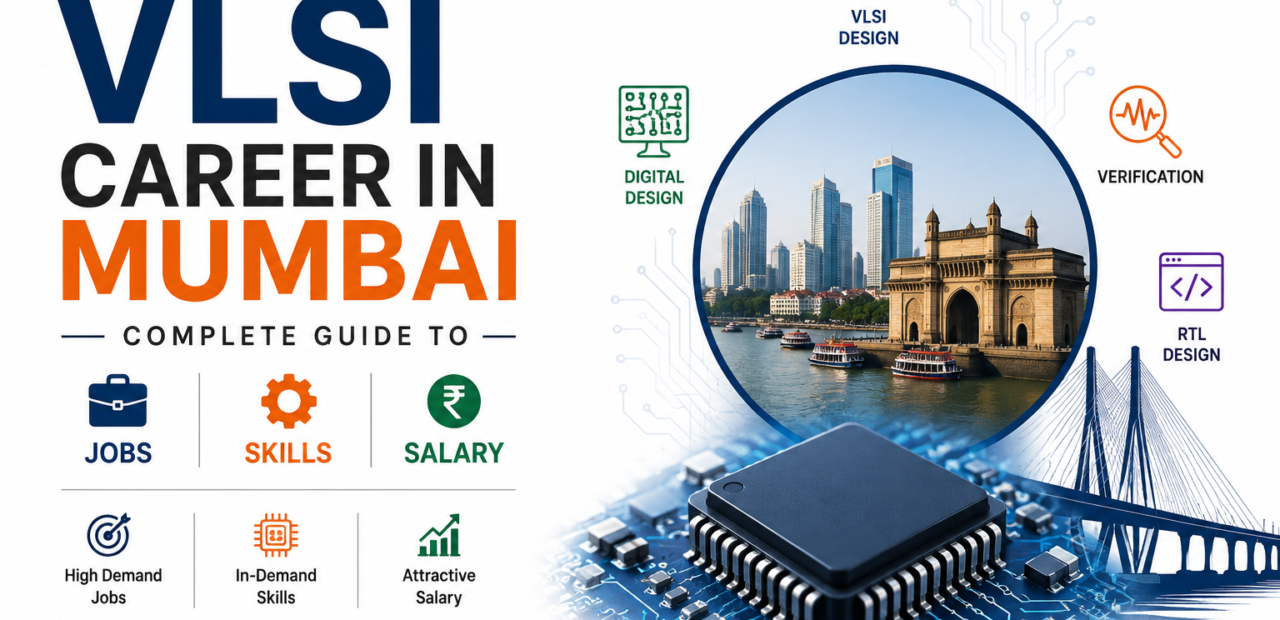
VLSI Career in Mumbai: Complete Guide to Jobs, Skills, and Salary

Mumbai has always run on finance, films, and trade — but a quieter industry is now taking root at its edges. In Taloja, near Panvel, a ten-billion-dollar chip fabrication plant is rising, backed by Tower Semiconductor and the Adani Group. It’s a sign that Mumbai is stepping into India’s VLSI story in a way it never has before.
For anyone eyeing a career in chip design or verification, this shift matters. Jobs that once meant relocating to Bangalore or Hyderabad are opening closer to home, across design offices, R&D centers, and manufacturing units coming up around the city. This guide breaks down what a VLSI career in Mumbai actually looks like — the opportunity, the skills, and the money.
Why Mumbai Is Turning Into a Semiconductor Hotspot

For years, VLSI in India was synonymous with Bangalore and Hyderabad. Mumbai and its surrounding belt were seen as finance and media territory, not chip territory. That picture is changing fast. The Maharashtra government approved a $10 billion semiconductor fabrication project with Tower Semiconductor and Adani Group, planned for Taloja in Panvel, with an initial wafer capacity of 40,000 units per month. Not far away, in Mahape, Navi Mumbai, the RRP Group has already set up the state’s first semiconductor OSAT (packaging and testing) plant, part of a two-phase investment running into thousands of crores.
These aren’t isolated announcements. The state cabinet has cleared over ₹1.35 lakh crore in high-tech and industrial investments aimed at creating roughly a lakh jobs, and the central government’s India Semiconductor Mission 2.0, backed by a fresh Union Budget outlay, is pushing design, equipment, and packaging capacity across the country. Mumbai and its metropolitan region are increasingly part of that map, not on the sidelines of it.
Building the Right Foundation: VLSI Course Options in Mumbai for Freshers
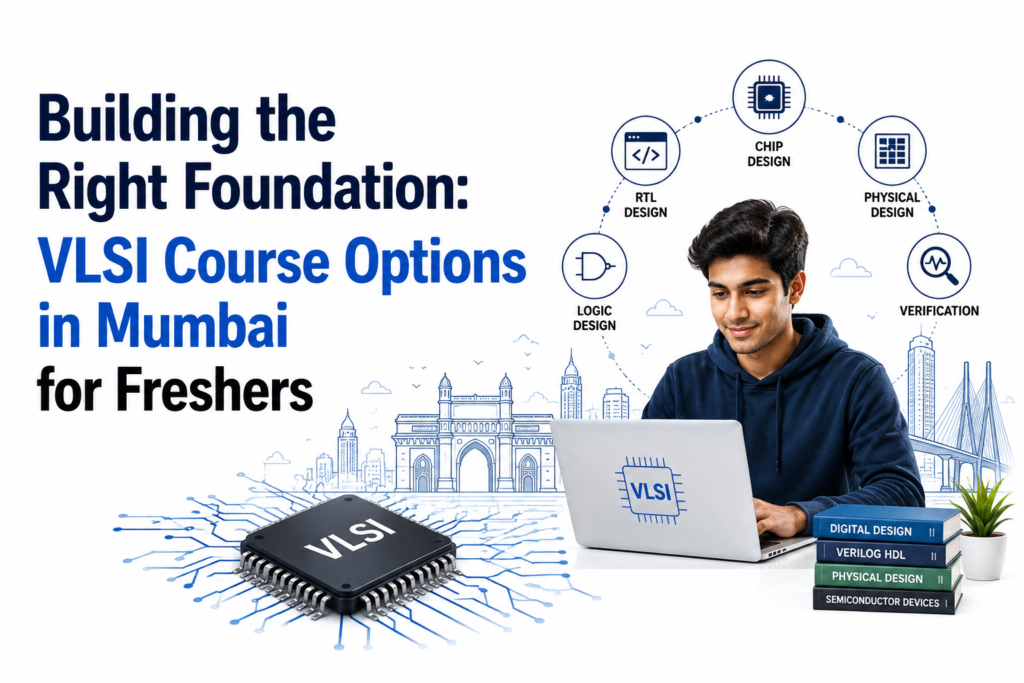
If you’re starting out, the first real decision is how you build your base. A good VLSI course in Mumbai for freshers should go beyond theory and get you comfortable writing and debugging code that actually simulates and synthesizes correctly. Look for a curriculum covering Verilog or VHDL, digital logic design, basic computer architecture, and enough exposure to industry-standard EDA tools that you’re not seeing them for the first time in an interview.
Institutions like IIT Bombay run advanced programs and research work that feed talent into the wider ecosystem, while several private training centers across the city and Navi Mumbai offer shorter, more hands-on certification tracks focused on RTL design, verification basics, or physical design fundamentals. Whichever path you choose, prioritize courses with real lab work and small projects over ones that are purely lecture-based — a working project you can explain in detail carries far more weight with a hiring panel than a certificate alone.
Core Skills That Get You Hired in VLSI
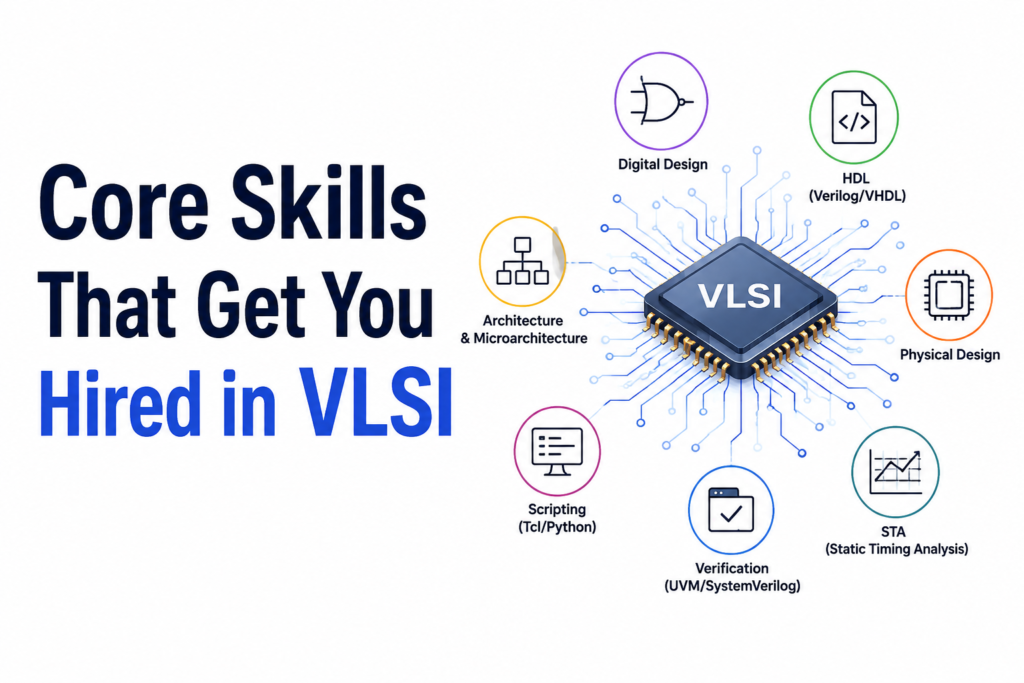
Course completion opens the door; skill depth is what gets you through it. At the entry level, strong command over Verilog or SystemVerilog and a genuine understanding of RTL design concepts — timing, synchronous versus asynchronous logic, finite state machines — separates candidates who can only recite definitions from those who can actually design.
Verification is one of the fastest-growing tracks right now, and familiarity with UVM (Universal Verification Methodology) along with a logical, patient approach to debugging testbenches is highly valued. On the backend side, physical design roles look for exposure to floorplanning, place-and-route, and static timing analysis (STA), typically using tools from Synopsys or Cadence. Design-for-Test (DFT) is another specialization worth knowing, since every chip that gets manufactured needs a testing strategy built in from the start.
Beyond the technical stack, the soft skills matter more than people expect: clear documentation habits, comfort working through long debug cycles without losing focus, and the ability to explain a design decision to someone outside your immediate team. Chip design is collaborative and iterative, and engineers who communicate well tend to move up faster than those who simply write good code.
Semiconductor Companies Hiring in Mumbai Right Now

The list of semiconductor companies hiring in Mumbai is shorter than Bangalore’s, but it’s growing and it’s real. The Tower Semiconductor–Adani fabrication unit in Taloja and the RRP Group’s OSAT facility in Mahape are creating direct openings in process engineering, quality, packaging, and testing as construction and hiring ramp up. Around these anchor projects, a supporting ecosystem of equipment vendors, materials suppliers, and contract engineering firms is starting to establish a local presence, which typically brings design-support and applications-engineering roles with it.
It’s also worth knowing that many Mumbai-based engineers work for design and verification teams headquartered in Bangalore, Hyderabad, or overseas, through hybrid arrangements or satellite offices. EDA companies and IP vendors often maintain small applications or sales-engineering teams in Mumbai to support customers across Western India, and these can be a practical entry point if you’re not ready to relocate. Keeping an eye on job boards, company career pages, and the India Semiconductor Mission’s investor updates is a reliable way to track new openings as they’re announced.
How to Get VLSI Jobs in Mumbai (and What Salary to Expect)
Figuring out how to get VLSI jobs in Mumbai comes down to combining the right foundation with visibility. Start by building a portfolio that shows actual work — a small RTL project, a verification testbench, or a physical design flow you’ve run end to end, even on open-source tools. Recruiters in this space respond far more to demonstrated work than to a long list of course names.
Apply directly to the fabrication and OSAT units mentioned above, since new plants typically hire in waves as construction milestones are reached. In parallel, use LinkedIn and niche job boards to track openings at design houses and applications-engineering teams with a Mumbai footprint, and don’t underestimate referrals — the VLSI community in India is close-knit, and a warm introduction from someone who has worked in the field often carries more weight than a cold application.
On compensation, entry-level roles in VLSI design or verification in Mumbai typically start in a similar range to other Indian tech hubs, since salaries in this field are driven more by skill and specialization than by city. Engineers with two to five years of experience in RTL design, verification, or physical design see a noticeable jump, particularly if they’ve worked on a chip that actually taped out. Senior engineers and those moving into architecture or lead verification roles command significantly higher packages, and specialization in areas like DFT or advanced-node physical design tends to command a premium almost everywhere in India, Mumbai included.
Mumbai’s VLSI story is still being written, but the direction is clear. With fabrication and packaging plants under construction, state-level investment flowing in, and a national semiconductor push backing it all, the city is no longer a place you leave to build a chip career — it’s becoming a place where you can start one.
1. Is VLSI a good career in Mumbai?
Yes. Mumbai offers growing opportunities in semiconductor design, embedded systems, verification, and electronics, making VLSI a promising career.
2. What is the salary for VLSI freshers in Mumbai?
VLSI fresher salaries in Mumbai vary by skills, role, company, and experience. Strong RTL, verification, or physical design skills can improve packages.
3. What skills are required for VLSI jobs in Mumbai?
Key VLSI skills include digital electronics, Verilog, SystemVerilog, Linux, scripting, RTL design, verification, physical design, and EDA tools.
4. Can freshers get VLSI jobs in Mumbai?
Yes. ECE, EEE, and electronics freshers can apply for VLSI jobs in Mumbai by building strong fundamentals, practical projects, and relevant tool skills.
5. Which VLSI jobs are available in Mumbai?
Common roles include RTL Design Engineer, Verification Engineer, Physical Design Engineer, DFT Engineer, Analog Layout Engineer, and VLSI Trainee.