

Electronics & Semiconductor Assembly Robotics Market Expected to Reach $17 Billion by 2036

Picture a factory floor where a robotic arm places a chip smaller than a grain of rice onto a circuit board, thousands of times an hour, without ever missing its mark. That scene is no longer a preview of the future — it’s the daily reality inside electronics plants today, and it’s about to scale up in a very big way.
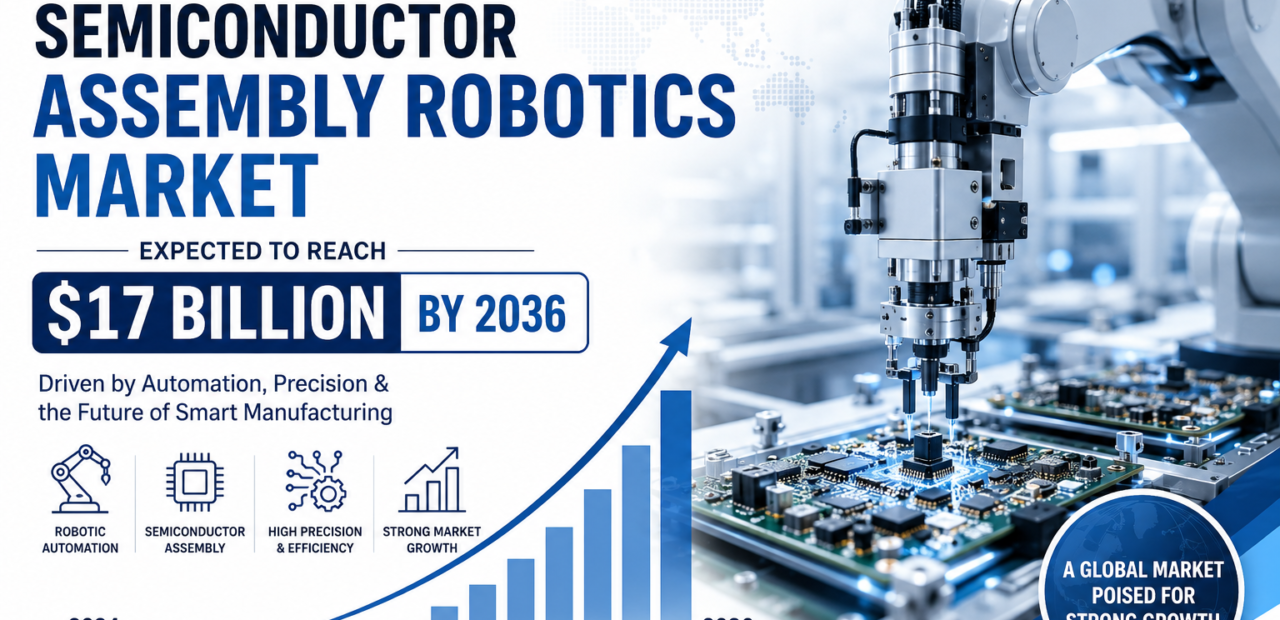
According to new industry projections, the global Electronics & Semiconductor Assembly Robotics Market is set to grow from around $6.6 billion in 2026 to roughly $17.1 billion by 2036. That works out to a steady 10% annual growth rate over the next decade, translating into an incremental market opportunity of more than $10 billion. Behind these numbers lies a manufacturing world being quietly rebuilt around precision, speed, and automation.
Why This Market Is Accelerating Right Now

For years, assembly robotics has been part of electronics manufacturing, but it stayed largely in the background — useful, but not urgent. That has changed. Chips have grown smaller and more densely packed, while devices like smartphones, wearables, and AI accelerators demand ever-tighter tolerances that human hands simply cannot match at scale.
At the same time, semiconductor fabrication plants are expanding aggressively across the world to meet demand for advanced processors, memory, and AI-focused silicon. Every new fab or expansion project needs assembly lines that can operate around the clock with minimal error rates. Add in the electric vehicle boom, which requires robust power electronics and sensor assemblies, and you get a manufacturing environment where robotics isn’t optional anymore — it’s foundational. Smart factory initiatives and Industry 4.0 investment cycles are reinforcing this shift, pushing companies to replace older, semi-manual lines with fully automated, data-connected assembly cells.
SMT Placement Systems Are Leading the Way
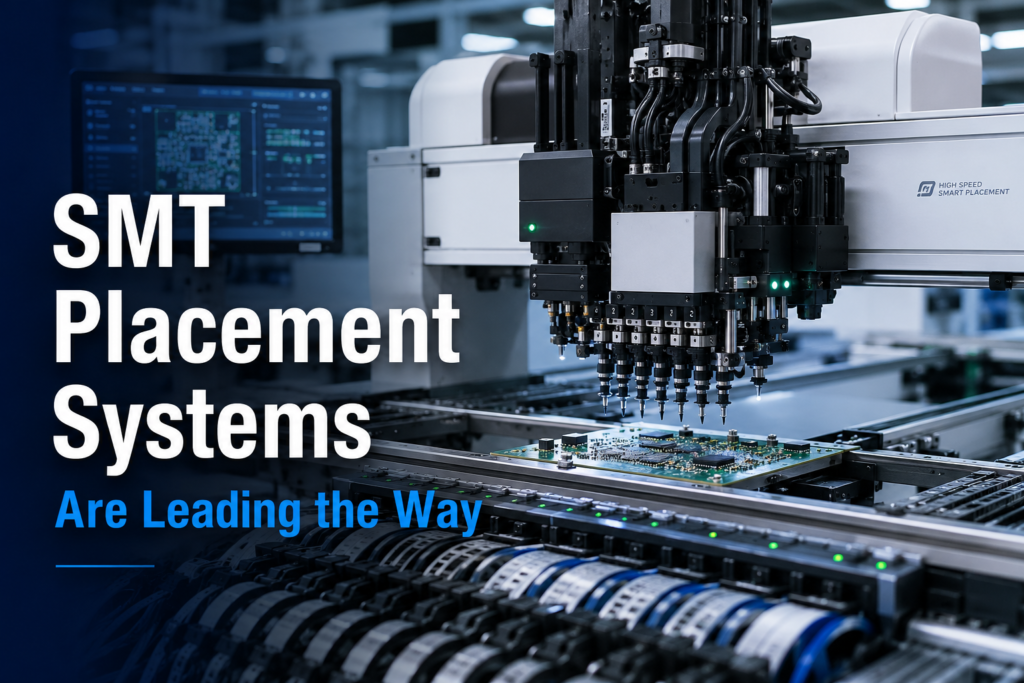
Not all assembly robots play the same role, and one category stands out clearly in current market data: Surface Mount Technology (SMT) placement systems. These machines are responsible for picking up tiny electronic components and placing them precisely onto printed circuit boards, and they currently account for close to 38% of the overall market.
This dominance makes intuitive sense. As circuit boards pack in more components at smaller sizes, placement accuracy becomes the single biggest bottleneck in production speed and yield. A single misplaced component can mean a defective board, wasted materials, and costly rework. SMT systems solve this by combining high-speed robotic placement with vision-guided accuracy, allowing manufacturers to keep pace with shrinking component sizes without sacrificing throughput. On the component side, hardware itself — the robotic arms, sensors, and placement heads — makes up about two-thirds of total market value, underlining how much of this growth is tied to physical manufacturing equipment rather than software alone.
The Regional Picture: Where the Growth Is Concentrated

Geography plays a major role in how this market is unfolding. Asia Pacific continues to anchor global semiconductor and electronics production, home to the world’s largest fabrication hubs and contract manufacturers. Countries with deep-rooted chip manufacturing ecosystems keep expanding capacity, and each expansion cycle brings a fresh wave of demand for assembly robotics.
North America and parts of Europe are also seeing renewed investment, partly driven by efforts to build more resilient, geographically diversified supply chains after years of disruption. Government-backed incentives for domestic chip production, combined with private investment in EV and AI hardware manufacturing, are encouraging companies to build new automated assembly lines closer to home rather than relying solely on offshore production. This diversification doesn’t shrink the Asia Pacific advantage, but it does mean the next decade of growth will be spread across more regions than the last one was.
What This Means for the Road Ahead
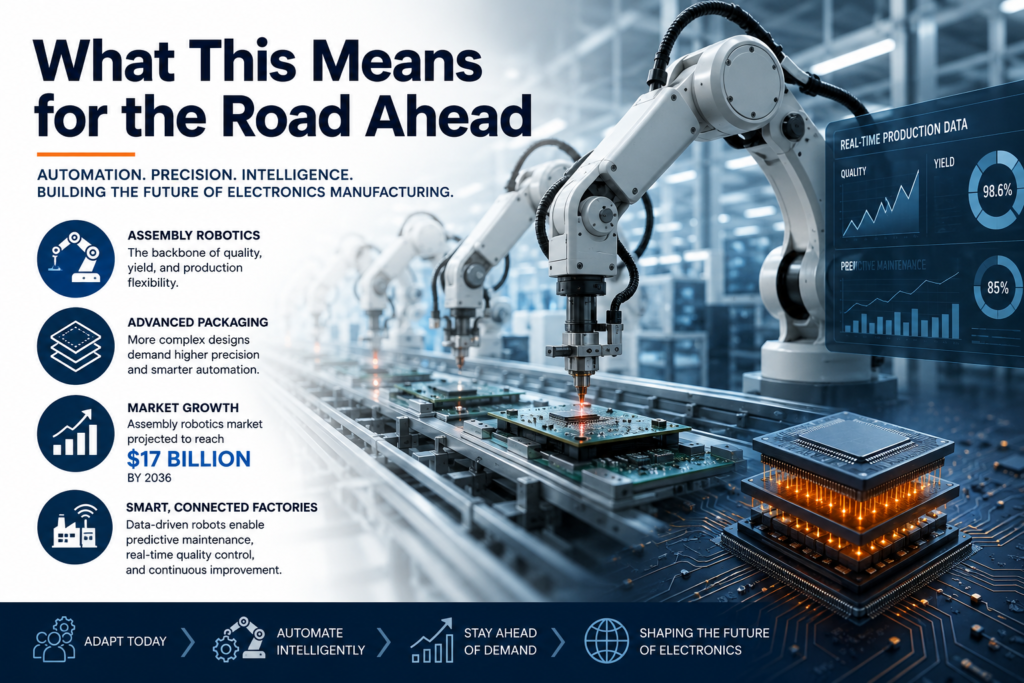
Looking beyond the raw numbers, this market’s growth tells a broader story about where electronics manufacturing is headed. Assembly robotics is no longer just about replacing manual labor — it’s becoming the backbone of quality control, yield improvement, and production flexibility. As chip designs move toward more advanced packaging techniques, including stacking multiple layers of silicon into a single compact unit, the precision demands on assembly equipment will only increase.
Manufacturers that invest early in flexible, upgradeable robotic systems will likely have an edge, since production requirements are shifting quickly alongside chip design trends. Meanwhile, the push toward smart, connected factories means these robots increasingly generate data that feeds back into production planning, predictive maintenance, and quality assurance — turning assembly lines into continuously improving systems rather than static ones.
For anyone tracking the semiconductor and electronics manufacturing space, this projected growth to $17 billion by 2036 isn’t just a market forecast — it’s a signal of how deeply automation is becoming embedded in the way the world builds its chips and devices. The companies that adapt to this shift early, whether by upgrading their production lines or rethinking how automation fits into their broader manufacturing strategy, are the ones best positioned to keep up as demand for smaller, faster, and more reliable electronics keeps climbing.