



MOSFET vs Transistor: Key Differences, Working, Advantages & Applications

In electronic engineering, choosing the right semiconductor switch dictates your circuit’s speed, thermal performance, and overall power efficiency. While the term “transistor” broadly encompasses several semiconductor components, engineers most frequently compare traditional Bipolar Junction Transistors (BJTs) with modern Metal-Oxide-Semiconductor Field-Effect Transistors (MOSFETs). Understanding how these two components differ in operational physics and drive mechanics is essential for building scalable hardware.
Comparing a standard BJT transistor to a MOSFET highlights a classic engineering trade-off: current control versus voltage control. Traditional BJTs depend on continuous base current to stay conducting, which adds driver complexity and constant power draw. MOSFETs, by comparison, operate as field-effect devices using an insulated oxide gate. This fundamental distinction makes MOSFETs the standard for high-frequency switching, power conversion, and digital logic.
MOSFET vs. Transistor (BJT): Technical Comparison
| Parameter / Feature | Bipolar Junction Transistor (BJT) | Metal-Oxide-Semiconductor FET (MOSFET) |
| Terminals | Base, Collector, Emitter | Gate, Drain, Source |
| Charge Carriers | Bipolar (Both Electrons & Holes) | Unipolar (Majority Carriers Only) |
| Switching Speed | Moderate to Slow (Limited by storage time) | Very Fast (Nanoseconds switching capability) |
| Static Power Dissipation | Higher (Requires continuous base current) | Negligible (Gate current is minimal) |
| Thermal Coefficient | Negative (Prone to thermal runaway) | Positive (Self-limiting, safe in parallel) |
1. Structural and Operational Principles
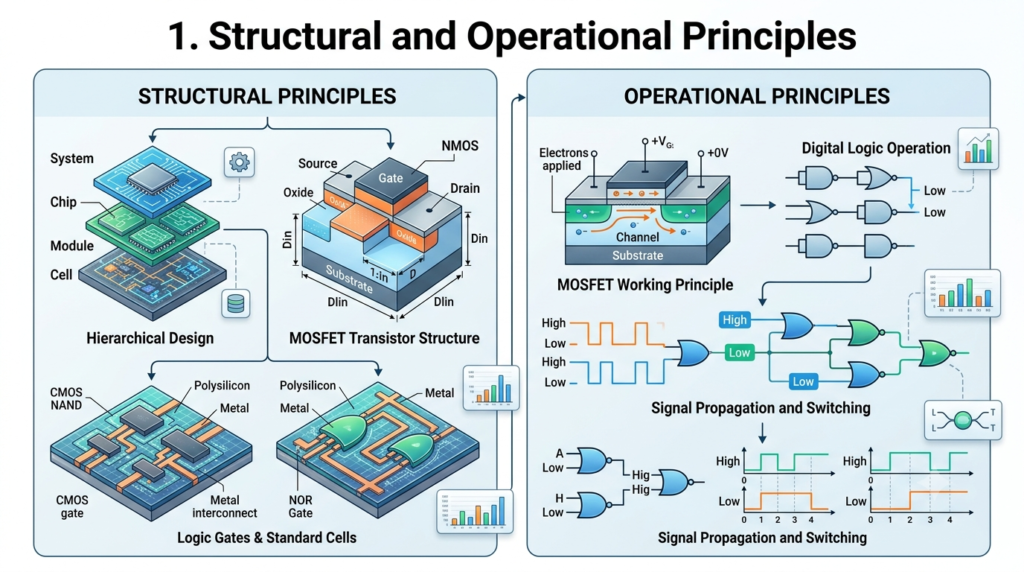
The internal physics of a classic Bipolar Junction Transistor (BJT) rely on both majority and minority charge carriers—electrons and holes—moving across two physical P-N junctions. Terminals called the Base, Collector, and Emitter regulate this flow. Injecting a small base current directly dictates the larger current flowing between collector and emitter. Because physical current must pass through the control terminal, BJTs exhibit lower input impedance and experience thermal runaway risks if current flow scales unchecked.
MOSFETs operate using a unipolar construction that depends exclusively on majority carriers moving through a semiconductor channel. Featuring Gate, Drain, and Source terminals, the gate is electrically isolated from the main conductive channel by an extremely thin silicon dioxide layer. Applying voltage to the gate creates an electrostatic field that creates or closes this channel. This insulated design gives MOSFETs extremely high input impedance and virtually eliminates static gate drive current.
2. Current Control vs. Voltage Control Mechanics

A BJT functions fundamentally as a current-controlled current source. To keep a BJT turned on in saturation mode, driver circuits must supply a continuous current into the base terminal. The ratio between collector current and base current defines the transistor’s current gain ($h_{FE}$). While BJTs offer consistent forward voltage drops in low-power linear applications, supplying this continuous base drive incurs permanent power losses that compound in high-current circuits.
MOSFETs function as voltage-controlled current devices. Instead of requiring continuous current flow, a MOSFET only needs a differential threshold voltage ($V_{GS}$) applied across its gate and source terminals to modulate current flow. Current only flows into the gate momentarily to charge the parasitic gate capacitance during transitions. Once charged, static power consumption drops to near zero, making MOSFETs far easier to drive directly from low-power microcontroller output pins.
Read More: Beginner Guide to DC Circuits for Students and Beginners
3. MOSFET vs Transistor: Key Differences
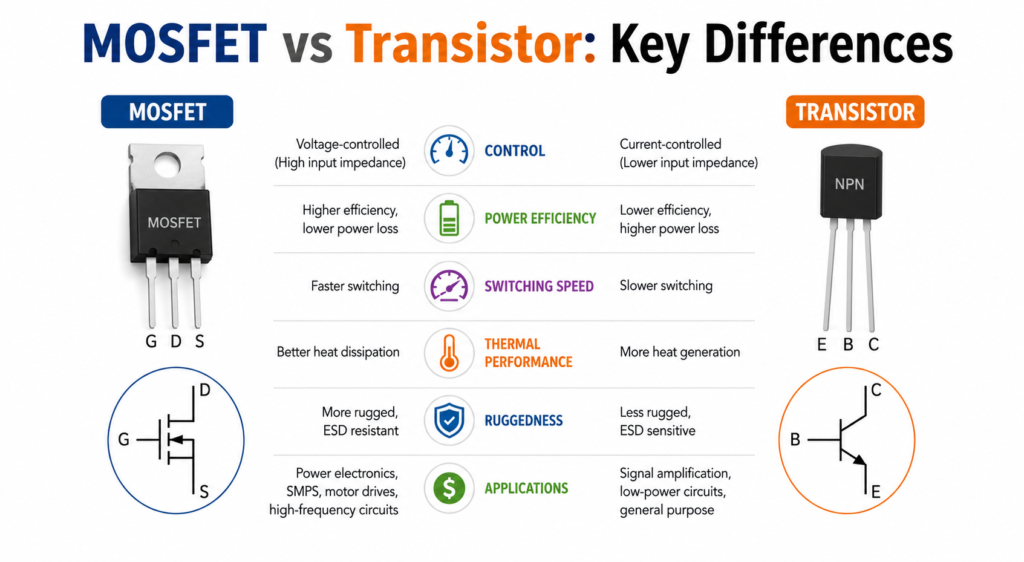
While both components ultimately do the same job — controlling current flow — the mechanism, efficiency, and ideal use cases differ quite a bit. Here’s a clear side-by-side comparison:
- Control mechanism: A transistor (BJT) is current-controlled, meaning it needs continuous base current to stay switched on. A MOSFET is voltage-controlled, needing almost no continuous gate current once the field is established.
- Power efficiency: MOSFETs consume far less power during operation because the insulated gate draws negligible current, while BJTs lose more energy as heat due to constant base current draw.
- Switching speed: MOSFETs switch significantly faster, which is why they dominate high-frequency circuits like switch-mode power supplies and digital logic gates.
- Input impedance: MOSFETs have very high input impedance thanks to the oxide layer, while BJTs have comparatively low input impedance.
- Noise sensitivity: BJTs tend to be less sensitive to static electricity, while MOSFETs, because of their thin gate oxide, can be more vulnerable to damage from electrostatic discharge if not handled carefully.
- Size and integration: MOSFETs can be manufactured at a much smaller scale, which is exactly why they became the foundation of integrated circuits and modern microprocessors.
- Thermal stability: MOSFETs generally offer better thermal stability at higher power levels, making them more suitable for high-power switching applications like motor drivers and inverters.
None of this makes one component universally “better” — the right choice depends entirely on the application, the power levels involved, and how fast the circuit needs to switch.
4. Advantages of MOSFETs and Transistors

Advantages of MOSFETs:
- Very low power consumption due to negligible gate current
- High switching speed, ideal for high-frequency applications
- Compact size, allowing millions to be packed onto a single chip
- Lower heat generation at high switching frequencies
- Well suited for digital logic and power-efficient circuit design
Advantages of Transistors (BJTs):
- Strong current amplification capability, useful in audio and analog circuits
- More robust against static discharge compared to MOSFETs
- Simpler biasing in certain analog amplifier designs
- Reliable performance in lower-frequency, lower-power applications
- Generally more cost-effective for basic switching tasks in simple circuits
Understanding these trade-offs helps engineers and hobbyists alike choose the right component instead of defaulting to whichever one is more familiar.
5. Limitations & Where You’ll Actually Find Them

Real-world applications today:
Traditional BJTs still show up in audio amplifiers, radio-frequency circuits, and simple switching applications where linear, current-driven behavior is genuinely useful.
MOSFETs power computer processors, DC-DC converters, motor controllers, solar inverters, and virtually every modern power supply.
Wide-bandgap MOSFETs made from Silicon Carbide are increasingly used in electric vehicle traction inverters, since they handle higher voltages with less energy loss, a trend that has accelerated as more automakers move to 800-volt battery architectures for faster charging.
Gallium Nitride devices are behind the wave of ultra-compact, high-wattage fast chargers now common for phones and laptops, since GaN can switch at much higher frequencies while running cooler than older silicon designs.
Conclusion
Choosing between a MOSFET and a transistor isn’t about picking the “better” component in a vacuum — it’s about matching the device to the job. Need clean signal amplification for an audio circuit or a simple analog design? A BJT still gets the job done reliably. Building something that needs to switch fast, run efficiently, and pack into a tight space — a power supply, a motor driver, or anything resembling modern digital logic? A MOSFET is almost always the smarter pick.
As SiC and GaN devices keep maturing and dropping in cost, that gap is only going to widen in favor of MOSFET-based designs across high-power and high-frequency applications. Understanding the fundamentals now — how each device is controlled, how it switches, and where it naturally fits — makes it much easier to keep up as the underlying materials and technologies keep evolving.
1. What is the main difference between a MOSFET and a transistor?
A MOSFET is voltage-controlled, while a BJT transistor is current-controlled. MOSFETs switch faster and consume less power in most electronic circuits.
2. Which is better: MOSFET or transistor?
MOSFETs are better for high-speed and low-power switching, while BJTs are preferred where high current gain and linear amplification are required.
3. Why are MOSFETs used instead of BJTs?
MOSFETs offer faster switching, higher input impedance, lower power consumption, and better efficiency, making them ideal for modern electronics.
4. Where are MOSFETs commonly used?
MOSFETs are widely used in power supplies, motor drivers, inverters, SMPS, microcontrollers, EVs, and computer hardware
5. What are the advantages of a MOSFET?
MOSFETs provide fast switching, low power loss, high input impedance, compact size, and excellent efficiency in digital and power circuits.
6. Which component is cheaper: a MOSFET or a traditional BJT?
Standard Bipolar Junction Transistors (BJTs) are generally cheaper to manufacture for basic low-power applications due to simpler fabrication processes. However, discrete power MOSFETs have become highly affordable and offer much better energy efficiency in modern designs.
7. Why are MOSFETs used to build computer microprocessors instead of BJTs?
MOSFETs can be scaled down to nanometer dimensions while maintaining low static power consumption. Complementary MOS (CMOS) technology allows billions of N-channel and P-channel MOSFETs to be packed onto a single silicon chip without generating excessive heat, making modern CPU architectures possible.