

VLSI Career Paths in 2026: Which Domain Should Freshers Choose?

A single chip the size of your fingernail now decides whether a car drives itself, a phone lasts a full day, or an AI model runs in your pocket instead of a data center. That tiny piece of silicon is the reason VLSI has quietly become one of the most talked-about career fields of this decade, and 2026 is shaping up to be the year it stops being a “hidden gem” and starts being common knowledge.
If you are exploring vlsi career paths for fresher profiles right now, you are standing at an interesting crossroads. The industry is expanding faster than the talent pool supporting it, so opportunities are wide open, but the field is also splitting into several distinct domains. Picking the right one early can save years of confusion, so let’s break down where the demand is, what skills matter, and how to walk into this industry with confidence.
Why VLSI Is Having a Real Moment in 2026

The semiconductor push isn’t just marketing talk anymore. Countries are building new fabrication plants, design centers are opening at a rapid pace, and companies across AI, electric vehicles, 5G, and IoT are all competing for the same pool of chip talent. This has created a rare situation where demand is outpacing supply, especially for engineers who understand both the theory and the practical tools used in the industry.
What makes this moment different from earlier tech booms is that VLSI isn’t a trend that can be automated away easily. Chips need to be designed, verified, and physically laid out by people who understand hardware at a deep level. That barrier to entry is exactly what keeps salaries attractive and competition healthier than in oversaturated software roles. For anyone entering now, this is less about chasing a hype cycle and more about stepping into a structurally growing industry.
The Core Domains: Where the Real Choice Begins

Most beginners assume VLSI is one single job, but it’s actually an umbrella covering several very different day-to-day roles. Understanding these before you specialize is the single biggest factor in choosing a path you’ll actually enjoy.
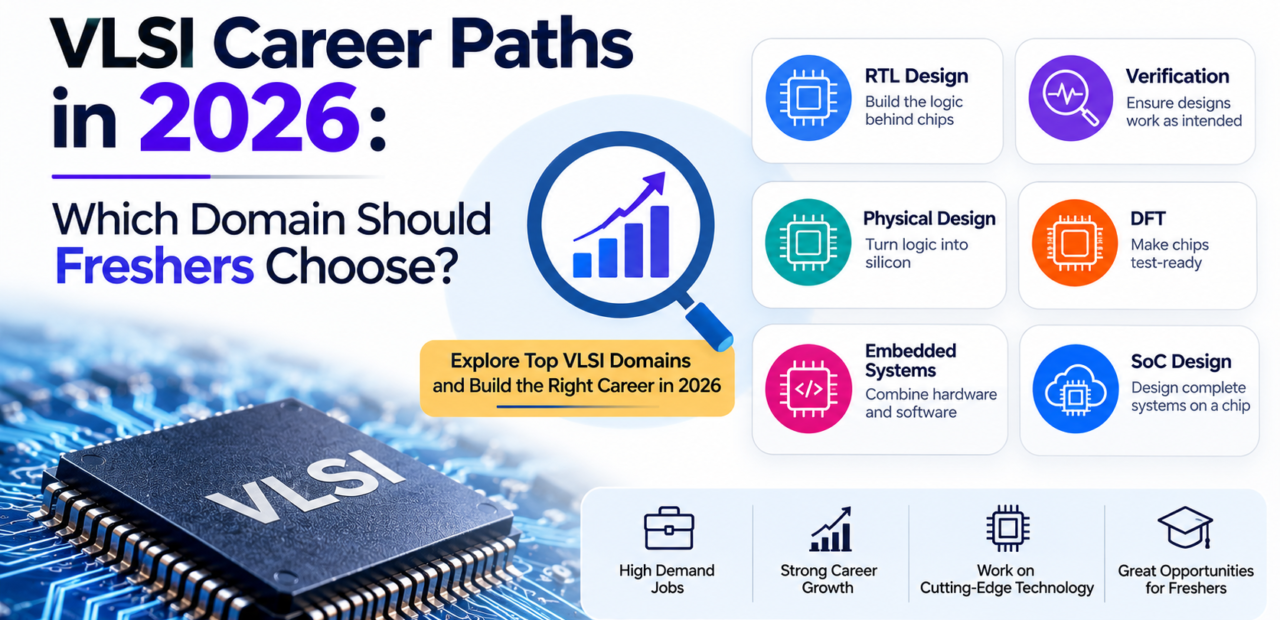
RTL Design involves writing the logic that describes how a chip should behave, using hardware description languages. It suits people who enjoy building systems from the ground up and thinking in terms of logic and architecture.
Verification is where a huge share of hiring is currently concentrated. Verification engineers make sure a design behaves correctly before it becomes physical silicon, using methodologies like UVM. Since a single bug caught late can cost enormous amounts of money, companies invest heavily in this function, making it one of the most stable entry points for newcomers.
Physical Design takes the finished logic and turns it into an actual layout on silicon, dealing with placement, routing, timing, and power. As chips move to smaller and more advanced nodes, this domain is becoming increasingly specialized and valuable.
Design for Testability (DFT) ensures that chips can be tested efficiently after manufacturing. It’s a narrower niche but one where experienced professionals are consistently in demand because very few people specialize in it early.
Analog and Mixed-Signal Design focuses on the circuits that interact with the real world, like power management and sensors. It requires a different mindset than digital design and tends to reward people who enjoy precision and hands-on problem solving.
There isn’t a universally “best” domain here. Verification currently offers the widest number of entry-level openings, while physical design and analog roles tend to reward specialization over time. The right choice depends on whether you enjoy logic-heavy thinking, meticulous debugging, or hands-on circuit work.
A practical way to test your fit before committing is to try a small self-guided project in two or three domains before picking one. Spend a weekend writing a basic RTL module, then another trying a simple verification testbench, and notice which one keeps your attention longer without feeling like a chore. That instinct is usually a better guide than any ranking list of “top paying” domains you’ll find online.
Building the Right Skillset: High Demanding VLSI Courses Worth Considering
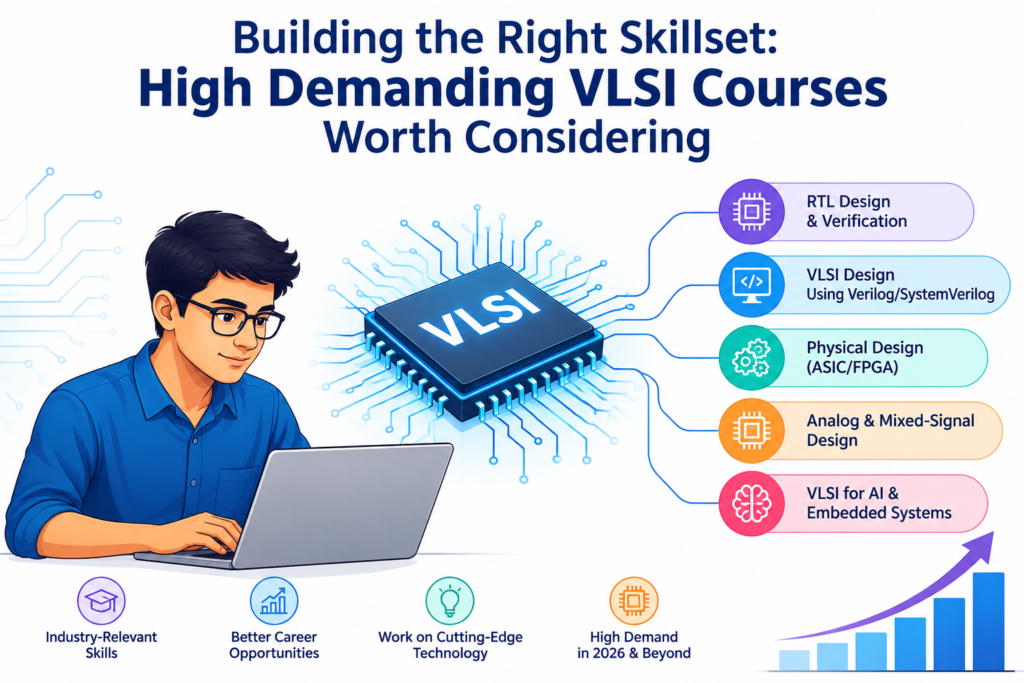
Choosing a domain is only half the equation. Backing it up with the right training is what actually gets you hired. Right now, the courses generating the most attention are the ones that go beyond theory and force hands-on exposure to real industry tools like Cadence, Synopsys, and Siemens EDA software.
Some of the most sought-after learning paths in 2026 focus on:
- Practical RTL design and Verilog or SystemVerilog based projects rather than pure classroom teaching
- UVM-based verification training, since this remains one of the highest-hiring areas in the field
- Physical design courses that include real placement and routing exercises on modern process nodes
- Low-power design techniques, since battery-driven devices and EVs are pushing this skill into high demand
- Exposure to AI-assisted design flows, as design tools increasingly use machine learning to speed up chip development
A course is only as good as the practical exposure it offers. Before enrolling anywhere, check whether the program includes real projects, internship pathways, or lab access, because tool familiarity is what separates a resume that gets shortlisted from one that gets ignored.
How to Crack a VLSI Job Interview as a Fresher

This is usually the part that intimidates newcomers the most, but the good news is that VLSI interviews tend to follow a fairly predictable pattern once you know what to expect.
Most interview processes are built around three layers: fundamentals, tool knowledge, and applied problem solving. On the fundamentals side, expect deep questions on digital logic, computer architecture basics, and whichever domain you’re targeting, whether that’s design concepts, verification methodology, or physical design flow. Interviewers are less interested in memorized definitions and more interested in whether you can explain the “why” behind a concept.
The tool knowledge layer checks whether you’ve actually used industry software rather than just studied it. This is exactly why hands-on projects matter so much going in. Even a small personal project where you designed, verified, or laid out something simple gives you real stories to talk through instead of textbook answers.
Finally, applied problem solving usually shows up as small design or debugging puzzles during the interview itself. Practicing out loud, explaining your thought process step by step, and staying calm when you don’t immediately know an answer often matters more than getting every question perfect. Interviewers are hiring for trainability as much as existing knowledge, especially at the fresher level.
A simple way to prepare is to pick one domain, build one solid project around it, and be ready to explain every decision you made in that project in detail. That single project often becomes the anchor of an entire interview conversation.
It also helps to prepare a short list of questions to ask the interviewer about their team’s tools, workflow, or current chip projects. Beyond making a good impression, it genuinely helps you judge whether the role matches the domain you’re aiming for, since job titles in this industry don’t always describe day-to-day work consistently across companies.
Choosing Your Path: What Actually Matters Long Term

At the end of the day, the “best” VLSI domain is the one that matches how you think and what kind of daily work energizes you rather than whichever one is trending this year. Verification offers volume and stability, physical design offers deep technical specialization, analog work offers a different kind of precision-based challenge, and RTL design offers the satisfaction of building systems from scratch.
What matters more than the domain itself is momentum. The semiconductor industry rewards people who keep learning past their first job, since tools, process nodes, and methodologies evolve constantly. Treat your first domain choice as a strong starting point rather than a permanent label, and stay open to moving across domains as your interests and the industry itself continue to shift.
2026 is shaping up to be one of the most rewarding years to enter this field, not because it’s easy, but because the industry genuinely needs skilled people faster than it can produce them. Pick a domain, build something real, and walk into your first interview with a project you can talk about for twenty minutes without running out of things to say.
Which VLSI domain is best for freshers in 2026?
RTL Design, Design Verification, Physical Design, and DFT are among the best VLSI domains for freshers due to strong hiring demand and career growth.
Which VLSI domain has the highest salary?
Physical Design, Analog Layout, and Design Verification often offer higher salaries as engineers gain experience and specialized semiconductor skills.
Is VLSI a good career in 2026?
Design Verification and Physical Design currently offer some of the highest numbers of VLSI job openings for freshers and experienced engineers.
Which VLSI domain has the most job opportunities?
Design Verification and Physical Design currently offer some of the highest numbers of VLSI job openings for freshers and experienced engineers.
Should I choose RTL Design or Verification?
Choose RTL Design if you enjoy digital logic. Pick Design Verification if you like debugging, testing, and ensuring chip functionality before manufacturing.