



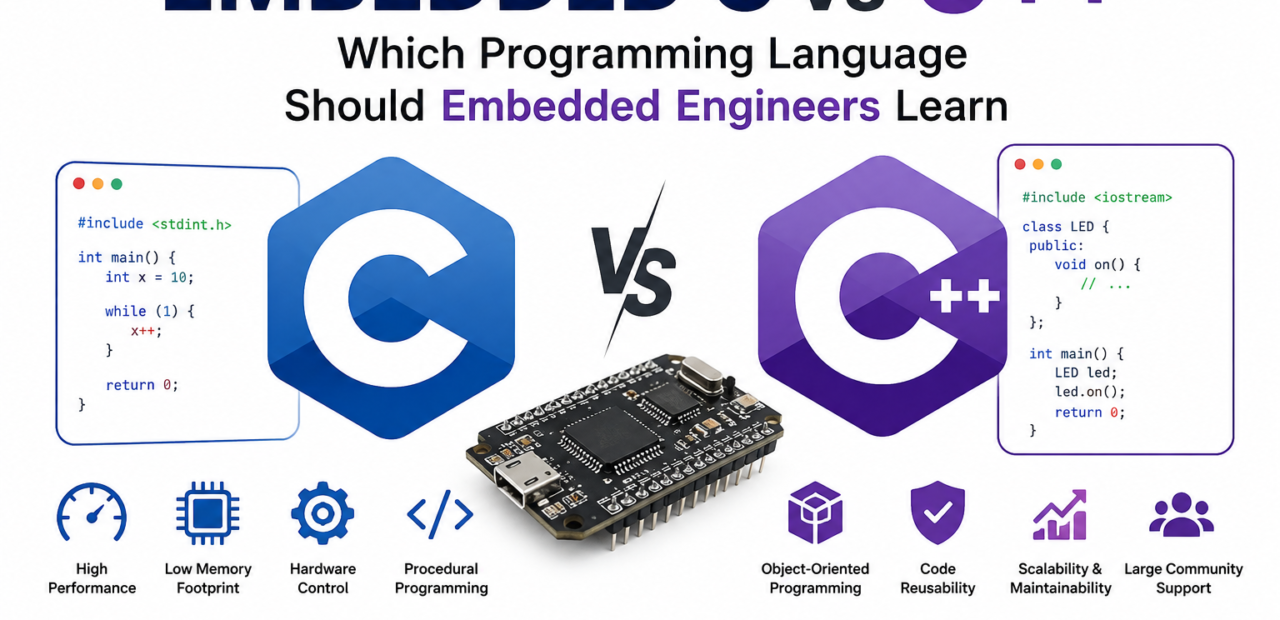
Embedded C vs C++: Which Programming Language Should Embedded Engineers Learn

At the foundational layer of embedded development, hardware resource management dictates language selection. Embedded C excels in ultra-constrained environments—such as 8-bit or 16-bit microcontrollers with only a few kilobytes of RAM—because it maps almost directly to assembly instructions. Engineers can manipulate memory-mapped registers directly using bitwise operations, ensuring predictable memory footprints and zero hidden runtime overhead.
C++ can achieve identical hardware control, but it requires careful feature selection to keep memory usage low. When engineers use zero-cost abstractions like inline member functions or constexpr, C++ compiles down to machine code that is just as efficient as C. However, improper use of dynamic memory allocation (new/delete), heavy template instantiation, or runtime type information (RTTI) can quickly bloat flash memory and cause unpredictable heap fragmentation in resource-starved systems.
Embedded C vs. C++: Comprehensive Feature Comparison
| Feature / Metric | Embedded C | Embedded C++ |
| Primary Programming Paradigm | Procedural / Functional | Object-Oriented, Generic, & Procedural |
| Hardware Abstraction Level | Low-level (Direct register access, bare-metal pointers) | Mid-to-High level (Classes, HAL wrappers, RAII) |
| Memory Footprint (Flash & RAM) | Minimal; generates extremely compact machine code | Slightly larger; depends on template and class usage |
| Execution Determinism & Speed | Highly deterministic; minimal runtime overhead | Equivalent to C when dynamic features are avoided |
| Code Reusability & Architecture | Low-to-Moderate (Relies on headers, function pointers) | High (Classes, inheritance, templates, namespaces) |
Hardware Control and Memory Footprint: Bare-Metal Realities
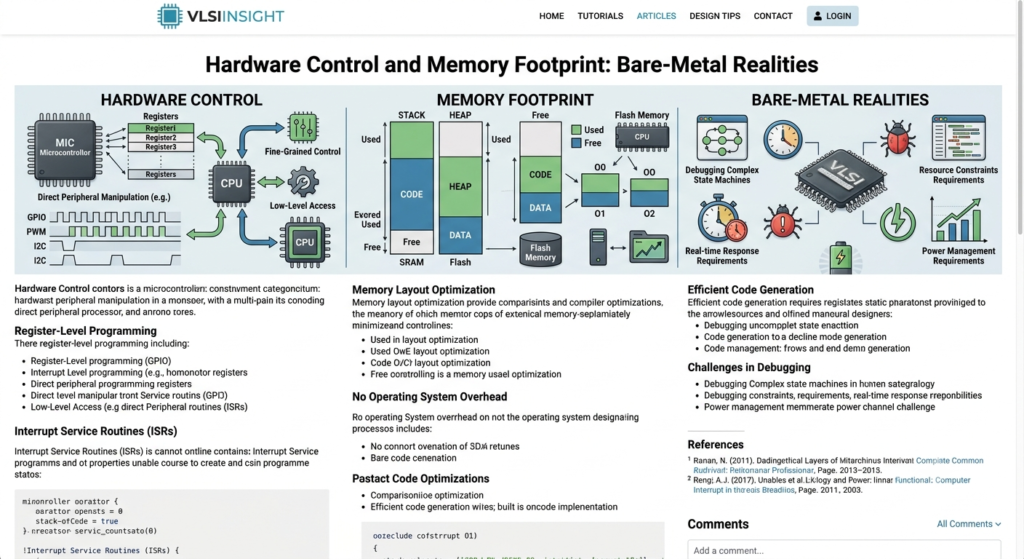
The comparison always starts here, and for good reason. Embedded C is essentially the C language adapted for microcontrollers — lightweight, predictable, and close to the hardware. It compiles into small, fast binaries, which matters enormously when you’re working with a chip that has only a few kilobytes of flash memory.
C++ brings object-oriented programming, templates, and abstraction layers that make large codebases easier to organize. But those features come with trade-offs: heavier binaries, less predictable memory behavior if used carelessly, and a steeper learning curve. Neither language is objectively “better” — the right choice depends on the constraints of the project. A tiny 8-bit sensor node still leans heavily on C, while a connected device with a rich display and networking stack often benefits from C++’s structure.
Software Architecture and Reusability: Managing Code Complexity
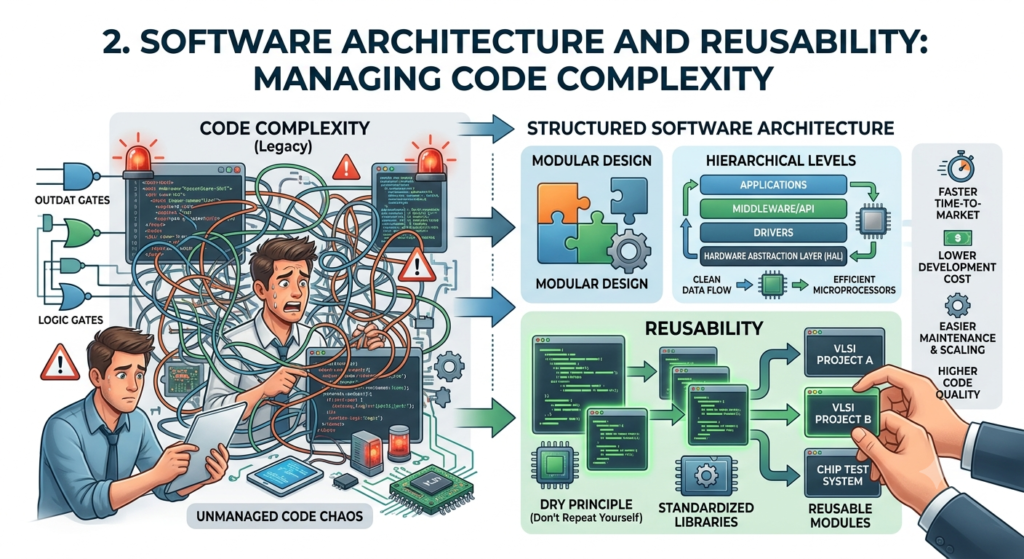
Hardware capability quietly makes this decision for you more often than developers realize. A decade ago, most microcontrollers ran on a few kilobytes of RAM, so C was the only realistic option — it doesn’t rely on heap allocation or dynamic dispatch, both of which are risky on constrained memory.
Today’s microcontrollers look very different. Chips built on modern Cortex-M cores now ship with megabytes of flash and hundreds of kilobytes of RAM, running well above 100 MHz. That extra headroom has opened the door for C++ in projects that would have been C-only territory a few years back. Even so, safety-critical fields like automotive and medical devices still mandate strict coding standards such as MISRA C, which keeps C firmly in place for production firmware in those industries. So the real question isn’t “C or C++ for embedded systems” in the abstract — it’s “what does this specific board and industry require.”
Read More: SRAM vs DRAM: Why Both Are Still Used Today
Embedded C vs C++ for Microcontroller Programming
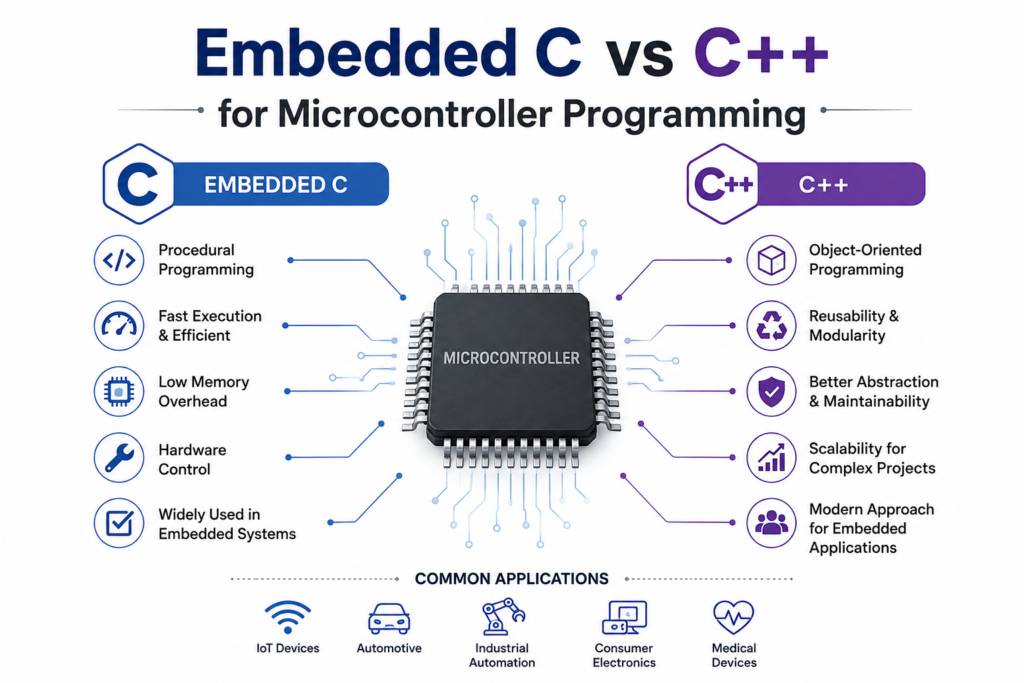
When you zoom into microcontroller programming specifically, the practical differences become clearer. C gives you direct, unambiguous control over registers, interrupts, and memory-mapped I/O — there’s no hidden behavior happening behind the scenes. This transparency is exactly why bootloaders, real-time operating systems like FreeRTOS and Zephyr, and low-level driver code are still overwhelmingly written in C.
C++ shines when a project grows in complexity — think multiple sensor drivers, state machines, and communication protocols all running together. Its class-based structure makes large firmware easier to maintain and extend without turning into spaghetti code. Many teams now use a hybrid approach: C for the hardware-facing driver layer, and C++ for the application logic sitting above it. Understanding both isn’t optional anymore if you want to work across a full embedded stack rather than just one layer of it.
There’s also a middle ground worth knowing about: a restricted subset sometimes called “Embedded C++” was developed years ago specifically for low-memory microcontrollers. It kept useful C++ concepts like classes while stripping out heavier features such as multiple inheritance, templates, exceptions, and runtime type identification — all of which can eat into flash and RAM unpredictably. Even though the formal standard faded, its philosophy lives on in how embedded teams write “restrained” C++ today: use the parts that add structure, skip the parts that add runtime overhead you can’t control.
Modern Trends Shaping the Embedded C vs C++ Debate
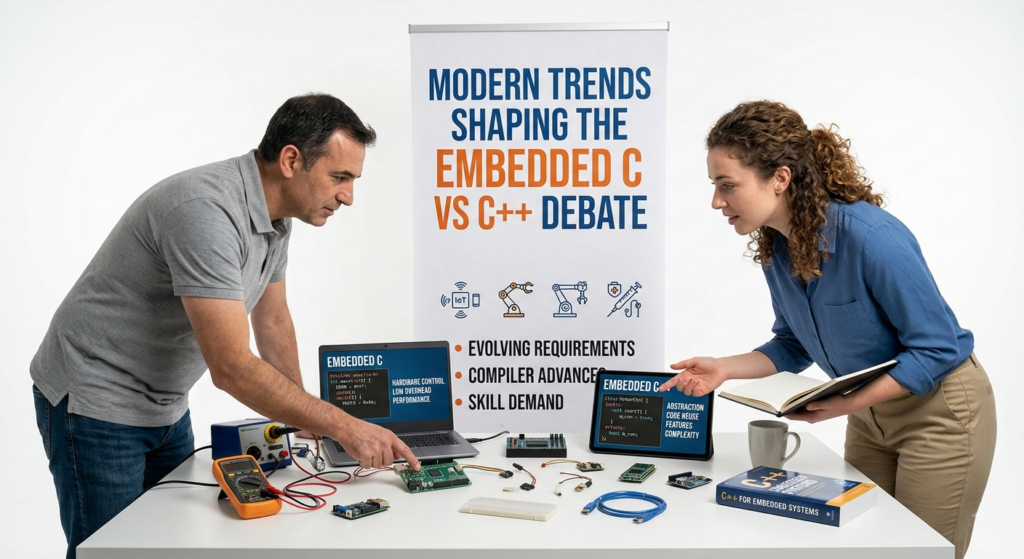
The landscape has genuinely shifted in the last couple of years. C++ has been climbing steadily in general programming language popularity indexes, partly driven by its growing use in embedded and systems-level work where structured, reusable code is now feasible thanks to more powerful hardware. At the same time, C hasn’t lost its grip on resource-constrained and safety-critical designs, where deterministic timing and minimal overhead are non-negotiable.
Another trend worth watching is the rise of Rust in security-sensitive IoT and connected embedded systems, thanks to its memory-safety guarantees without a garbage collector. It hasn’t replaced C or C++, but it’s pushing both communities to write more disciplined, safer code. Meanwhile, higher-level options like MicroPython are gaining ground for rapid prototyping on capable boards. None of this eliminates the need for solid C and C++ fundamentals — if anything, it raises the bar, since engineers are now expected to move fluidly between low-level and high-level tools depending on the project phase.
It’s also worth noting that language popularity indexes now show C++ edging ahead of C for the first time in decades, largely because of its dominance outside embedded work in areas like game engines, desktop software, and performance-critical backend systems. That broader popularity doesn’t automatically translate into embedded adoption, but it does mean the pool of C++ tooling, compilers, and community support keeps growing — which indirectly benefits embedded C++ development too.
Embedded C vs C++ Career Opportunities

From a career standpoint, this isn’t really an either-or decision. Job listings for firmware engineers, embedded software developers, and VLSI-adjacent roles almost always list both languages together, because real products use both at different layers of the stack. Automotive, industrial automation, and medical device companies tend to prioritize deep C expertise paired with MISRA compliance knowledge. Consumer electronics, IoT platforms, and companies building connected products with GUIs or complex application logic increasingly look for strong C++ skills alongside C.
Specializing in only one language narrows your options more than it should. Engineers who are comfortable writing lean, hardware-level C code and can also structure larger systems in C++ tend to have an easier time moving between industries — from automotive ECUs to consumer IoT devices to industrial controllers — without having to relearn the fundamentals each time.
Recruiters and hiring managers in the embedded and VLSI space also tend to value candidates who can read a datasheet, write a driver in C, and then wrap that driver in a clean C++ interface for the rest of the application to use. That combination signals you understand both the hardware and the software architecture around it, which is exactly the skill set that separates a junior firmware developer from someone trusted to own a full product’s codebase.
Conclusion
There isn’t a single winner in the Embedded C vs C++ conversation, and treating it like a competition misses the point. C remains the backbone of low-level, resource-constrained, and safety-critical firmware, while C++ is increasingly the language of choice for larger, more structured embedded applications running on capable hardware. The engineers who stay relevant aren’t the ones who picked a side early — they’re the ones who learned to move comfortably between both, choosing the right tool for the specific chip and product in front of them.
If you’re planning your next skill investment, don’t frame it as choosing one language over the other. Build a strong foundation in C first, since it teaches you exactly how hardware behaves at the register level, then layer C++ on top once you’re comfortable — that sequence mirrors how most real embedded teams actually work.
1. Which is better for embedded systems, C or C++?
Embedded C is simple and efficient, while C++ offers OOP and advanced features. The best choice depends on project complexity, performance, and hardware requirements.
2. Is Embedded C better than C++?
Embedded C is widely used for low-level programming and resource-constrained devices. C++ can be better for complex embedded applications requiring scalability.
3. Should embedded engineers learn C or C++?
Embedded engineers should learn C first, then C++. Strong C knowledge builds a foundation for microcontrollers, drivers, RTOS, and low-level embedded programming.
4. Is C++ good for embedded systems?
Yes. Modern C++ is increasingly used in embedded systems because it supports object-oriented programming, reusable code, and complex software architectures.
5. Is Embedded C still in demand in 2026?
Yes. Embedded C remains highly relevant for microcontrollers, automotive electronics, IoT devices, firmware, and real-time embedded applications.
6. Do modern microcontrollers support standard C++ libraries? Most modern
ARM Cortex-M, RISC-V, and ESP32 toolchains fully support C++ standards up to C++20. However, embedded developers typically avoid parts of the C++ Standard Template Library (STL) that rely on unconstrained dynamic heap allocation, opting instead for embedded-friendly, static container libraries.
7. How does resource acquisition (RAII) in C++ benefit embedded systems? RAII
automatically ties hardware resource life cycles—such as disabling interrupts, releasing bus locks, or closing file descriptors—to object scopes. When an object goes out of scope, its destructor automatically frees the resource, preventing silent memory leaks and unreleased hardware locks.