


VLSI vs Firmware Engineering: Skills, Salary, Jobs & Career Growth

Picture two engineers starting the same week at the same company. One stares at a chip layout past midnight, chasing a timing violation that could sink a multi-million-dollar tape-out. The other is elbow-deep in a bootloader that refuses to wake up a sensor, flipping registers one bit at a time. Both are building the hardware that runs the world — yet their daily lives, paychecks, and career paths look almost nothing alike.
That gap is exactly what confuses most people trying to break into semiconductor and embedded careers. VLSI and firmware sit right next to each other on paper — both deal with chips, both need strong fundamentals. But once you’re actually working, the tools, mindset, and pace of the job diverge sharply. This guide breaks down what each field involves, what they pay in 2026, and how to pick the right one for you.
VLSI vs Firmware: What’s the Real Difference?
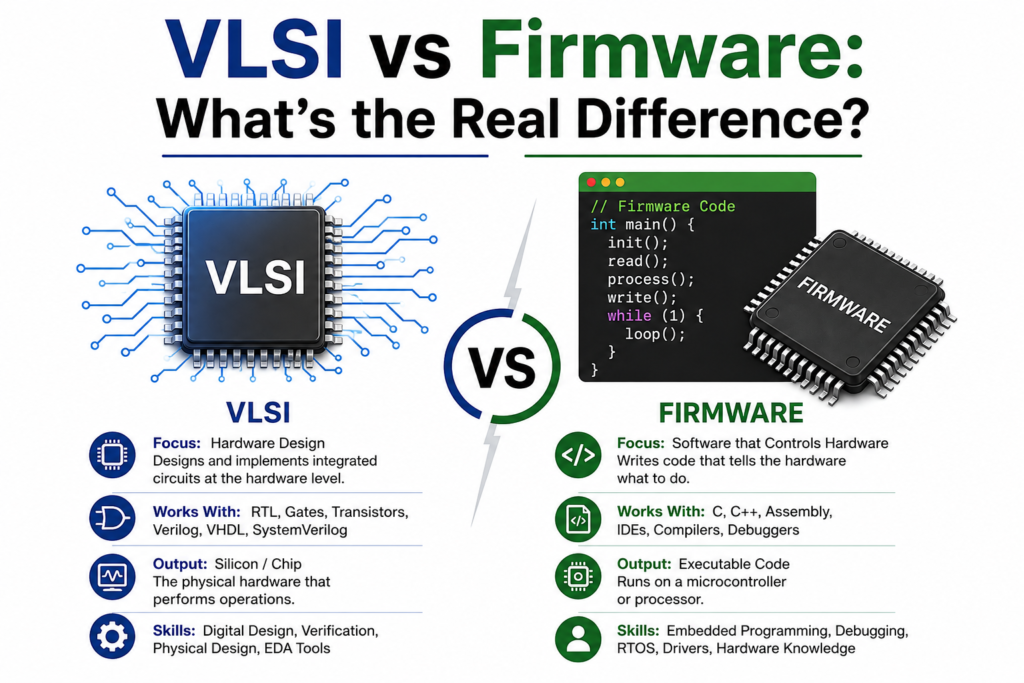
VLSI, short for Very Large Scale Integration, is the discipline of designing and verifying the actual silicon — the millions of transistors packed onto a chip. A VLSI engineer works before the chip physically exists, writing RTL code, running simulations, checking timing, and eventually handing off a design to be manufactured in a fab. It is precise, mathematical work where a single mistake can cost months and enormous sums of money to fix.
Firmware engineering starts after the chip is real. A firmware engineer writes the low-level software that lives directly on that hardware — the code that initializes a processor, talks to sensors, manages power, and makes a device actually do something useful. Where VLSI is about building the brain, firmware is about teaching that brain to function inside a real product, whether that’s a smartwatch, a car’s control unit, or a satellite.
In short: VLSI creates the silicon, firmware brings it to life. One field lives in EDA tools and hardware description languages; the other lives in compilers, debuggers, and real hardware boards.
Skills Required: VLSI Engineering vs Firmware Engineering
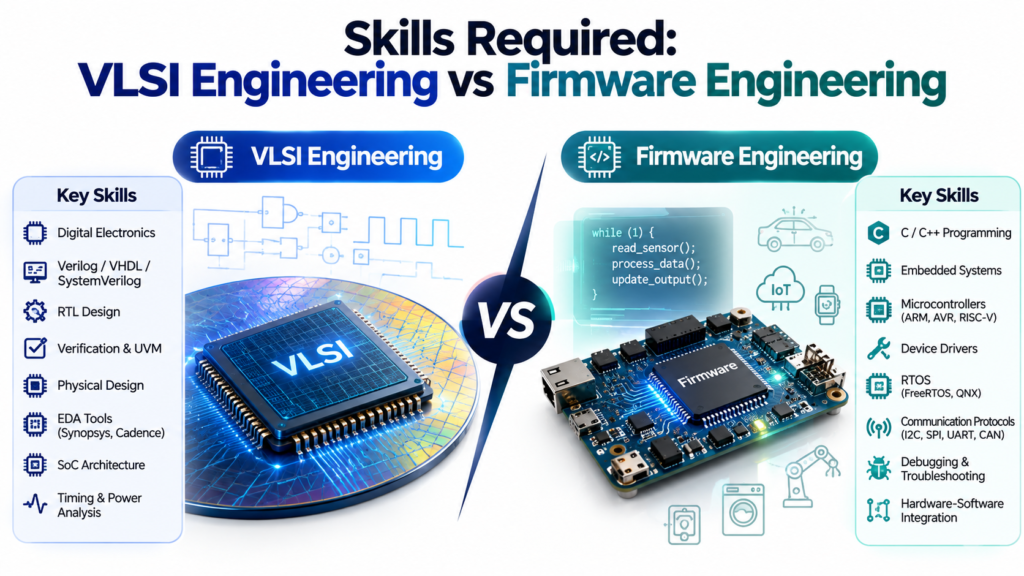
The skill sets barely overlap, which is why switching between them mid-career is harder than it looks.
VLSI engineers need strong command of Verilog or VHDL, digital logic design, and simulation tools from vendors like Synopsys, Cadence, or Siemens EDA. Depending on specialization, they also need static timing analysis, design-for-test (DFT) methodologies, physical design and layout, or formal verification techniques. It is a field built on deep theoretical grounding in digital electronics combined with fluency in expensive, industry-specific software.
Firmware engineers lean heavily on C and C++, real-time operating systems (RTOS) like FreeRTOS or Zephyr, and a working knowledge of microcontroller architectures such as ARM Cortex-M. They need to read datasheets fluently, understand communication protocols like I2C, SPI, and UART, and debug problems using oscilloscopes and logic analyzers as often as a laptop. Where VLSI rewards patience with abstraction, firmware rewards patience with the messy, physical unpredictability of real hardware.
Both fields demand strong fundamentals in digital electronics, but VLSI pulls you toward chip-level abstraction while firmware pulls you toward the software-hardware boundary. Neither is “easier” — they are simply different games.
Salary Comparison: Which Field Pays More?

Money is usually the first question, and the honest answer is: it depends heavily on specialization, seniority, and location.
In the United States, VLSI design and verification roles report average salaries in the range of roughly $170,000 to $215,000 a year, with senior and staff-level design verification engineers regularly crossing $220,000, and top earners well above $300,000 at large semiconductor companies. Firmware and embedded engineering roles trend somewhat lower on average but are far from modest — embedded firmware engineers commonly earn between $120,000 and $170,000, and broader embedded systems engineering roles (which blend firmware with systems-level work) have reported 2026 medians around $190,000, with senior specialists earning comparably to VLSI counterparts.
In India, VLSI remains one of the higher-paying core engineering tracks. Entry-level VLSI roles typically start in the ₹4–10 lakh range annually, and engineers with five or more years of experience in physical design or verification can reach ₹20–50 lakh or more, particularly at multinational chip companies. Firmware and embedded roles in India follow a similar trajectory but with slightly more variation, since firmware talent is spread across automotive, industrial, and consumer electronics companies with very different pay scales.
The bigger pattern in 2026: VLSI tends to have a higher ceiling at senior levels because chip design directly determines a product’s cost and performance, while firmware pays extremely competitively wherever hiring is difficult — and right now, hiring is very difficult.
Job Opportunities in 2026: Which Field Has More Openings?
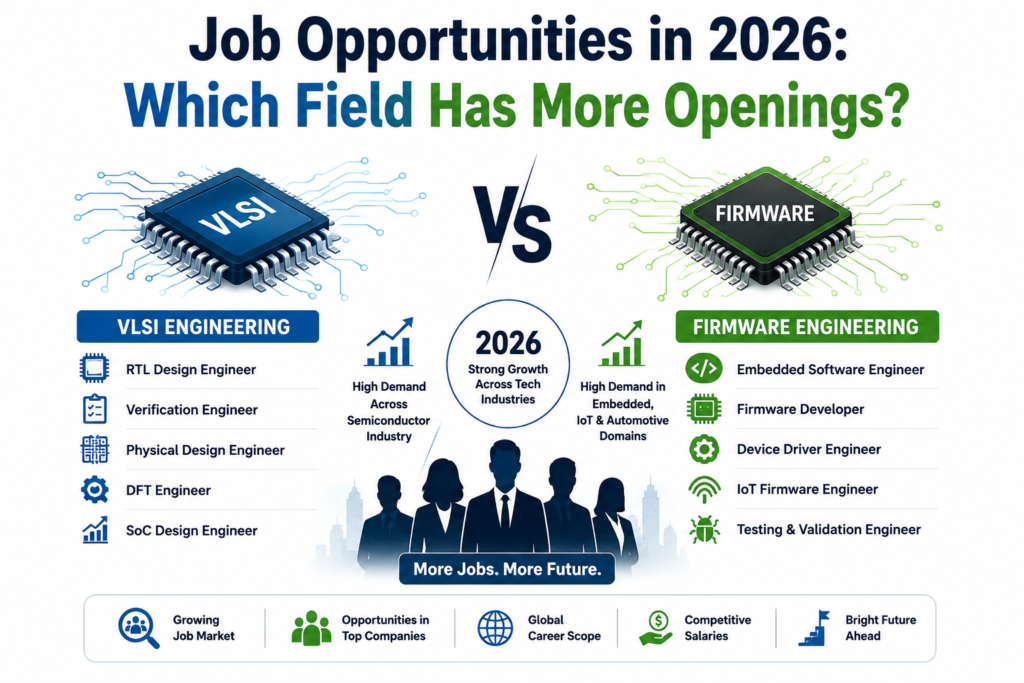
This is where the two fields tell very different stories.
VLSI hiring is tied closely to the health of the global semiconductor industry, and that industry is currently in an unusually strong growth phase. AI accelerators, electric vehicles, and government-backed semiconductor manufacturing initiatives across the US, India, and other countries have pushed chip design demand to levels not seen in years. This has created a genuine talent shortage in specialized areas like physical design, DFT, and analog layout, where experienced engineers are scarce and in-demand.
Firmware hiring is arguably even tighter. Industry hiring data from 2026 suggests a large share of firmware and embedded job postings sit unfilled for months, because the pool of engineers who can comfortably work at the hardware-software boundary is small and shrinking relative to demand. Every connected device — from industrial sensors to electric vehicles to medical wearables — needs firmware, which means the field’s job base is broader than VLSI’s, even if individual openings sometimes take longer to fill.
If pure volume of open roles matters most to you, firmware currently has the edge, since almost every electronics product needs firmware while VLSI roles concentrate around semiconductor design centers. If you’re chasing the highest-paying specialist roles, VLSI’s ceiling remains higher, particularly at large chipmakers.
Career Growth: Long-Term Prospects in VLSI and Firmware

Career trajectories in both fields tend to branch in similar ways but land in different places.
A VLSI career typically moves from junior design or verification engineer to senior specialist, then toward architecture, technical leadership, or management roles overseeing entire chip projects. Because chip design cycles are long and expensive, seniority in VLSI is closely tied to proven track record on successful tape-outs, which makes experienced engineers extremely valuable and hard to replace.
A firmware career often moves from embedded developer to systems or platform engineer, then toward roles that blend firmware with broader product architecture — sometimes crossing into IoT strategy, robotics, or automotive systems leadership. Because firmware sits closer to the finished product, experienced firmware engineers often develop strong product intuition, which opens doors into technical program management or even startup founding roles.
Both paths reward depth over breadth. Engineers who specialize — in a niche like DFT or in a protocol stack like automotive CAN bus firmware — tend to see faster growth and stronger compensation than generalists in either field.
1. What is the main difference between VLSI and Firmware Engineering?
VLSI focuses on designing and verifying semiconductor chips, while Firmware Engineering develops low-level software that controls and communicates with hardware.
2. Which is better, VLSI or Firmware Engineering?
Both offer strong careers. VLSI suits those interested in chip design, while Firmware Engineering is ideal for professionals interested in coding, embedded systems, and hardware.
3. Which pays more, VLSI or Firmware Engineering?
Salaries vary by skills, role, location, and experience. Specialized VLSI roles can offer high packages, while experienced firmware engineers also earn competitive salaries.
4. What skills are required for VLSI Engineering?
VLSI engineers need Digital Electronics, Verilog, SystemVerilog, RTL Design, Verification, CMOS concepts, scripting, Linux, and knowledge of EDA tools.
5. What skills are required for Firmware Engineering?
Firmware engineers typically need C/C++, Embedded C, microcontrollers, RTOS, debugging, device drivers, communication protocols, and hardware fundamentals.