

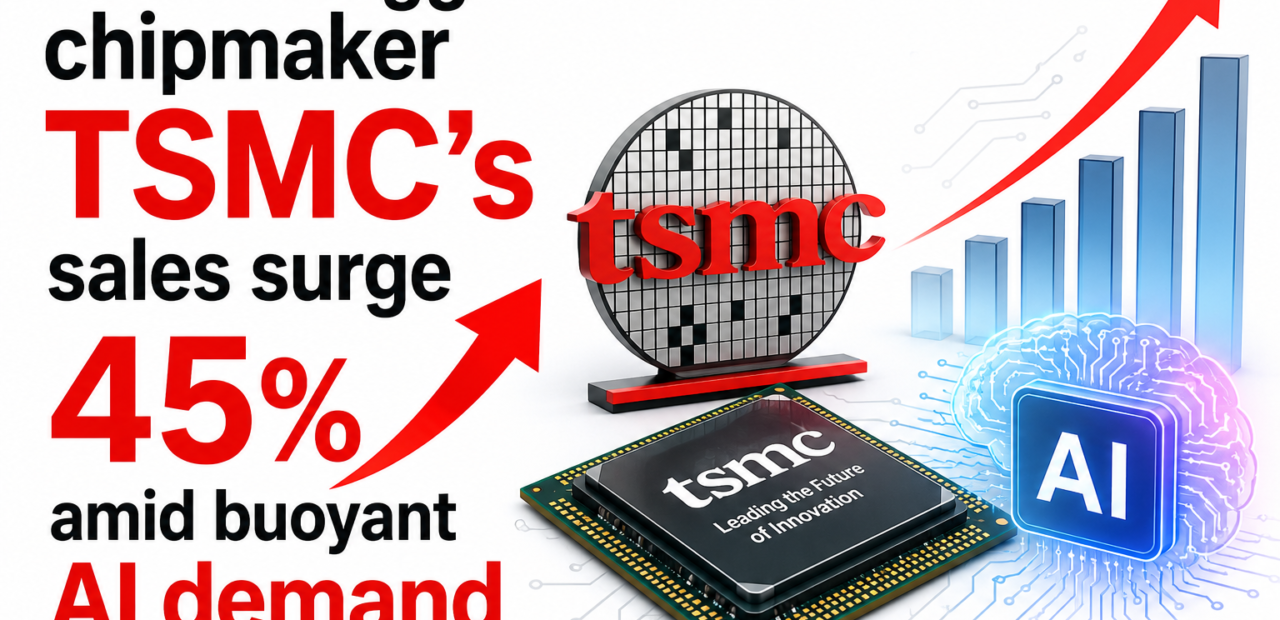
World’s Biggest Chipmaker TSMC’s Sales Surge 45% Amid Buoyant AI Demand

The AI boom just handed out its report card, and one company topped the class by a mile. TSMC, the company quietly building the silicon brains behind almost every major AI system on the planet, has posted a jaw-dropping 45% jump in monthly sales, and the number is turning heads across the entire tech industry.
For anyone tracking where the AI money is actually going, this single data point tells a bigger story than a dozen earnings calls. It confirms that the appetite for advanced chips hasn’t slowed down, and it puts TSMC firmly at the center of one of the biggest industrial shifts of this decade.
TSMC’s July Revenue Numbers Explained
TSMC reported revenue of roughly NT$467.58 billion, translating to about $14.5 billion, for the month of July. That figure represents a year-on-year increase of nearly 45%, a pace that has surprised even seasoned market watchers. As the world’s largest contract chipmaker, TSMC produces chips for a long list of major technology companies, which makes its monthly numbers a widely followed indicator of overall demand in the semiconductor world.
What makes this jump notable is timing. It arrived during a period when broader tech stocks have wobbled and investors have started asking harder questions about whether AI infrastructure spending is sustainable. TSMC’s numbers suggest that, at least for now, orders keep flowing in faster than expected, and the company has already pulled ahead of its own full-year growth target with several months still left on the calendar.
Why AI Demand Keeps Climbing

The driving force behind this surge isn’t a mystery. High-performance computing, the segment where TSMC books its AI-related chip production, has grown to make up roughly two-thirds of the company’s total revenue. That is a remarkable shift for a business that once leaned heavily on smartphone and consumer electronics manufacturing.
Large technology companies are pouring enormous sums into building out data centers, training clusters, and specialized processors to support generative AI tools and services. Every one of those systems ultimately depends on advanced semiconductors, and TSMC sits right at the center of that supply chain. Company leadership has described AI-related demand as remaining unusually strong and showing no real signs of cooling off, a sentiment echoed by several industry analysts who track the sector closely.
Expansion Plans and Rising Capital Spending

To keep pace with orders, TSMC isn’t just celebrating strong numbers, it’s actively expanding its manufacturing footprint. The company has raised its capital expenditure plans for the year to a range between $60 billion and $64 billion, a substantial increase that signals confidence in continued long-term demand rather than a short-term spike.
Part of that investment is going toward accelerating construction at its Arizona manufacturing facilities, part of a broader push to diversify production beyond Taiwan. Building new fabrication capacity takes years and enormous amounts of capital, so a company only commits at this scale when it expects the demand to persist well beyond the current quarter. TSMC’s finance leadership has reportedly described the AI wave as a trend likely to unfold over many years rather than a passing cycle, which explains the scale of this spending commitment.
What This Means for the Global Chip Market
TSMC’s performance doesn’t exist in a vacuum. Its results ripple outward across the entire semiconductor ecosystem. Following the announcement, several European chip stocks moved higher, with companies like ASML, Infineon, and STMicroelectronics all seeing gains, since strong TSMC demand often translates into stronger demand for the equipment and components that feed into chip production.
At the same time, competition in advanced chip manufacturing is intensifying. Other major players in the memory and foundry space are racing to expand their own AI-related capacity, turning the AI chip race into a multi-front battle across several countries and companies. TSMC’s scale and technological lead currently give it a significant edge, but analysts caution that monthly revenue figures can be volatile, and one exceptional month doesn’t guarantee the next will look the same.
Still, the broader trend line is hard to ignore. Semiconductor stocks as a group have posted strong gains this year, even after a recent pullback tied to concerns over how much capital big tech companies are willing to keep committing to AI infrastructure. TSMC’s July numbers offer a reassuring signal that, for now, the demand backing that spending remains very real.