
How Semiconductor Companies Actually Hire VLSI Freshers

Most fresh graduates walk into their first VLSI interview believing a good GPA and a neat resume will carry them through. Then the interviewer asks them to draw a timing diagram on a blank sheet, and the room goes quiet. That gap between what gets taught and what gets tested is exactly why so many capable engineers get rejected in the first round, while others with average grades walk out with an offer letter.
The truth is that semiconductor companies don’t hire the way most job portals or campus placement cells describe it. There is no single “VLSI interview pattern,” and there is no shortcut that works for every company. What actually happens is a layered filtering process where technical depth, tool familiarity, and the ability to explain your own project matter far more than the college name on your certificate. This blog breaks down what really happens behind the scenes when a chip company looks at a fresher’s application.
1. What Recruiters Screen For Before the Interview Even Starts

Long before a candidate sits for a technical round, resumes go through a silent filtering stage. Recruiters and hiring managers scan for specific signals: whether the candidate has worked on a complete design flow rather than a textbook exercise, whether they mention tools like Cadence, Synopsys, or ModelSim by name, and whether their project description shows understanding of why a design choice was made, not just what was built.
A resume that lists “RTL design using Verilog” without any explanation of the block, the verification method, or the outcome usually gets skipped. On the other hand, a resume that mentions a specific FIFO design, the corner cases handled during verification, and the coverage achieved tends to get shortlisted even if the project was academic. This is the stage where preparation quietly begins, months before the actual interview call arrives. Anyone currently enrolled in a VLSI course in Noida or elsewhere should treat their capstone project as the single most important line on their resume, because that is what recruiters read first.
2. The Real Interview Process Inside Semiconductor Companies
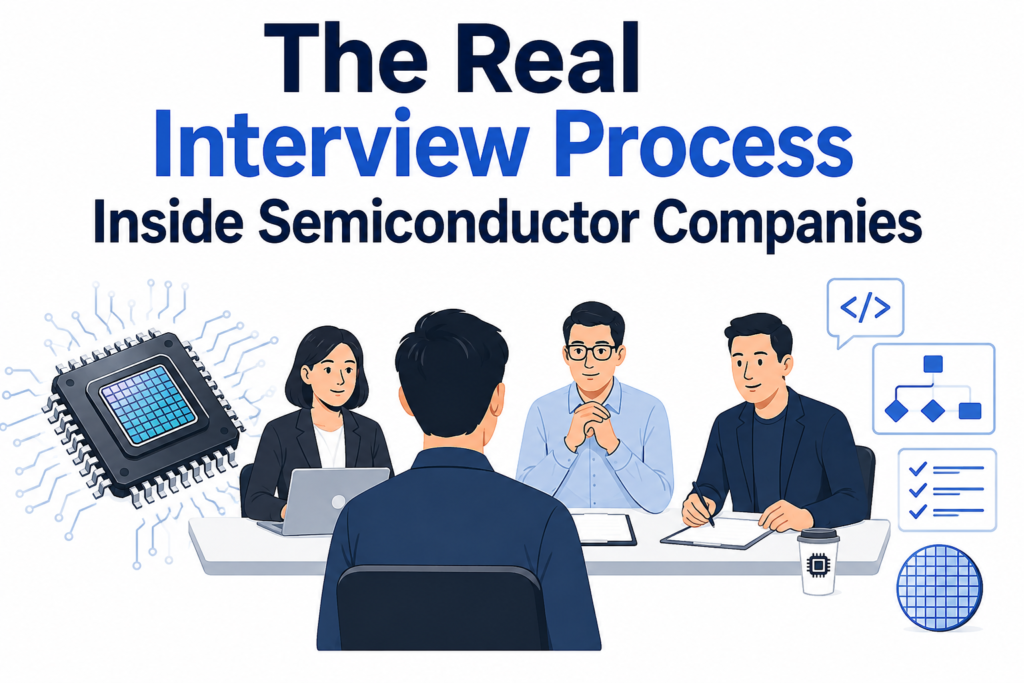
Once shortlisted, the process typically runs through three stages, though the order can shift depending on the company. The first is a technical screening, often conducted online or over a call, covering digital logic fundamentals, basic scripting, and simple design problems. The second is a deeper technical round with a design engineer, where the candidate is expected to defend their own project in detail and solve live problems on a whiteboard or shared screen.
The third round, when it happens, is usually a managerial or HR conversation focused on communication, team fit, and willingness to relocate to hubs such as Bangalore, Hyderabad, or Pune. What surprises many freshers is how little weight is given to memorized answers. Interviewers are far more interested in watching how someone reasons through an unfamiliar problem than in hearing a rehearsed definition. Companies expanding their India design centers around advanced process nodes are specifically looking for people who can think on their feet, because production timelines leave no room for engineers who only know theory.
3. Why Design Service Companies Are Becoming a Major Entry Point

There is a persistent myth that a VLSI career must begin at a large multinational chip maker. In reality, design service companies have quietly become one of the most practical entry routes for freshers. These firms work on contracts across verification, physical design, DFT, and STA for multiple product companies, which means a fresher joining one gets exposed to a wider variety of real projects faster than they might inside a single large organisation.
Working at a design services firm often means less glamour but more hands-on tape-out exposure early in a career. Freshers who start here tend to pick up practical vocabulary — floorplanning, placement, clock tree synthesis, routing, and ECO handling — much sooner than peers who join a large company and get placed in a narrow, specialised role. Many hiring managers privately admit that a candidate who spent a year at a design services company often interviews better than one who spent the same year untouched by real deadlines, simply because pressure teaches things a classroom cannot.
4. The Skills That Actually Separate a Hired Fresher From a Rejected One
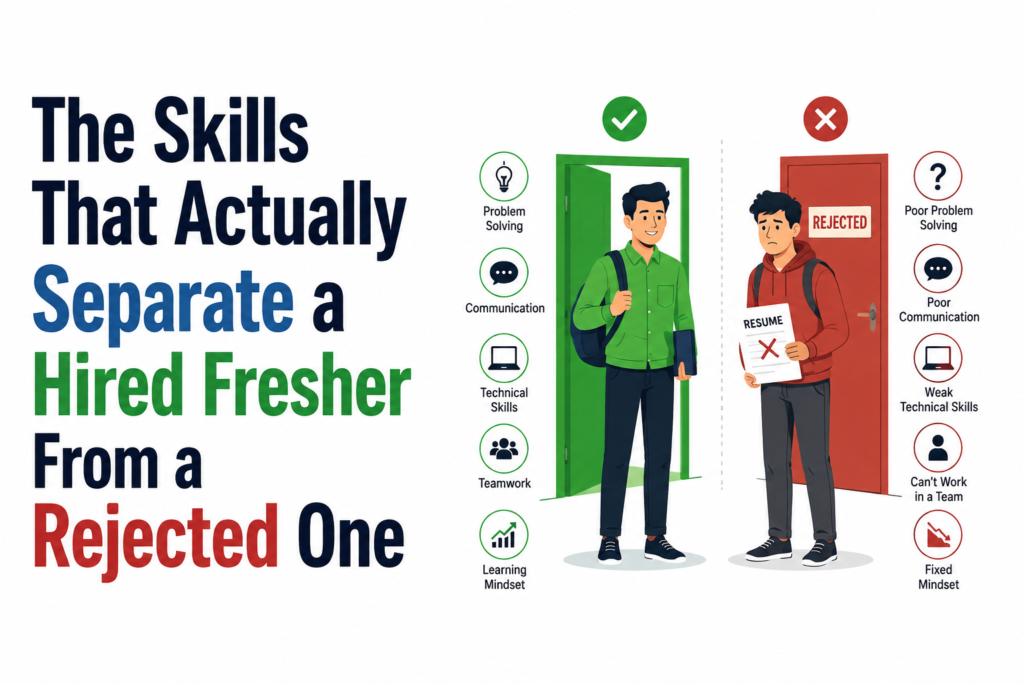
Certificates and course completions rarely decide the final outcome. What decides it is whether a candidate can hold a conversation about their own work without hesitation. The engineers who get hired consistently share a few traits: they can explain the difference between synthesis and simulation without confusion, they understand basic scripting well enough to automate a repetitive task, and they can walk through a static timing analysis report and point out a violation.
Familiarity with SystemVerilog and verification methodologies has become a strong differentiator, even for freshers targeting design roles rather than pure verification. So has comfort with Linux-based environments, since almost every EDA tool runs inside one. None of these skills require years of experience to build; they require deliberate practice on real, even if small, projects rather than passive video-watching. This is precisely the gap that a well-structured, project-heavy VLSI course in Noida or any serious training program aims to close, because theory alone rarely survives contact with a live interview panel.
5. Where Regional Hubs Like Noida Fit Into the Bigger Hiring Map

India’s semiconductor hiring map is no longer limited to Bangalore and Hyderabad. With government-backed investment flowing into the broader ecosystem, design and verification work is gradually spreading into the National Capital Region, and Noida has started building a visible presence in this shift. Training centers offering a focused VLSI course in Noida have grown alongside this demand, giving candidates in North India a local pathway into design and verification roles without necessarily relocating early in their career.
This regional spread matters because it changes how freshers should think about their first job. A strong project portfolio built during a structured VLSI course in Noida can now open doors to remote-first design service roles, satellite offices of larger companies, or fully local semiconductor startups that are increasingly setting up shop outside the traditional hubs. The map is widening, and freshers who position themselves early in these growing regional clusters often face less competition than those chasing the same handful of well-known companies in Bangalore.
Conclusion
Getting hired into a semiconductor company as a fresher has very little to do with luck and almost everything to do with preparation that matches how the industry actually tests people. Recruiters are not looking for perfect answers; they are looking for engineers who understand the reasoning behind their own work and can hold up under a live technical conversation. Whether that preparation happens through a design services stint, a self-driven project, or a structured VLSI course in Noida, the companies hiring in 2026 are consistently rewarding depth over polish. The freshers who understand this distinction early are the ones who stop collecting rejections and start collecting offers.
1. How do semiconductor companies hire VLSI freshers?
Most companies assess digital electronics, Verilog, RTL concepts, projects, coding, aptitude, and interview performance before hiring VLSI freshers.
2. What skills do semiconductor companies expect from VLSI freshers?
Strong digital electronics, Verilog, SystemVerilog, Linux, scripting, and hands-on VLSI projects improve hiring chances.
3. Do VLSI projects help freshers get hired?
Yes. Practical RTL Design, Verification, DFT, or Physical Design projects demonstrate real-world skills and strengthen your resume.
4. Which VLSI domain is easiest for freshers?
RTL Design, Design Verification, DFT, and Physical Design are popular entry-level domains with strong demand for trained freshers.
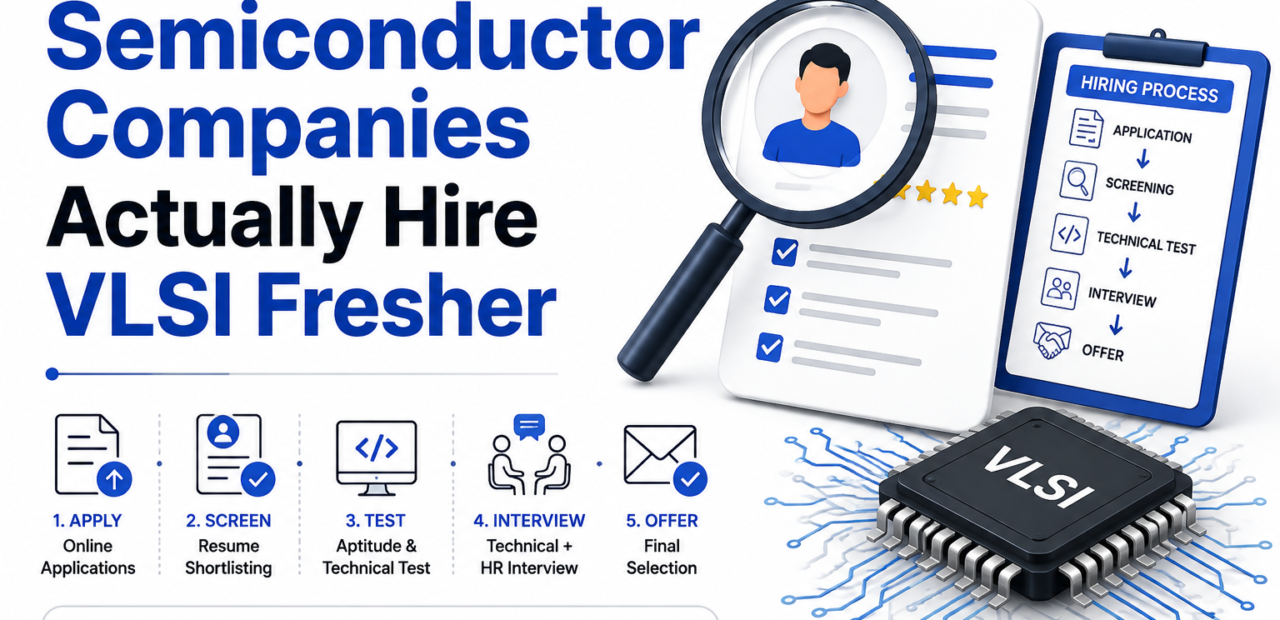
5. What is the VLSI hiring process for freshers?
The process usually includes resume screening, aptitude, technical interviews, coding or HDL tests, and an HR interview.