

CXMT IPO Marks Major Step in China’s Semiconductor Push

For years, China talked about breaking free from foreign memory chips. This week, one company actually did something about it, and the stock market noticed in a big way.
ChangXin Memory Technologies, better known as CXMT, just pulled off one of the wildest stock market debuts Asia has seen in a long time. Shares more than quintupled on their first day of trading in Shanghai, turning a homegrown DRAM maker into the most valuable listed company in China, ahead of even the country’s largest bank. For an industry that China has spent a decade trying to crack, this is a moment worth paying attention to.
What CXMT Actually Is
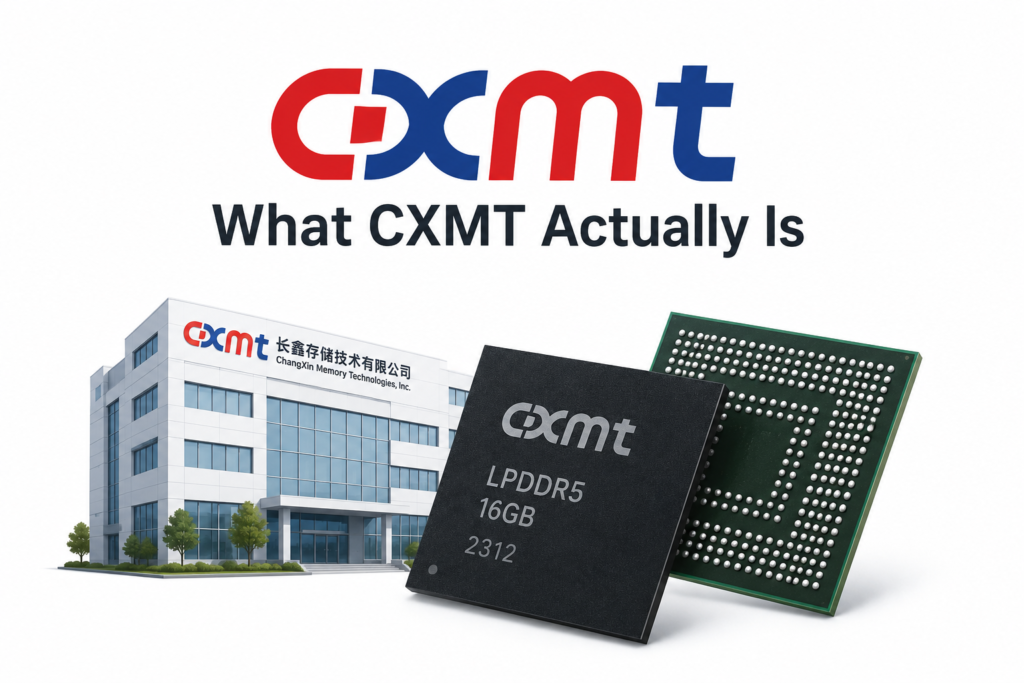
CXMT is not a brand-new name, even though it feels like one to most people outside the chip world. The Hefei-based company was founded in 2016 with heavy backing from the Chinese government, built specifically to reduce the country’s dependence on foreign DRAM suppliers. DRAM, or dynamic random-access memory, is the kind of chip that sits inside almost every phone, laptop, server, and increasingly, every AI data center on the planet.
Until now, that market was essentially a closed club. Samsung, SK Hynix, and Micron controlled the vast majority of global DRAM production, and cracking into that group required years of capital, engineering talent, and manufacturing scale that few companies could match. CXMT has spent nearly a decade quietly building that capability, and it has now grown into the world’s fourth-largest DRAM producer, holding roughly 7.67 percent of the global market based on last year’s sales figures.
Inside the IPO Numbers

The listing itself was priced at 8.66 yuan per share on Shanghai’s STAR Market, a board specifically created for high-growth tech companies. CXMT raised close to 57.92 billion yuan, around 8.6 billion dollars, making it the biggest IPO in Asia so far this year. If the overallotment option gets fully exercised, that number could climb even higher.
What happened next is the part that grabbed headlines. Shares surged nearly 466 percent on debut day, pushing CXMT’s market capitalization to roughly 3.3 trillion yuan. That figure alone was enough to overtake Industrial and Commercial Bank of China, previously the country’s most valuable listed firm. It’s a rare thing for a chipmaker, even a successful one, to leapfrog a national banking giant in a single trading session.
Part of the excitement comes from timing. Revenue at CXMT reportedly grew close to sevenfold in the first half of the year, driven largely by a global memory shortage tied to surging AI infrastructure demand. Reports have also surfaced that Apple has begun testing CXMT’s memory chips for devices sold within China, which, if confirmed at scale, would be a significant vote of confidence from one of the world’s most demanding buyers.
Why This Matters for China’s Chip Strategy
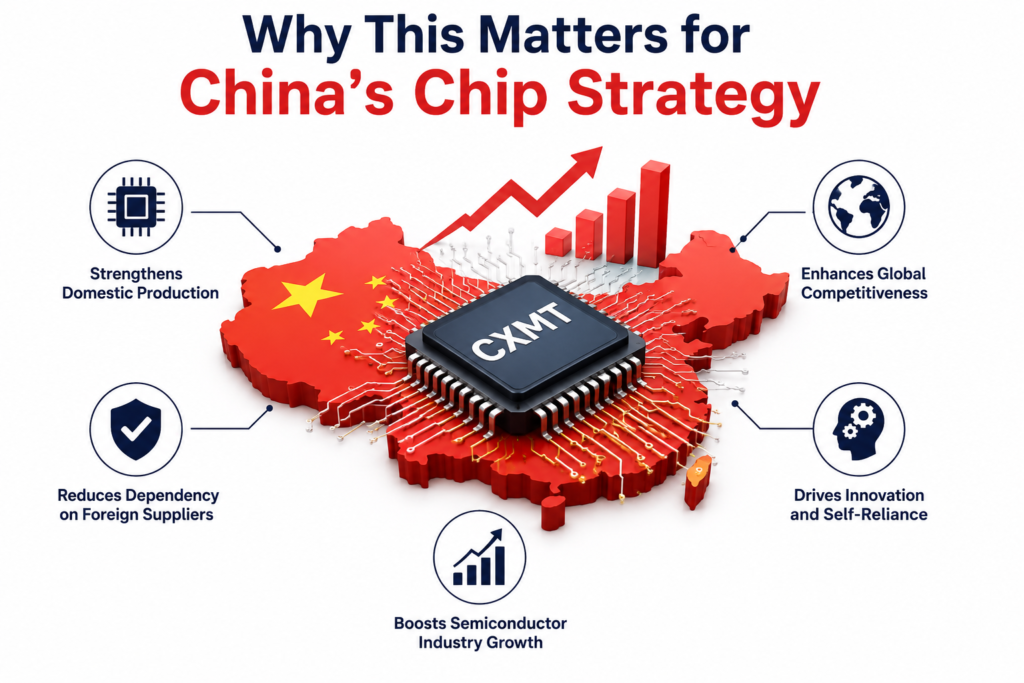
China’s push for semiconductor self-sufficiency isn’t new, but it hasn’t always produced visible wins. Export restrictions from the US and its allies have made it harder for Chinese companies to access advanced lithography tools and foreign components, forcing firms like CXMT to lean on domestic suppliers wherever possible. That approach is slower and often more expensive, but it also builds a supply chain that’s harder to disrupt from the outside.
CXMT’s rise shows that this strategy is starting to pay off, at least in the memory segment. The company has stated plans to move into high-bandwidth memory, the specialized chip type used in AI accelerators from companies like Nvidia. That’s a notable ambition, since HBM production is technically demanding and currently dominated almost entirely by SK Hynix and Samsung. Success here wouldn’t just help CXMT financially, it would give China a foothold in one of the most strategically important corners of the AI hardware stack.
Money raised from the IPO is expected to go mostly toward scaling up wafer production, which suggests CXMT is planning to compete on volume as much as on technology. In an industry where fabrication capacity often decides who wins price wars, that’s a meaningful signal about the company’s long-term intentions.
What It Means for the Rest of the Industry
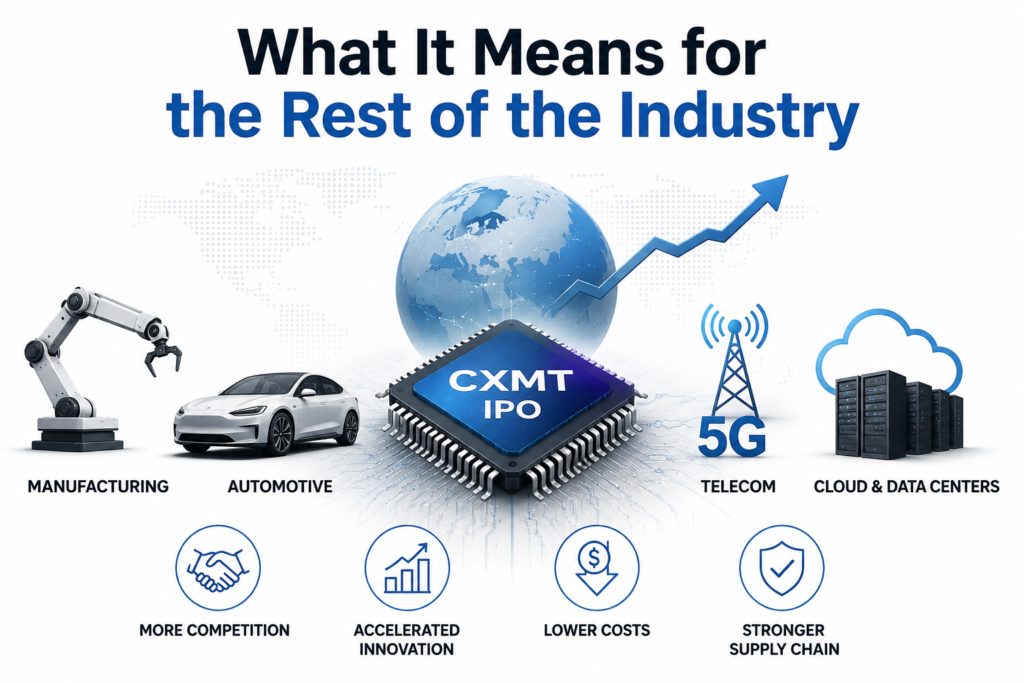
The ripple effects reached well beyond Shanghai. Shares of Micron, Samsung, and SK Hynix all dipped following CXMT’s debut, as investors weighed the prospect of a fourth serious competitor entering a market that has operated as a stable oligopoly for years. Analysts have been quick to point out that CXMT still trails its rivals technologically by several years, so this isn’t an overnight disruption. But markets tend to price in direction, not just current position, and the direction here looks clear.
There’s also a broader lesson for anyone tracking the semiconductor space. Memory chips have quietly become one of the most contested battlegrounds in the AI era, since every large language model, every data center buildout, and every next-generation device depends on a steady, affordable supply of DRAM and HBM. A new, government-backed player with serious manufacturing scale changes the competitive math for everyone, from pricing to future capacity planning.
Some industry voices have already cautioned that current profit margins across the memory sector are unusually high and unlikely to hold at this level indefinitely. That’s worth keeping in mind before reading too much into any single quarter’s numbers. Still, even with that caveat, CXMT’s listing marks a genuine turning point. It’s proof that China’s semiconductor ambitions have moved past the planning stage and into real, market-tested execution, and the rest of the industry will need to plan around that reality going forward.