



AI in RTL Design and Verification: Transforming Modern Chip Development

A single chip today can carry billions of transistors, yet the teams building it haven’t grown a billion times bigger. Something had to give — and that something is AI quietly rewriting how RTL gets written, checked, and signed off.
For years, RTL design and verification followed a familiar rhythm: write logic by hand, simulate it, debug it, repeat until coverage numbers looked acceptable. That rhythm is breaking. Large language models can now draft synthesizable RTL for common blocks, and agentic AI systems are starting to run entire verification cycles with far less manual babysitting. This shift isn’t hype — major EDA vendors have already demonstrated verification workflows running dramatically faster than traditional flows, and the pace of change is only picking up.
Why RTL Design Is Getting Harder to Do Manually
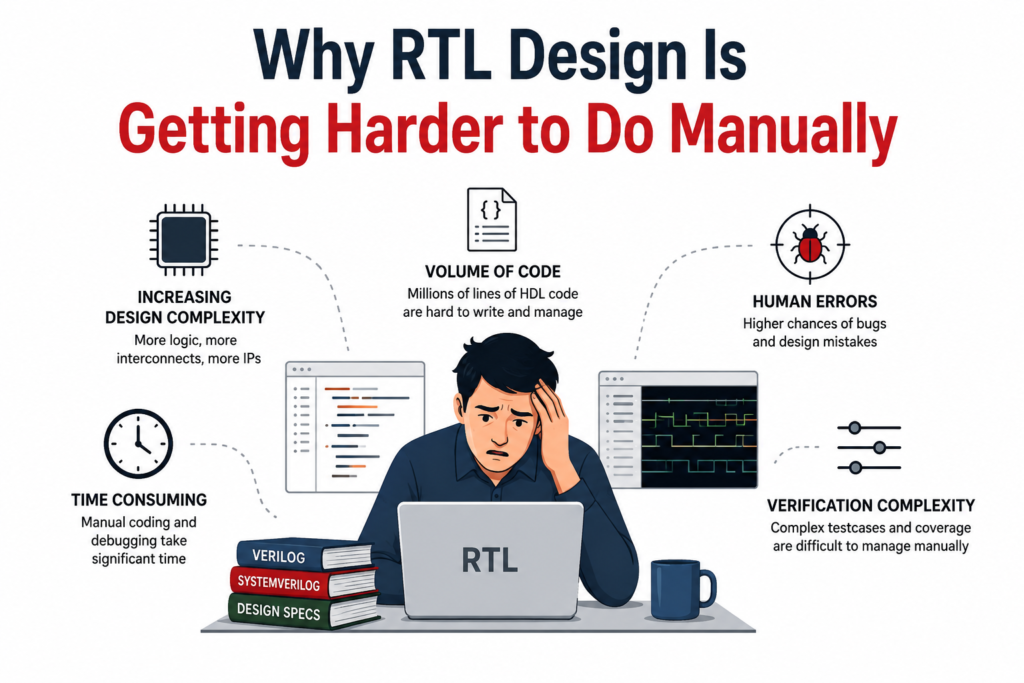
Chip complexity has outpaced the traditional design methodology. Every new node brings more IP blocks, tighter power budgets, and shorter time-to-market windows. Engineers are expected to verify more corner cases in less time, using the same headcount they had a decade ago. This gap between complexity and capacity is exactly where AI has found its opening. Instead of replacing designers, AI tools are absorbing the repetitive, low-judgment work — writing boilerplate logic, generating glue code, translating specifications into structured formats — so that human attention goes toward the parts of a design that actually need deep reasoning, like timing-critical datapaths or architectural tradeoffs.
How AI Is Changing RTL Design Itself

Language models have moved past being a novelty for generating a counter or a FIFO. They’re now reliably used for well-understood, easy-to-verify blocks: protocol adapters, controllers, arbiters, and other logic with a clear specification. What’s changed isn’t blind trust in AI-generated code — it’s a sharper understanding of where it helps and where a human still has to take the wheel. One place AI has proven surprisingly strong is repair work: feed a model a synthesis error or a failing simulation log, and it can often spot a width mismatch, a missing reset, or a dangling assignment faster than a human scanning through waveforms. Large, performance-critical pipelines still go through careful manual design, but the scaffolding around them is increasingly AI-assisted.
Agentic AI and the New Era of Verification

Verification has historically been the biggest bottleneck in chip development, and it’s also where AI is making the loudest impact. Instead of automating single steps in isolation, agentic AI now operates across the whole verification workflow — reading a specification, building a mental model from RTL and test code, generating coverage points and testbench code, running the tools, and then tracing failures back to the original spec to explain what went wrong. When RTL changes mid-project, these systems can identify exactly which tests need to be rerun and which ones are now irrelevant, cutting down on wasted simulation cycles. Some EDA vendors have already reported verification workflows completing tens of times faster than before, with meaningfully higher coverage, thanks to this kind of autonomous orchestration. It doesn’t remove engineers from the loop — sign-off decisions still need human judgment — but it removes an enormous amount of the manual coordination that used to eat up a verification engineer’s week.
The Push Toward a “Golden Specification”

One of the more interesting developments shaping this space is the idea of a golden specification: a single, machine-readable, and unambiguous reference document that every team — RTL designers, formal verification engineers, testbench writers, and firmware developers — can consume without losing meaning in translation. Today, specifications are scattered across documents, spreadsheets, and tribal knowledge, which makes it hard for AI tools to reason about intent reliably. A golden specification would give AI systems an authoritative ground truth to check generated RTL and testbenches against, making correctness something that can actually be measured rather than assumed. It’s still early, and building a spec that’s precise enough for both humans and machines to trust is a real engineering challenge, but it’s the direction the industry is clearly heading.
How to Learn RTL Design in the AI Era
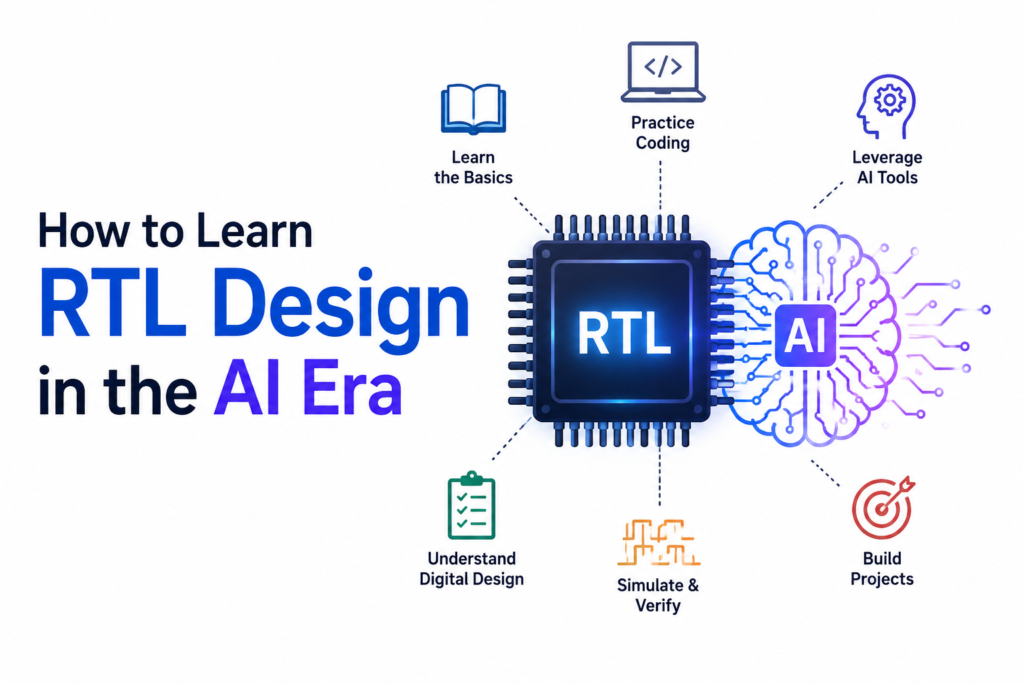
If you’re trying to figure out how to learn RTL design today, the honest answer is that the fundamentals haven’t changed — only the tools around them have. You still need a solid grip on digital logic, timing, finite state machines, and how a synthesizer turns your code into gates. What’s different is that AI can now act as a fast, tireless practice partner: it can explain why a piece of RTL behaves unexpectedly, suggest cleaner ways to structure a module, or generate a testbench skeleton you can build on. A good rtl design and verification course today should teach both sides of that coin — the core hardware description language skills that never go out of style, and how to responsibly use AI assistance without becoming dependent on it for things you don’t actually understand. Practicing on real projects, reading other people’s RTL, and getting comfortable with simulation and coverage tools will always matter more than any single tool you use along the way.
Final Thoughts
AI in RTL design and verification isn’t a distant trend anymore — it’s already reshaping daily workflows inside chip companies, from startups to the largest EDA vendors. The engineers who benefit most won’t be the ones who avoid these tools out of caution, nor the ones who hand over judgment entirely. They’ll be the ones who understand the fundamentals deeply enough to know when to trust AI-generated RTL, when to double-check it, and when to write it themselves. That balance is quickly becoming the most valuable skill in modern chip development.
1. What is AI in RTL Design and Verification?
AI uses machine learning to automate RTL coding, bug detection, verification, and optimization, making chip development faster and more accurate.
2. How is AI transforming RTL Design?
AI speeds up RTL development by generating code, optimizing logic, detecting errors early, and improving overall chip design productivity.
3. Can AI replace RTL Design engineers?
No. AI assists RTL engineers by automating repetitive tasks, but human expertise is still essential for architecture, design decisions, and debugging.
4. How does AI improve Design Verification?
AI identifies bug patterns, generates smarter test cases, predicts failures, and reduces verification time while improving chip quality.
5. Why is AI important in semiconductor design?
AI shortens chip development cycles, improves design accuracy, reduces costs, and helps engineers manage increasingly complex semiconductor designs.