

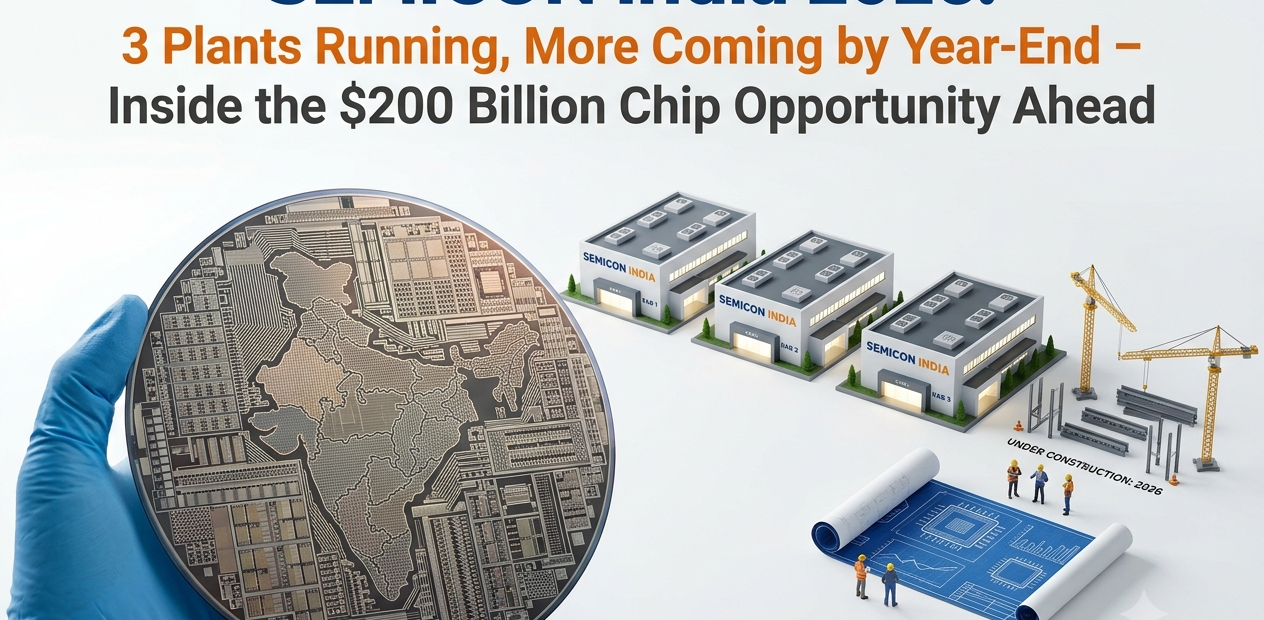
SEMICON India 2026: 3 Plants Running, More Coming by Year-End – Inside the $200 Billion Chip Opportunity Ahead

Three years ago, India didn’t manufacture a single commercial chip on its own soil. Today, three plants are shipping product, a fourth is racing to join them, and the country is preparing to host the world’s biggest names in semiconductors under one roof. That’s not a small shift — it’s the opening chapter of one of the most ambitious industrial bets India has made in decades.
With SEMICON India 2026 set to take place from September 17–19 in New Delhi, the spotlight is once again on how far the country’s chip mission has come, and how much further it still needs to go. Government officials are now talking openly about a $200 billion semiconductor market opportunity, built on a mix of assembly and testing plants already running, a first-ever wafer fabrication unit under construction, and a fresh policy push called Semicon 2.0. Here’s a clear, no-fluff look at where things actually stand.
Where India’s Chip Plants Stand Today
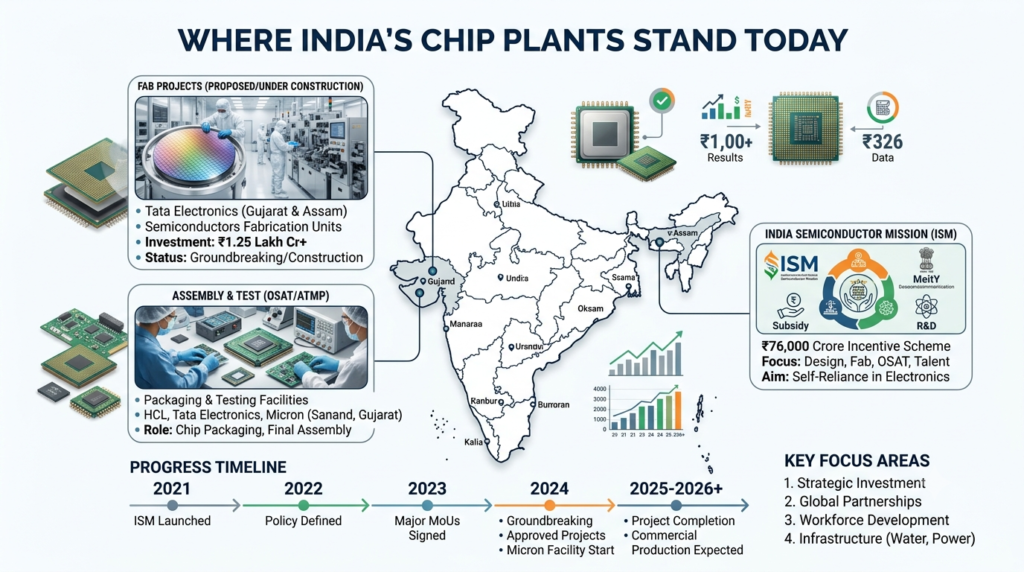
India’s semiconductor mission has moved from paperwork to production faster than most expected. Micron Technology’s Sanand facility became the country’s first operational plant, inaugurated on February 28, 2026, followed quickly by the Kaynes Semicon plant at Sanand on March 31. A third unit, the CG Semi outsourced assembly and test (OSAT) facility, also in Sanand, has since joined commercial production, taking the total to three plants actively shipping chips.
These are assembly, testing, and packaging (ATMP/OSAT) units rather than full wafer fabs, meaning they take imported silicon wafers and turn them into finished, packaged chips ready for use in electronics. That distinction matters, but it doesn’t diminish the milestone. Getting from groundbreaking to commercial shipment in roughly two years is a genuinely fast timeline by global industry standards, and officials have credited strong state-level execution, particularly in Gujarat, for keeping projects on schedule.
Union Electronics and IT Minister Ashwini Vaishnaw has said four plants are expected to be operational within 2026, with two more targeted for 2027. Of the twelve semiconductor projects approved so far under the mission, a handful are inching toward commercial output while the rest remain in earlier stages of construction or pilot runs.
Dholera: India’s First Front-End Fab and the Road to 2028
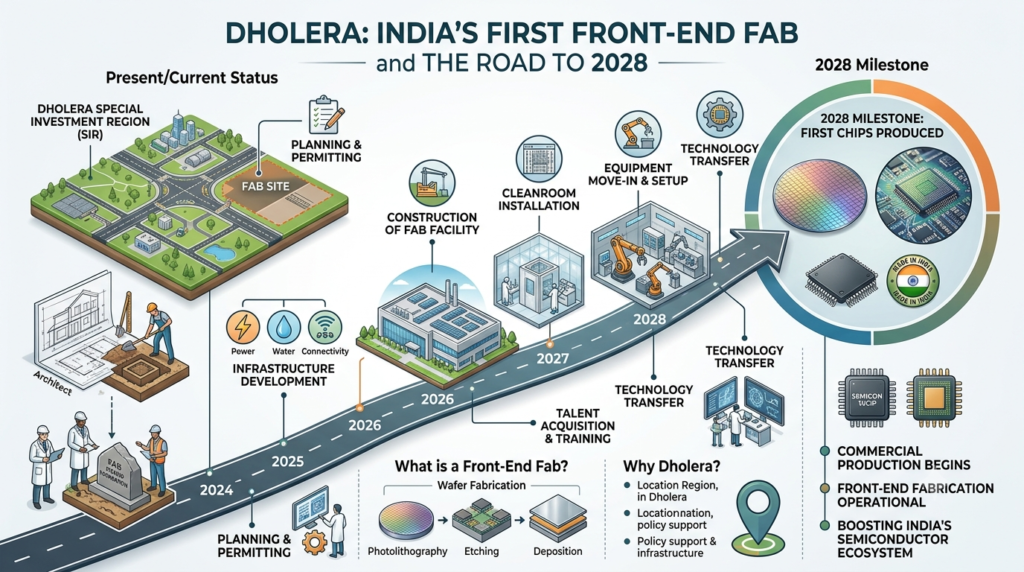
While packaging plants are grabbing headlines this year, the project everyone in the industry is really watching is Dholera, Gujarat. This is Tata Electronics’ front-end wafer fabrication facility, and it represents something India hasn’t done before: actually fabricating silicon circuits from raw wafers, not just assembling imported ones.
Tata partnered with Taiwan’s Powerchip Semiconductor Manufacturing Corporation to build the fab, and more recently signed an agreement with Dutch lithography giant ASML to secure the equipment needed to run it. Construction is underway, with commercial production targeted for around 2028 at a 90-nanometer process node — a mature node used widely in automotive, industrial, and power electronics rather than cutting-edge smartphone chips.
That choice of node isn’t a limitation so much as a strategy. Mature-node chips are in enormous global demand, face fewer supply bottlenecks, and let India build manufacturing muscle before attempting more advanced processes. Getting a front-end fab running at all, regardless of node size, is a genuine industrial achievement that very few countries have managed to pull off from scratch.
Semicon 2.0: The Bigger Policy Bet Behind the Boom
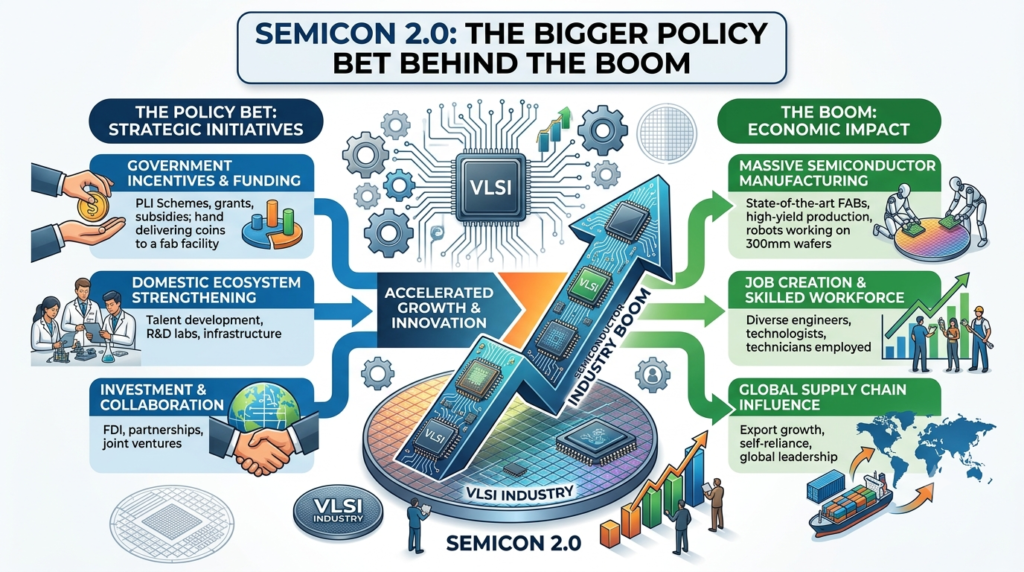
None of this expansion would be happening at this pace without sustained government backing. The original Semicon India Programme launched in 2022 with an outlay of ₹76,000 crore, aimed at kickstarting fabrication, display manufacturing, and packaging investment. That funding helped attract the first wave of plants now coming online.
In 2026, the government approved the next phase: Semicon 2.0, backed by an additional ₹1,27,500 crore (roughly $13 billion). This phase widens the focus beyond just building plants — it now covers semiconductor design, specialized equipment, materials and chemicals, and research infrastructure. That broader scope matters because India’s fabs currently import the overwhelming majority of their manufacturing equipment and specialty chemicals from abroad. Building a domestic supply chain around materials and tools, not just the chips themselves, is what will determine whether this industry becomes self-sustaining or stays dependent on imports indefinitely.
Semicon 2.0 also signals a shift in ambition: from proving India can assemble and package chips, to proving it can support the entire value chain, from raw materials to finished silicon.
Why the World Is Watching SEMICON India 2026
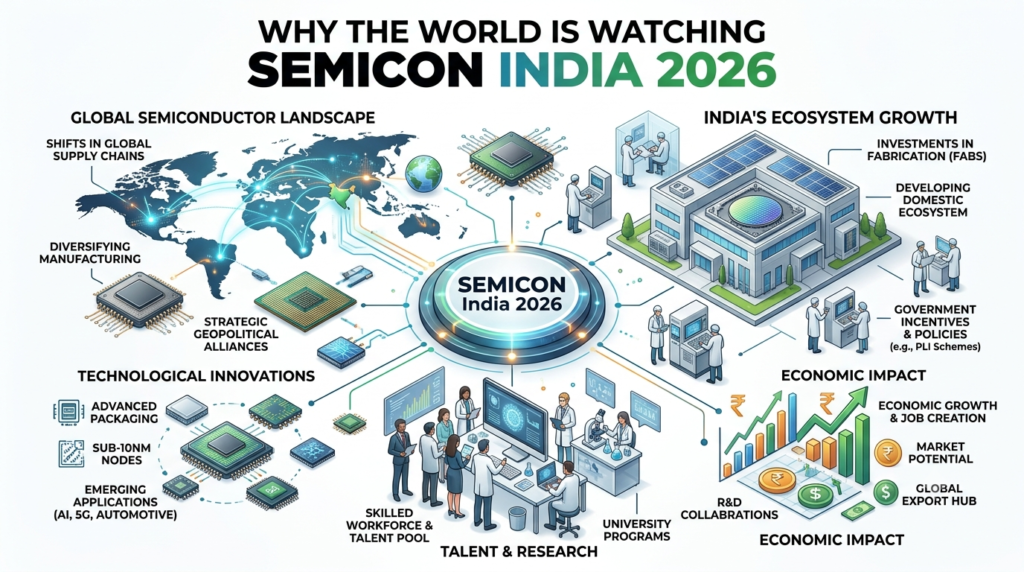
This year’s SEMICON India event carries more weight than previous editions simply because there’s now something tangible to show. Organized jointly by the India Semiconductor Mission and SEMI, the three-day conference at Yashobhoomi in Dwarka will bring together global CEOs, policymakers, and manufacturers under the theme “Business Opportunities Await.”
A day before the formal inauguration, Prime Minister Narendra Modi is expected to hold a roundtable with global semiconductor chief executives, echoing a similar session held at the 2025 edition where companies briefed him directly on investment plans. Industry participation at SEMICON India has reportedly grown by 30 to 40 percent annually, and organizers expect that momentum to continue this year, building on last year’s turnout of tens of thousands of attendees and hundreds of exhibitors from dozens of countries.
The $200 billion figure being floated by officials reflects where the government believes the domestic semiconductor market can land as demand from smartphones, automotive electronics, data infrastructure, and industrial systems keeps climbing. Whether India hits that number depends heavily on execution over the next few years: getting Dholera into production on schedule, expanding the ATMP base beyond the first few plants, and building the materials and equipment ecosystem that Semicon 2.0 is meant to support.
For now, the story is one of real, measurable progress rather than just announcements. Three plants are shipping chips. A fourth is close behind. A front-end fab is physically under construction. And in September, the people who decide where the next round of global chip investment goes will be sitting in a room in New Delhi, watching to see if India can keep this pace up.