

Physical Design vs RTL Design: Which VLSI Role Should You Choose?

Picture two engineers sitting in the same VLSI company canteen. One spends her day writing Verilog code that decides how a processor behaves. The other spends his day fighting timing violations at 2 AM before a tapeout deadline. Both are chip designers. Both are in high demand. Yet their jobs, mindsets, and career paths could not be more different — and picking the wrong one for your personality can slow your growth for years.
If you are trying to break into the semiconductor industry and keep hearing the terms “RTL design” and “physical design” thrown around without a clear answer on which one suits you, this guide breaks it down in plain language. No jargon overload, no fence-sitting — just a practical comparison so you can make a confident, informed choice about your VLSI career.
Both roles sit inside the same overall ASIC design flow, and understanding where each one fits in that pipeline makes the rest of this comparison much easier to follow. Think of chip creation as a relay race: RTL design runs the first leg by defining what the chip should do, and physical design runs the final leg by turning that definition into a manufacturable piece of silicon. Neither leg works without the other, which is exactly why both roles remain in steady demand across the industry.
What Does an RTL Designer Actually Do?
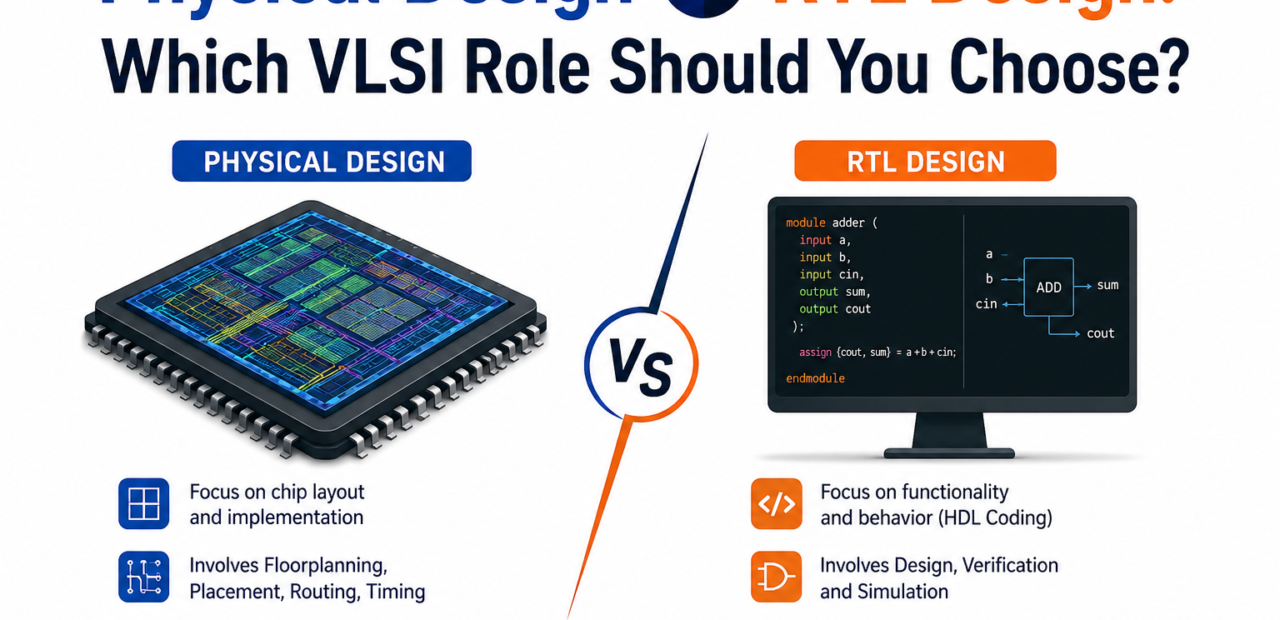
RTL, or Register Transfer Level design, is the front-end stage of chip creation. An RTL designer takes an architecture specification — essentially a blueprint of what the chip needs to do — and translates it into hardware description code using Verilog or VHDL. This code defines how data moves between registers, how logic blocks talk to each other, and how the final circuit will behave once it is powered on.
The daily grind here revolves around writing clean, synthesizable code, running simulations to catch bugs, debugging waveform outputs, and constantly refining the design against a functional specification. It is a role built for people who enjoy problem-solving at a conceptual level and like seeing how a system’s logic comes together piece by piece. Strong fundamentals in digital logic, computer architecture, and coding discipline matter far more here than deep knowledge of manufacturing processes.
What Does a Physical Design Engineer Actually Do?

Physical design is the back-end half of the same journey. Once the RTL code is verified and synthesized into a gate-level netlist, it lands on the desk of a physical design engineer, whose job is to turn that netlist into an actual chip layout that a fabrication plant can manufacture. This includes floorplanning, placement, clock tree synthesis, routing, and a long list of signoff checks covering timing, power, and manufacturability.
Physical design work is tool-heavy and detail-obsessed. Engineers spend their time inside platforms like Synopsys IC Compiler or Cadence Innovus, chasing timing closure, fixing congestion, managing IR drop, and squeezing every bit of performance out of silicon real estate at nodes as small as 5nm or 3nm. If you enjoy hands-on optimization, working against hard physical constraints, and seeing a design physically take shape, this side of the flow tends to feel more rewarding.
On top of the technical side, RTL work also demands patience for long simulation cycles and a habit of reading specification documents carefully, since a single misread requirement can ripple into weeks of rework later in the flow. Engineers who move up in this track often end up owning entire IP blocks or subsystems, working closely with architects to translate high-level product requirements into working hardware logic.
RTL Design vs Physical Design: The Real Differences
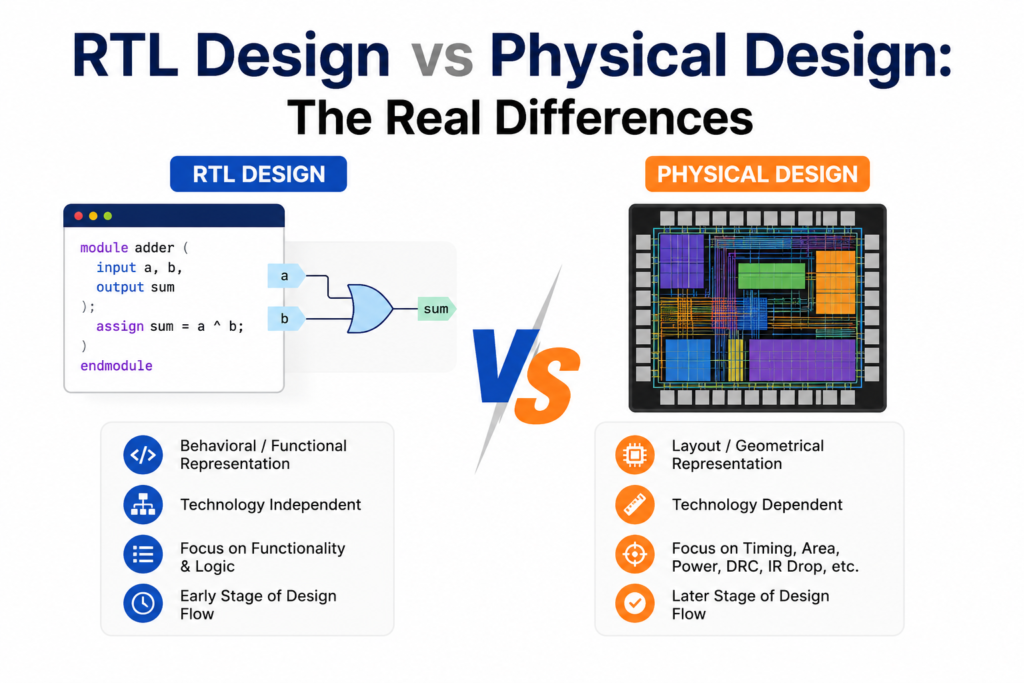
The honest answer to “which is better, RTL design or physical design” is that neither is objectively superior — they simply reward different strengths. RTL design leans toward abstract thinking, coding fluency, and functional correctness. Physical design leans toward precision engineering, tool mastery, and closing hard numerical constraints under deadline pressure.
Career-wise, RTL design often opens smoother paths into verification, architecture, and even software-adjacent roles later on, since the skillset overlaps with programming logic. Physical design, on the other hand, tends to build extremely specialized expertise that becomes harder to replace as chips move to advanced nodes — which is part of why experienced physical design engineers frequently command premium pay. Neither path is easier than the other; they simply test different muscles.
There is also a temperament factor worth naming honestly. Physical design work often comes with tighter tapeout deadlines and more late-stage firefighting, since timing and power issues tend to surface only after most of the layout is already in place. RTL design has its own pressure points too, mainly around functional bugs found late in verification, but the day-to-day rhythm is generally more predictable. Neither pressure style is worse than the other — it simply comes down to which kind of stress you handle better.
RTL Design vs Physical Design Jobs: Demand, Salary, and Growth
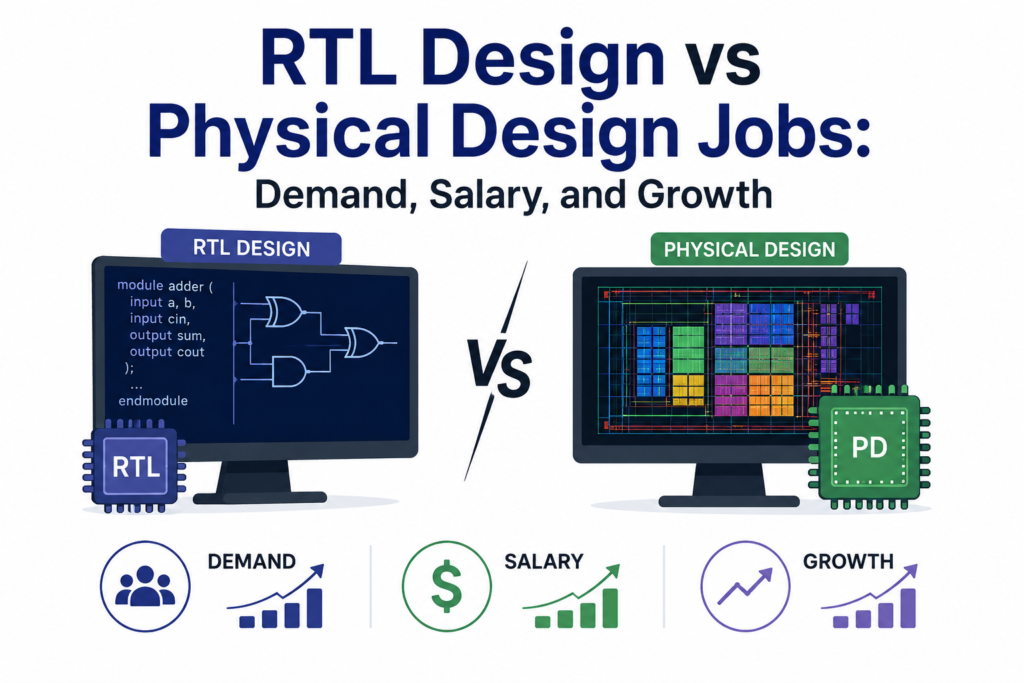
Job market data paints an interesting picture. RTL design openings tend to be more numerous because most companies need multiple engineers building and verifying logic blocks before a chip ever reaches layout. Physical design roles are fewer in number but historically harder to fill, since the tool expertise and signoff experience take longer to build — and that scarcity often translates into strong compensation once you cross the early-career stage.
India’s semiconductor push is reshaping this equation further. With Tata Electronics’ fab in Dholera targeting first silicon by the end of 2026, alongside new OSAT and packaging facilities coming up in Assam, Gujarat, and other states, demand is expanding well beyond the traditional design-only hubs. Government-backed programs under India’s Semiconductor Mission 2.0 are pushing investment into full-stack chip design capability, meaning both RTL and physical design talent are being absorbed faster than before, not just in Bengaluru but across a widening set of cities.
It’s also worth noting that pay bands in both tracks vary heavily by company, city, and node expertise rather than by role title alone. A physical design engineer working on advanced nodes at a top product company can out-earn many RTL peers, but an RTL engineer who moves into architecture or verification leadership can just as easily close that gap over time. Chasing the “higher paying” label early in your career matters far less than building deep, provable expertise in whichever track you pick.
Physical Design or RTL Design for Freshers: How to Choose
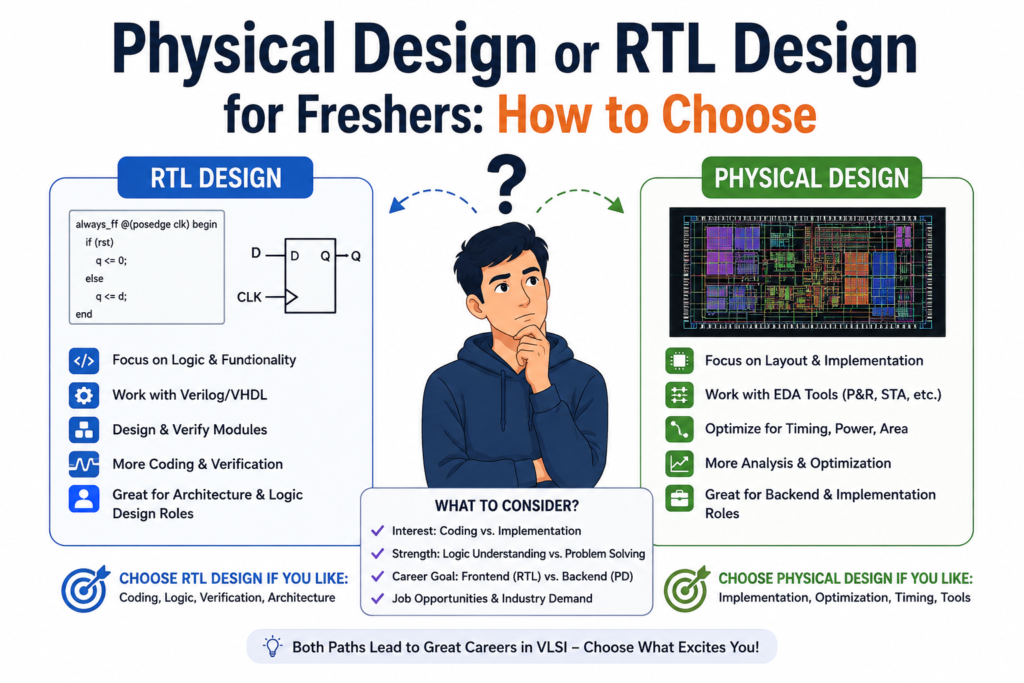
For someone entering the industry, the decision usually comes down to three honest questions. First, do you enjoy writing and debugging code more than working inside layout and analysis tools, or the other way around? Second, are you comfortable with the intense EDA-tool learning curve that physical design demands, or would you rather build strength in HDL coding and simulation first? Third, where do the open roles actually exist in the region or companies you’re targeting right now?
A practical approach is to build a small project in both directions — a simple RTL module simulated end-to-end, and a basic physical design flow run on an open-source or academic tool — before committing. That hands-on exposure tells you more about your natural fit than any amount of reading. Many engineers also start in RTL or verification and transition into physical design later, since a solid grasp of digital logic makes the back-end learning curve noticeably easier.
1. What is the difference between RTL Design and Physical Design?
RTL Design defines chip functionality using HDL, while Physical Design converts the logical design into a manufacturable chip layout through placement, routing, and timing.
2. Which is better: RTL Design or Physical Design?
RTL Design suits engineers interested in coding and digital logic, while Physical Design is ideal for those interested in chip layout, timing, power, and implementation.
3. Is RTL Design a good career in VLSI?
Yes. RTL Design is a strong VLSI career involving Verilog, SystemVerilog, digital design, synthesis concepts, debugging, and development of chip functionality.
4. Is Physical Design a good career in VLSI?
Yes. Physical Design offers strong career opportunities in floorplanning, placement, clock tree synthesis, routing, timing closure, power, and chip implementation.
5. Which is easier, RTL Design or Physical Design?
Neither is universally easier. RTL requires strong coding and digital logic skills, while Physical Design demands knowledge of timing, layout, EDA tools, and implementation.