


‘Chameleon’ Chip Adapts to Changing Data Speeds, Reducing Prediction Errors by Up to 40x

What if a single chip could rewire its own personality in real time — slowing down to catch a subtle change, then speeding up the moment the world around it moves faster? That is no longer science fiction. Researchers in South Korea have just built exactly this kind of device, and it is already being called a “chameleon” chip for the way it blends into whatever data speed it is fed.
The team, led by Chair Professor Shinhyun Choi at the Korea Advanced Institute of Science and Technology (KAIST), has unveiled a semiconductor called a programmable dynamic memtransistor, or PDM. Unlike conventional chips that respond to data in one fixed way, this device can be tuned to match fast-changing or slow-changing signals — and it remembers that tuning even without constant power.
In trials involving messy, mixed-speed data, the PDM cut prediction errors by as much as 40 times compared to standard fixed-response chips. That is a staggering leap for a field where even small accuracy gains usually take years to achieve, and it signals a real shift in how AI hardware could be designed going forward. Here is what makes this breakthrough worth paying attention to, and why it matters for the wider VLSI and semiconductor community.
What Exactly Is a Programmable Dynamic Memtransistor?
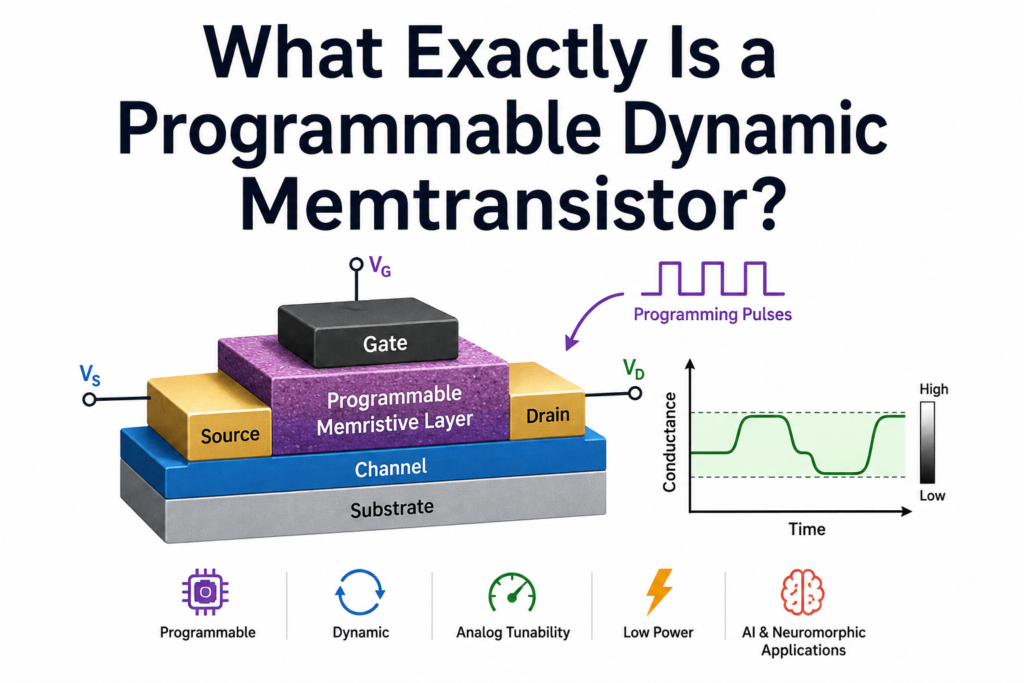
A memtransistor is a hybrid device that merges the storage ability of memory with the switching behavior of a transistor. Think of it as a component that does not just process information — it also holds onto a trace of what it has already seen, similar to how biological synapses work.
The PDM takes this a step further by allowing its time-response characteristics to be programmed into different states and locked in place. Once configured, it does not need continuous power to retain its settings, and it does not require heavy data preprocessing before use. Because the fabrication process is compatible with materials already used in mainstream commercial semiconductor manufacturing, it is realistic to scale this technology toward mass production rather than keeping it confined to a lab bench.
Why “Adapting to Data Speed” Is Such a Big Deal

Most digital systems today rely on software to interpret data that changes speed unpredictably — a hand moving quickly across a touchscreen, a self-driving car reacting to sudden obstacles, or a wearable sensor picking up irregular heartbeats. Handling this kind of variability usually means throwing more computation and power at the problem.
The PDM flips that approach. Instead of forcing software to compensate for a rigid chip, the hardware itself adjusts its response timing to match the incoming signal. When the device was tested on data where fast and slow patterns overlapped in complex ways, this built-in flexibility is what allowed it to reduce prediction errors by up to 40 times over fixed-response alternatives. In practical terms, that means less computational overhead, faster on-device decisions, and lower energy consumption — three things every AI hardware team is chasing right now.
Where This Technology Could Be Used First

The KAIST team has pointed to several real-world areas that stand to benefit almost immediately. Autonomous vehicles need to process rapidly shifting sensor data — road conditions, pedestrian movement, and traffic patterns — without lag. Robotics systems face similar demands when adjusting grip strength or navigation speed on the fly. Wearable health devices, which constantly track irregular biological signals like pulse or motion, are another natural fit.
Beyond these headline use cases, edge AI in general stands to gain. Devices that cannot rely on constant cloud connectivity — smart cameras, industrial sensors, portable diagnostic tools — need chips that can think for themselves locally. A device that adapts its own timing behavior without external retraining is a meaningful step toward smarter, more self-sufficient edge hardware.
What This Means for the Chip Design and VLSI Industry

This development is a reminder of how fast the boundary between memory, logic, and analog circuit design is dissolving. Programmable, self-adjusting devices like the PDM sit at the intersection of neuromorphic computing, memory engineering, and traditional transistor design — exactly the kind of interdisciplinary skill set that chip design teams are now hiring for.
For engineers and professionals looking to stay relevant as this shift accelerates, hands-on exposure to device physics, memory architectures, and analog-mixed signal design is becoming essential. This is one of the reasons interest in a structured VLSI course in Noida has been climbing steadily among people who want practical, industry-aligned training rather than theory alone. As chips increasingly blur the line between hardware and adaptive intelligence, professionals who understand both circuit-level design and system-level AI behavior will be the ones shaping what comes next in semiconductor innovation.
The PDM research was published in Nature Communications, adding academic weight to what is otherwise a fast-moving, commercially relevant story. Because the fabrication approach is compatible with existing commercial processes, this is not a device stuck years away from real deployment — it is one that chipmakers could realistically explore integrating far sooner than many recent lab breakthroughs.