

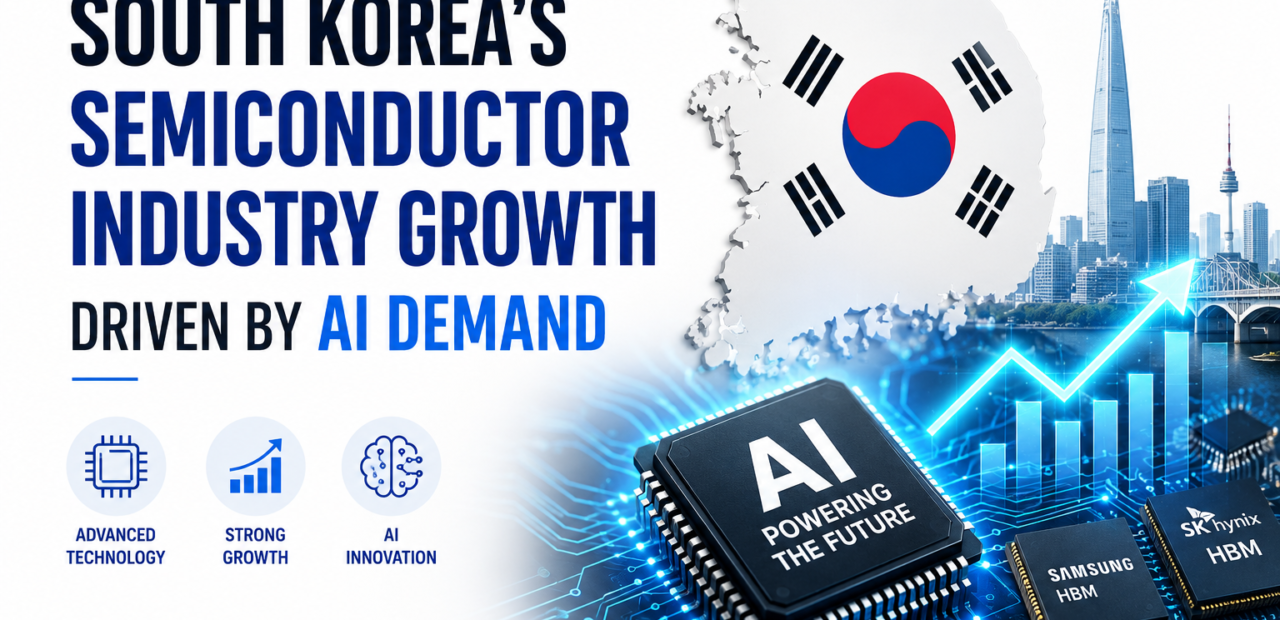
South Korea’s Semiconductor Industry Growth Driven by AI Demand

A quiet workshop revolution in Seoul, Cheongju, and Icheon is now moving global markets. What was once a story about memory chips and export numbers has turned into one of the defining industrial narratives of 2026 — and it is unfolding almost entirely because artificial intelligence needs somewhere to live.
South Korea’s chip exports have surged past records this year, with output climbing sharply and shipment values touching new highs. Behind those figures sits a single force: the explosive appetite for AI hardware. Samsung Electronics and SK hynix, the twin engines of the country’s economy, are now racing to build the memory that powers every large AI model on the planet. This is not a temporary spike — it is a structural shift in how the world’s chip supply chains are built.
The AI-Driven Memory Boom Reshaping Korean Chipmaking
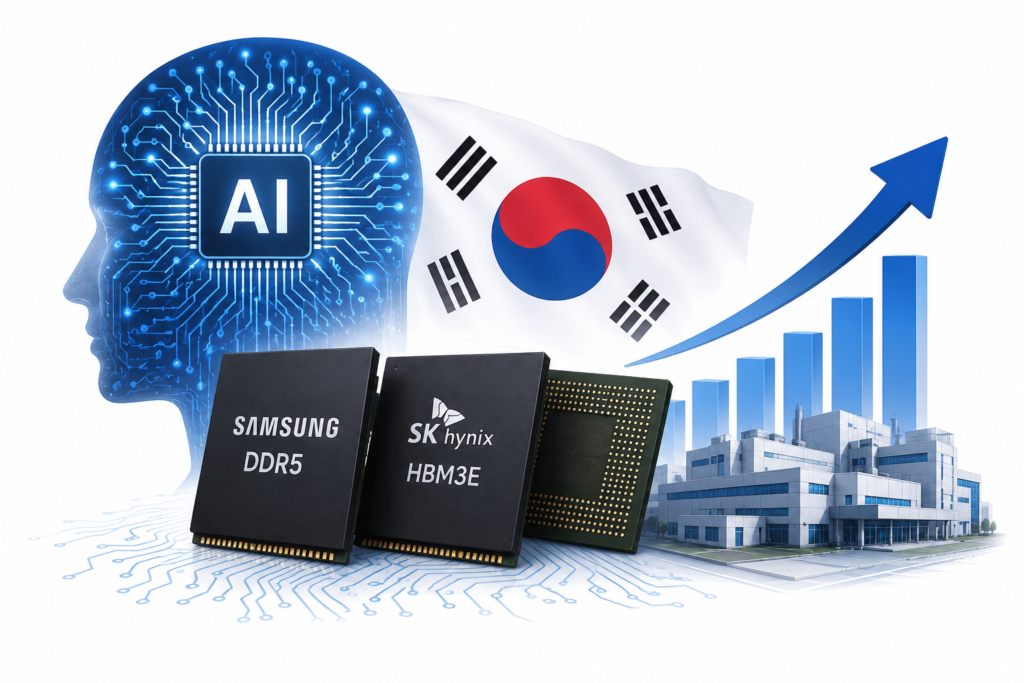
South Korea’s economy has always leaned heavily on semiconductors, but the scale of the current cycle is unusual even by that standard. The government recently revised its 2026 growth forecast upward to around 3%, marking the strongest projected expansion in five years, and officials pointed directly to the chip sector as the reason. Semiconductor output rose sharply through 2025 and accelerated further into early 2026, with exports reaching well over a hundred billion dollars in just the first few months of the year.
What is driving this is not general electronics demand but a very specific need: memory built for training and running AI models. Data centers around the world are being retooled for AI workloads, and each new generation of AI accelerator requires faster, denser, more power-efficient memory sitting right next to the processor. That has turned South Korea’s memory makers from commodity suppliers into strategic infrastructure providers, and pricing power has followed. Contract DRAM prices have risen dramatically over the past several months, reflecting just how tight supply has become relative to demand.
HBM4 and the Race to Solve AI’s Memory Wall
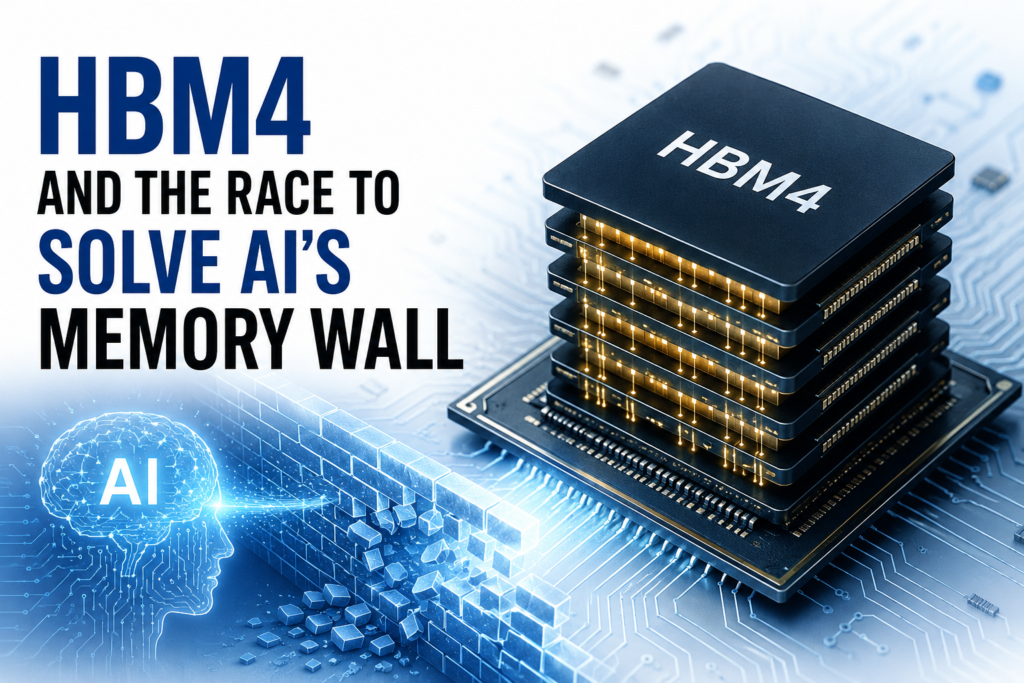
At the center of this boom is high-bandwidth memory, or HBM — a stacked memory technology that sits directly beside AI processors to feed them data fast enough to keep up with modern training and inference workloads. SK hynix built an early lead in this space with HBM3E and has been pushing hard into the next generation, HBM4, having already secured early mass-production capability and forming a dedicated HBM organization to manage the transition. Samsung, meanwhile, is treating HBM4 as a chance to prove that its memory, logic, foundry, and packaging divisions can work together as a single AI platform rather than separate businesses.
The stakes go beyond bragging rights. HBM4 is designed to address what engineers call the “memory wall” — the point where processing power outpaces the memory’s ability to deliver data, capping how fast AI systems can actually run. Analysts covering the space have estimated that SK hynix could command the majority share of the HBM4 market tied to next-generation AI platforms, while Samsung is investing aggressively in advanced packaging to close the gap. Both companies have also accelerated fab timelines by years rather than months, a sign of how urgent this race has become.
Government-Backed Investment Fueling a New Chip Ecosystem
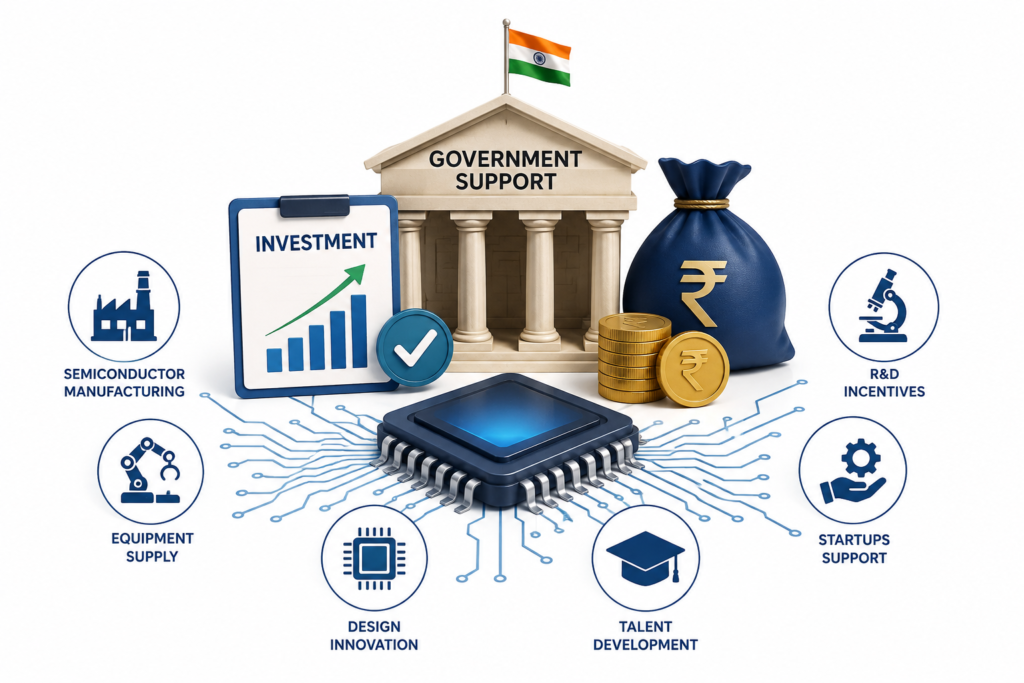
None of this expansion is happening by market forces alone. South Korea’s government has layered public investment on top of private capex to make sure the country stays ahead. Programs like the K-On-Device AI Semiconductor Technology Development Project are channeling hundreds of millions of dollars into building homegrown AI chip capability, with a goal of launching dozens of AI-focused system semiconductors before the end of the decade. A far larger National Growth Fund, worth close to a hundred billion dollars, is backing strategic industries including AI and semiconductors, and is directly supporting a wave of domestic AI chip and neural processing unit companies.
This dual-track approach — global memory giants scaling up alongside a new generation of specialized AI chip startups — is meant to close a gap policymakers have openly acknowledged. South Korea has long dominated memory manufacturing but lagged in system semiconductors, fabless chip design, and advanced packaging. The current AI cycle is being used as the moment to fix that imbalance, rather than simply riding the memory wave a second time.
Global Partnerships and the Road Ahead

The clearest sign of how central South Korea has become to the global AI supply chain is the scale of recent partnership deals. Samsung and SK hynix have locked in long-term AI chip supply agreements worth hundreds of billions of dollars with major US technology companies, securing high-bandwidth memory commitments that stretch out toward the end of the decade. Deals covering memory, foundry services, and advanced packaging are increasingly bundled together, reflecting how tightly these pieces now need to work as one system rather than separate products.
Supply is expected to stay tight for a while yet. Industry watchers generally agree that meaningful new HBM capacity will not arrive until 2027 or 2028, even with fabs being built and expanded at a faster pace than originally planned. That means the companies that already have capacity, relationships, and technical leadership are unusually well positioned for the next several years.