

VLSI Training in Pune 2026: Best Courses, Fees & Placement Support

What if the chip inside your smartphone, your car, or your smartwatch was designed by someone sitting right here in Pune? That’s not a distant dream anymore — it’s already happening, and the city is quietly becoming one of India’s strongest hubs for chip design talent.
With India’s semiconductor mission pushing billions into new fabs and design centres, the demand for trained VLSI professionals has never been higher. Pune, with its dense cluster of electronics companies, R&D centres, and engineering colleges, has turned into a natural home for serious VLSI learning. But with so many institutes claiming to be “the best,” picking the right one can feel overwhelming. This guide breaks down what actually matters — course quality, fees, curriculum depth, and real placement support — so you can make a decision based on facts, not marketing noise.
Why Pune Has Become a Hotspot for VLSI Learning

Pune’s tech ecosystem isn’t built overnight. The city already hosts a mix of multinational semiconductor offices, embedded systems companies, and product design teams, which creates a natural pull for chip-design talent. This is exactly why a vlsi training institute in pune tends to attract a steady stream of learners — the city offers proximity to real industry work, not just classroom theory.
Add to this the broader national push: new fabs, design-linked incentive schemes, and a growing number of fabless startups building original silicon for AI and automotive applications. All of this translates into more internships, more contract projects, and more entry points for someone trained locally. A good vlsi course in pune today isn’t just about learning Verilog syntax — it’s about being close to where the actual hiring is happening.
What a Good VLSI Training in Pune Should Actually Cover
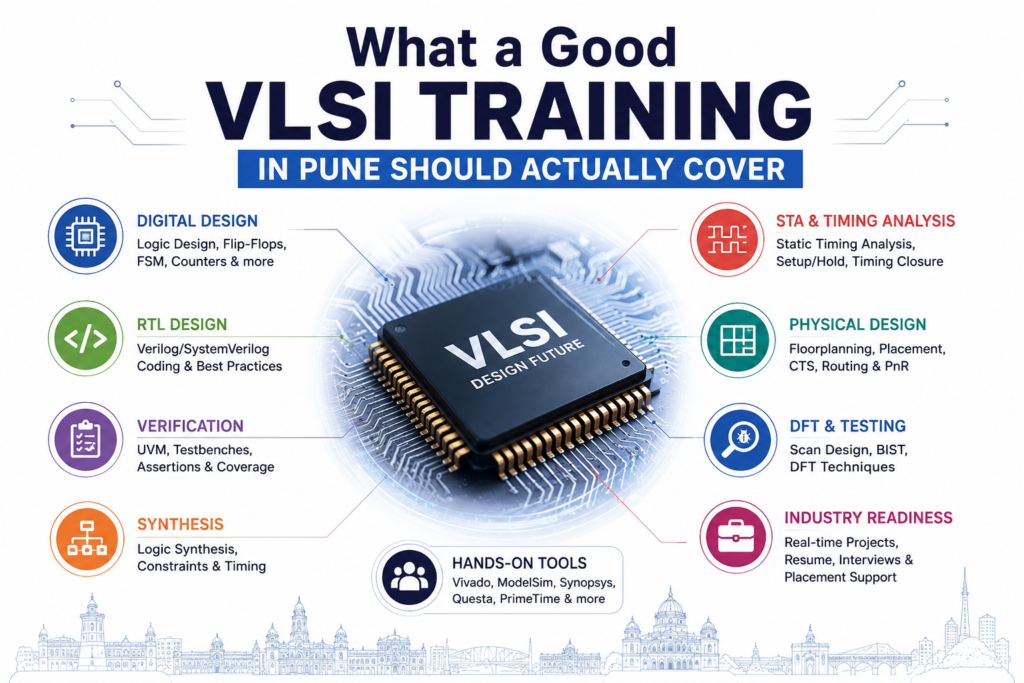
Not every vlsi training in pune program is built the same way, and this is where most people get confused. A strong curriculum usually moves through four connected stages: digital logic fundamentals, RTL design, functional verification, and physical design basics. Skipping any one of these creates gaps that show up painfully during interviews.
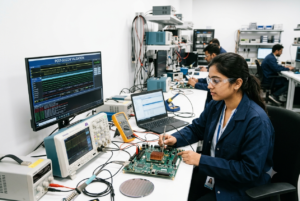
Look for training that includes hands-on lab work with industry-standard EDA tools, not just slide-based theory. Simulation, synthesis, and basic timing analysis exercises matter far more than memorized definitions. A well-structured program also builds in small projects — designing a simple processor module, running testbenches, or debugging waveform outputs — because recruiters increasingly ask for a portfolio, not just a certificate. If a program can’t show you a sample project or lab structure before you enrol, that’s a signal to ask more questions.
How to Learn RTL Design the Right Way
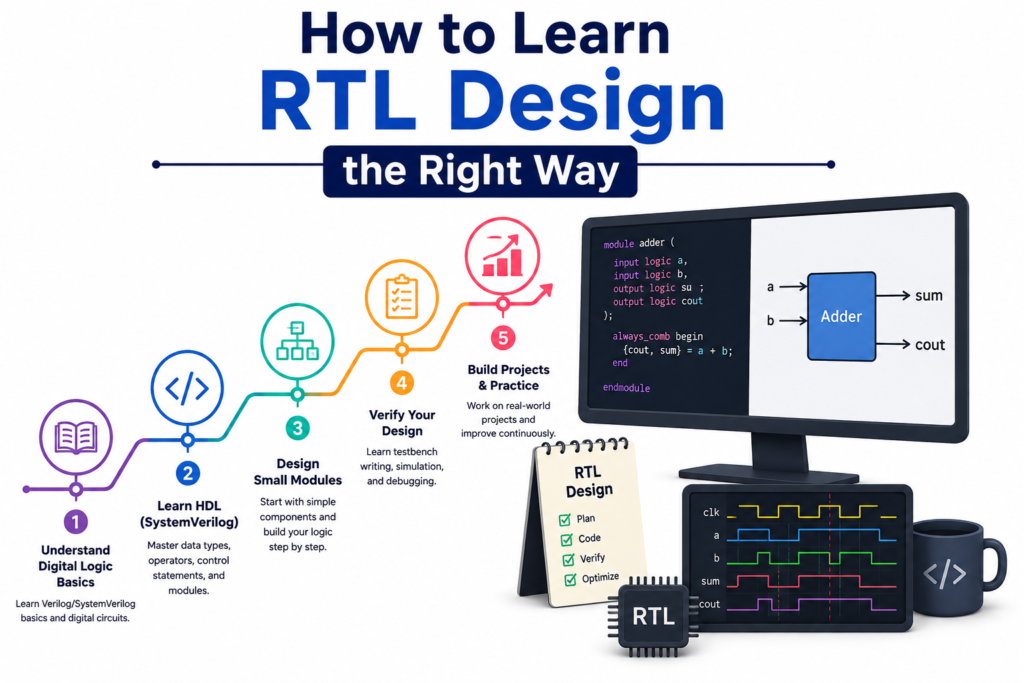
RTL design is the entry point for almost every VLSI career path, which is why so many people search for How to Learn RTL Design before choosing a course. The honest answer is that RTL design is learned by writing code, not by watching someone else write it.
Start with the basics of Verilog or SystemVerilog — data types, always blocks, and finite state machines — but don’t stop there. The real learning happens when you design something from scratch: a simple ALU, a UART controller, or a small memory controller, and then verify it against expected outputs. Mistakes at this stage are valuable; debugging a broken state machine teaches more than a dozen lecture slides ever will. If your training program pushes you toward building 3–4 small RTL projects rather than just covering syntax, you’re on the right track. Pair this with reading open datasheets and studying how real IP blocks are structured, since that habit alone separates confident RTL designers from those who only know the theory.
Comparing Fees Without Falling for the Cheapest Trap

Fees vary widely, and it’s tempting to just pick the lowest-priced option. But cost should be evaluated against what’s actually included — lab access, tool licenses, project mentoring, and doubt-clearing sessions all add real value that a low-cost, generic program often skips.
A reasonably priced vlsi course in pune should be transparent about what’s bundled: number of live sessions, access duration to recorded content, whether EDA tool licenses are provided or need separate installation, and how many projects are part of the curriculum. If a program is significantly cheaper than others but offers no lab access or minimal project work, the savings usually show up later as extra time spent covering gaps on your own. It’s worth comparing three or four options side by side on a simple checklist — curriculum depth, tool access, mentor availability, and project count — before fees become the deciding factor.
Placement Support: What to Actually Verify Before Enrolling
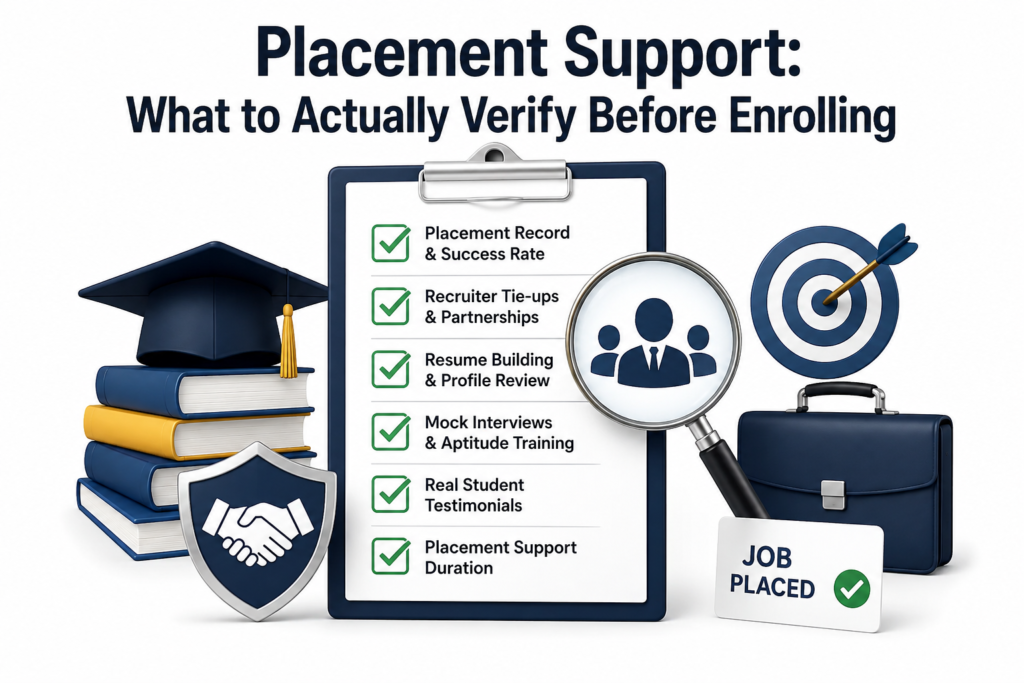
“Placement assistance” is one of the most overused phrases in training marketing, so it helps to know what genuine support looks like. Real placement support includes resume reviews tailored to VLSI roles, mock technical interviews covering RTL and verification concepts, and direct connections to hiring companies or referral networks — not just a generic list of job portals.
Ask specific questions: How many learners from the last batch actually got interview calls? Which companies have hired from this program recently? Is there a dedicated placement coordinator, or is it handled informally? A transparent program will answer these without hesitation and may even share verifiable outcomes. Genuine placement support also continues after the course ends — through interview scheduling help, doubt sessions before interviews, and sometimes soft-skill coaching for technical discussions, since VLSI interviews often test both depth of knowledge and clarity of explanation.
It also helps to check how a program handles follow-up support for those who don’t land an offer immediately. A responsible training provider will offer additional mock rounds, revised resume feedback, or extra referrals rather than treating placement as a one-time event. Semiconductor hiring cycles can be slower than typical IT recruitment, so patience paired with continued support usually matters more than a rushed placement guarantee.
Should You Choose an Online VLSI Course Instead?

Flexibility has made online learning a serious alternative to classroom training, and a well-designed vlsi online course in pune can match or even exceed in-person options if it includes live doubt-clearing sessions and remote lab access. The key is checking whether the online format still gives you real tool exposure — simulation software, waveform viewers, and synthesis tools — rather than just recorded lectures.
For working professionals or anyone balancing other commitments, online formats offer a practical middle ground: the same curriculum depth, but on a schedule that fits around existing responsibilities. What matters most is consistency — regular live interaction with a mentor, timely feedback on projects, and a structured pace, rather than a self-paced video library with no accountability.
Making the Final Decision
Choosing the right training path comes down to being honest about what you need: structured mentorship, hands-on project exposure, and support that continues through the interview process. Pune’s growing semiconductor ecosystem makes it a smart place to build this foundation, but the city alone won’t do the work — the quality of training you choose will.
Before enrolling anywhere, ask for a syllabus breakdown, a sample project, and details on placement outcomes. A program that’s confident in its value will never hesitate to share these details upfront. Take your time, compare properly, and choose training that treats your growth as the actual goal — not just another enrolment number.
The chip design field in India is still early in its growth curve, which means the people who build strong fundamentals now — through solid RTL practice, real project work, and genuine mentorship — are the ones best placed to benefit as the industry scales up over the next few years. Choose the training path that sets you up for that long game, not just a quick certificate.
1. Which is the best VLSI training institute in Pune in 2026?
Choose a VLSI institute offering RTL Design, Verification, Physical Design, DFT, hands-on projects, EDA tools, and strong placement support.
2. What is the average fee for VLSI training in Pune?
VLSI course fees in Pune generally range from ₹30,000 to ₹1,50,000, depending on the specialization, tools, course duration, and placement assistance.
3. Does VLSI training in Pune provide placement support?
Yes. Many Pune institutes offer placement assistance, mock interviews, resume preparation, and interview opportunities with semiconductor companies.
4. Which VLSI course is best for freshers in Pune?
RTL Design and Verification courses are ideal for freshers, providing strong digital design fundamentals and excellent job opportunities.
5. Can ECE students join VLSI training in Pune?
Yes. ECE, EEE, E&I, and related engineering graduates are eligible for most VLSI training programs in Pune.