
M.B. Patil Showcases KWIN City to Luxembourg Investors, Announces Japan Semiconductor Roadshow

What happens when a European steel-and-space powerhouse sits across the table from a state that wants to become India’s chip capital? You get exactly the kind of conversation Karnataka just had with Luxembourg, and it tells us a lot about where the next wave of semiconductor money is heading, and why this particular meeting mattered far more than a routine diplomatic photo opportunity.
Karnataka’s Minister for Large and Medium Industries, M.B. Patil, has been on a global charm offensive lately, and his latest stop was Luxembourg, where he pitched the ambitious KWIN City project to a delegation of investors. In the same breath, he confirmed that Karnataka is now setting its sights on Japan, with a dedicated semiconductor roadshow planned in Fukuoka. Two announcements, one clear message: Karnataka wants to be a serious player on the global chip map.
What Is KWIN City, and Why Does It Matter?
KWIN City stands for Knowledge, Wellbeing, and Innovation City, and it’s being developed along the Doddaballapura-Dabaspete corridor near Bengaluru. This isn’t a small industrial park; it’s a mega-project envisioned as a futuristic hub for advanced manufacturing, research, and technology-led growth, backed by an investment that runs into tens of thousands of crores. A dedicated 200-acre zone within KWIN City has already been earmarked for a semiconductor park, designed to give chip companies ready-to-use infrastructure rather than making them build from scratch. For an industry where speed to production matters as much as technical capability, that kind of plug-and-play readiness is a genuine differentiator.
The Luxembourg Pitch: More Than Just a Courtesy Visit
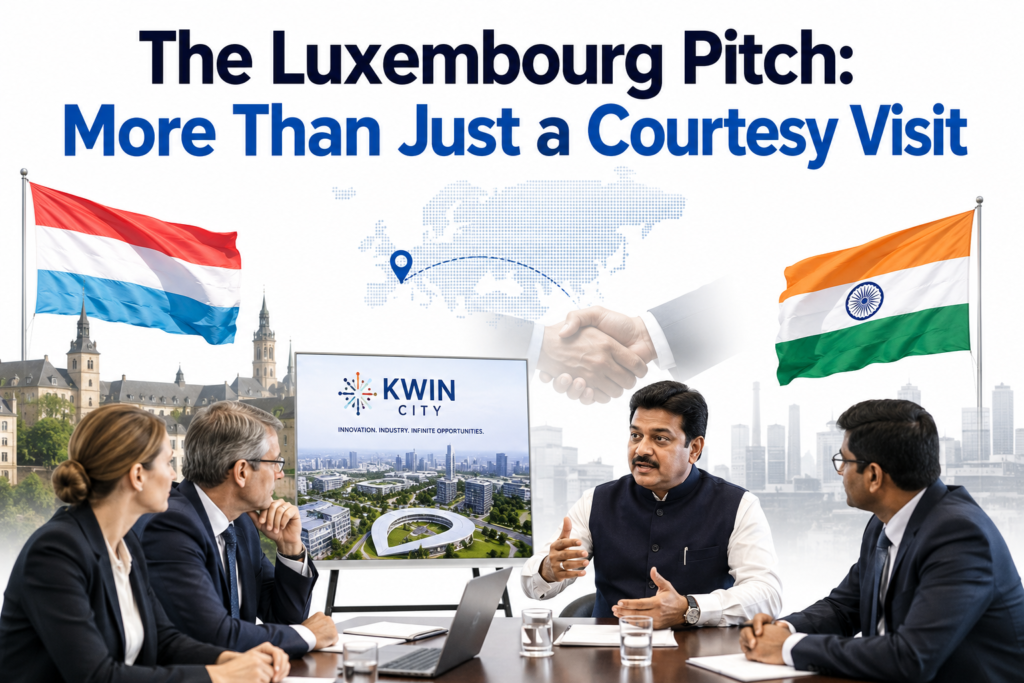
During his meeting with the Luxembourg delegation, Patil didn’t just describe KWIN City on paper. He invited Luxembourg’s companies, universities, and innovation agencies to actively partner in the project, framing it as an open invitation rather than a one-way sales pitch. This matters because Luxembourg, despite being one of Europe’s smallest countries, punches well above its weight in specialised industrial sectors. Getting its institutions to co-invest or collaborate on research could bring technical depth to KWIN City that goes beyond just capital.
Existing Ties: Ceratizit, Infosys, and Wipro as Proof Points

Rather than starting the relationship from zero, Patil pointed to existing links between Karnataka and Luxembourg as evidence that this partnership already has momentum. Luxembourg-based Ceratizit already manufactures advanced cutting materials in Karnataka, giving the state a working example of Luxembourg industrial expertise operating on Indian soil. On the flip side, Bengaluru-headquartered IT giants Infosys and Wipro both have operations in Luxembourg, showing that the economic relationship runs both ways. Patil also highlighted Luxembourg’s strengths in steel, automotive engineering, clean energy, industrial equipment, and space technology, sectors that align closely with what a modern manufacturing hub like KWIN City would eventually need.
Setting Sights on Japan: The Fukuoka Semiconductor Roadshow

While the Luxembourg meeting was about long-term collaboration, Patil’s second announcement was more immediately actionable. Karnataka will organise an investment outreach programme in Fukuoka, Japan, specifically aimed at attracting Tier-2 semiconductor companies and deepening ties with Japan’s semiconductor ecosystem. This decision followed a separate meeting with C. Ramkumar, the Consul General of India in Fukuoka, where discussions covered Karnataka’s policy support framework, its existing semiconductor ecosystem, research and development capabilities, and its extensive network of Global Capability Centres. Fukuoka itself has become a genuine hotspot for semiconductor activity in Japan, regularly hosting large industry expos that draw thousands of visitors and hundreds of exhibitors from across the global chip supply chain, so choosing it as the venue is a deliberate, well-informed move rather than a random destination pick.