


Karnataka Bets on AI, Robotics and Semiconductors with 6 New Technology Initiatives at BTS 2026

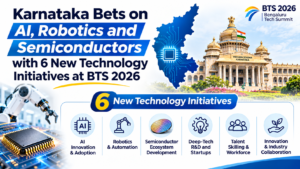
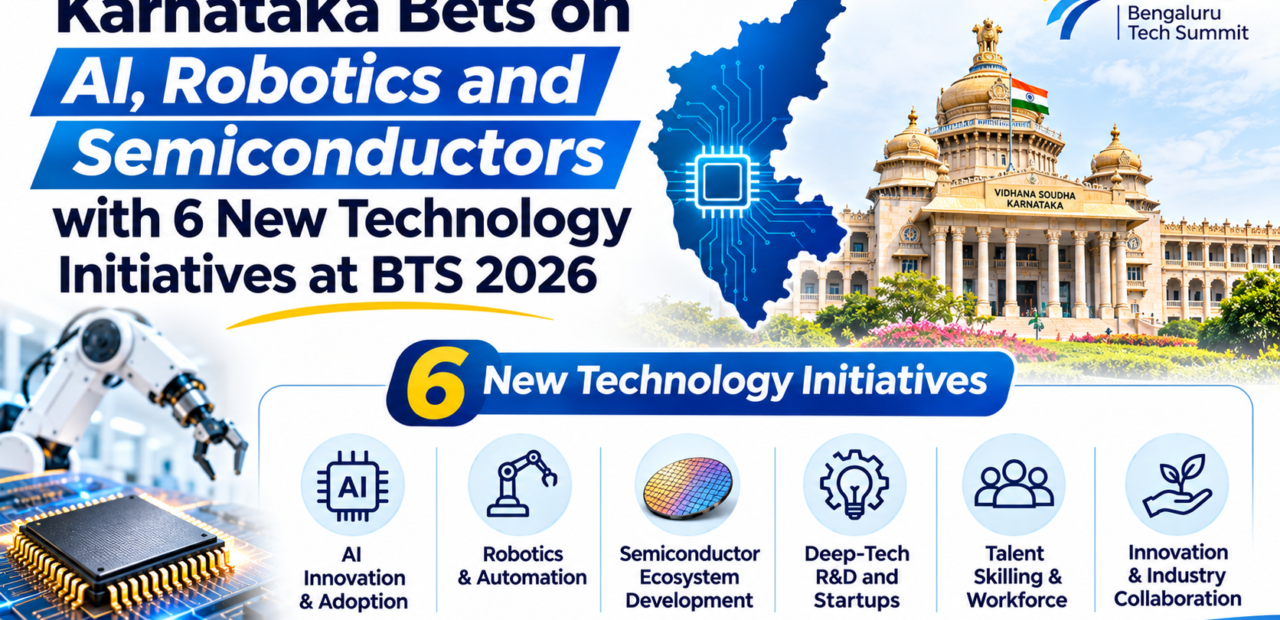
Karnataka is taking another significant step towards strengthening India’s position in the global technology and semiconductor ecosystem. At the 29th edition of Bengaluru Tech Summit (BTS) 2026, held under the theme “AI & Beyond”, the state government announced six technology initiatives covering artificial intelligence, robotics, semiconductor research, healthcare technology and deep-tech innovation. These initiatives focus on building research infrastructure, supporting emerging technology companies, encouraging industry-academia collaboration and developing solutions with commercial potential. With Bengaluru already recognised as a major technology and engineering destination, the announcements reflect Karnataka’s ambition to expand beyond its traditional IT services strengths and become a stronger centre for advanced technology development.
The announcements are particularly important for India’s semiconductor industry because two initiatives, the 2D Innovation Hub and INFIfab, focus directly on semiconductor research, fabrication infrastructure and advanced manufacturing technologies. Alongside these facilities, Karnataka AI Hub and BRAINZ aim to strengthen artificial intelligence and robotics innovation, while K-HEAL and Innoverse address healthcare engineering and deep-tech entrepreneurship. The state has also outlined industry partnerships to provide emerging AI technology training to 63,200 engineering and diploma students and professionals. Together, these developments represent a broader approach to building the infrastructure, talent and innovation ecosystem required for India’s next phase of technological growth.
Karnataka AI Hub: Strengthening Artificial Intelligence Research
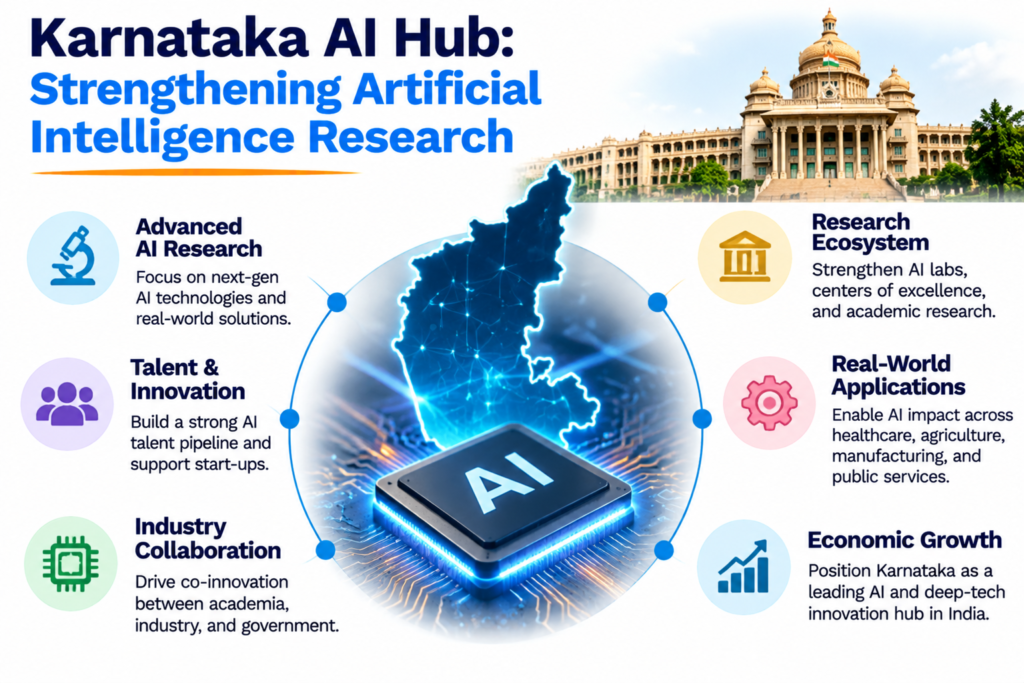
The Karnataka AI Hub, established at IIIT-Bengaluru, is designed to bring together students, researchers, startups, industry organisations and government institutions. Its objective is to encourage artificial intelligence research, develop specialised skills and support the transformation of innovative ideas into practical applications. The hub also represents an important step towards Karnataka’s proposed AI University, which aims to strengthen the state’s long-term artificial intelligence education and research capabilities.
The initiative reflects the growing importance of AI across industries, including healthcare, manufacturing, agriculture and financial services. Karnataka is also working with technology companies such as Google, Salesforce, Pega Systems, Sarvam AI and Gnani.ai on specialised training programmes. These partnerships aim to develop skills in Generative AI, Agentic AI, Voice AI, cloud computing and Responsible AI, with a target of training 63,200 students and professionals.
BRAINZ: Building a Robotics and AI Innovation Ecosystem
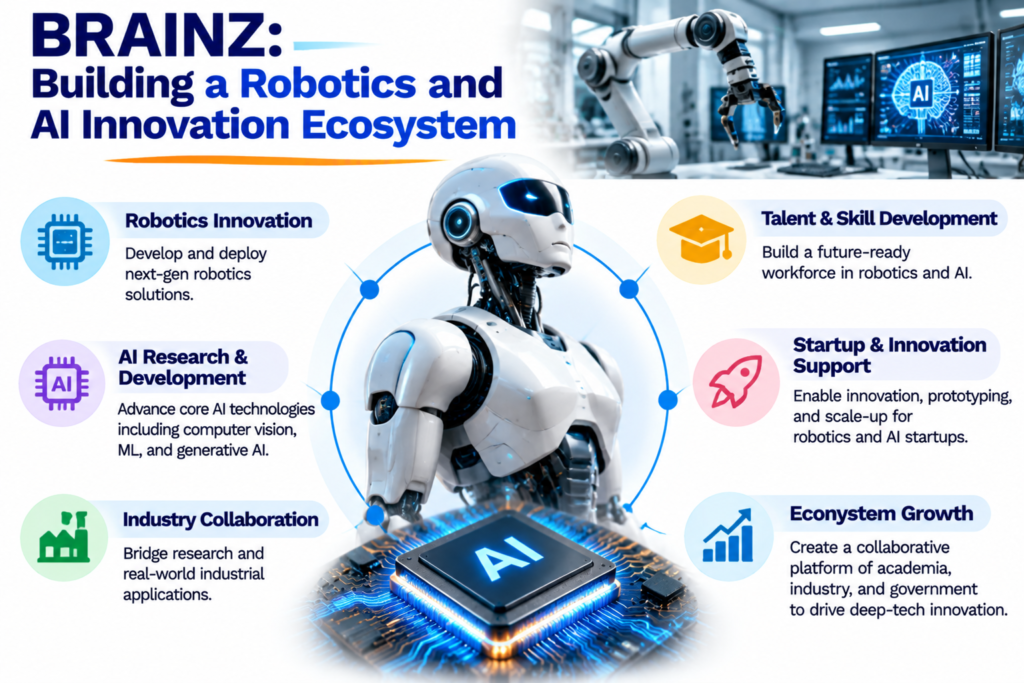
BRAINZ, or Bengaluru Robotics and AI Innovation Zone, is being developed through collaboration with ARTPARK at the Indian Institute of Science (IISc). The proposed nine-acre facility is intended to provide an environment where researchers, startups and industry organisations can work together on robotics, artificial intelligence and deep-tech technologies. The initiative aims to accelerate indigenous innovation and encourage the development of practical technology solutions.
The project has an ambitious target of catalysing investments worth ₹1,000 crore over five years. Its broader focus includes supporting robotics development, enabling research collaboration and helping innovative technologies move towards real-world deployment. This could create opportunities in industrial automation, autonomous systems, intelligent machines and other advanced engineering applications. However, the investment target represents an ambition rather than an already secured investment amount.
2D Innovation Hub: Expanding India’s Semiconductor Research Capabilities
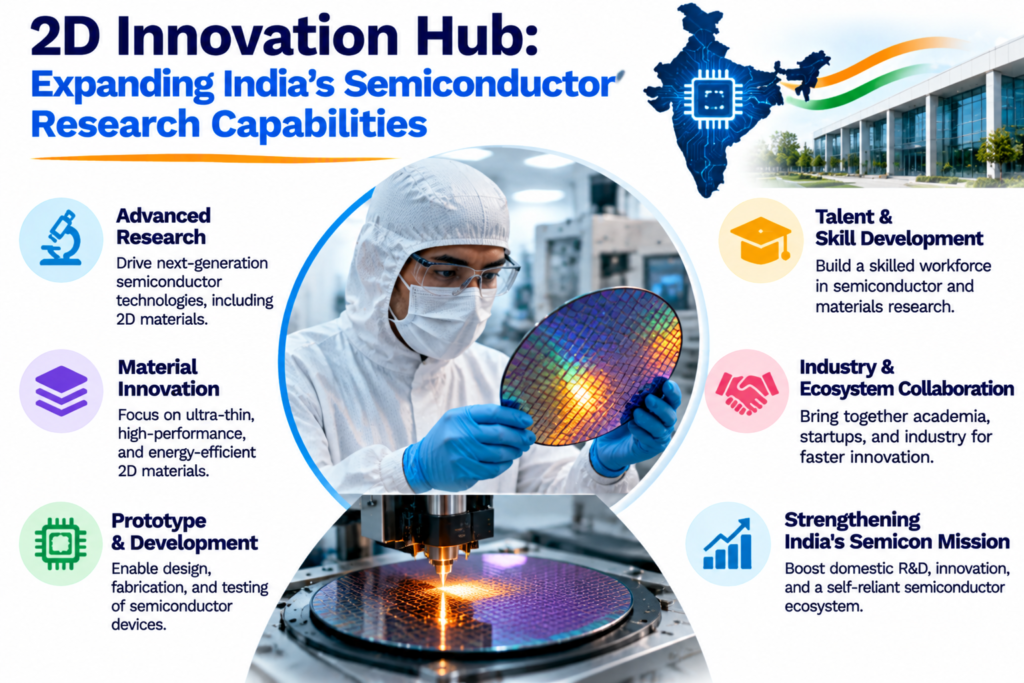
One of the most important announcements for the VLSI industry is the proposed 2D Innovation Hub at IISc Bengaluru. The Karnataka government is supporting the development of a national-level 200-mm (8-inch) semiconductor research and development fabrication and pilot-line facility. Led by IISc in collaboration with academic and industry partners, the initiative is intended to provide shared infrastructure for semiconductor research, process development and technology validation.
Such facilities are important because semiconductor innovation requires access to specialised fabrication equipment, cleanroom environments, process monitoring and testing infrastructure. A research and pilot-line facility can help researchers and engineers experiment with semiconductor processes before technologies move towards larger-scale industrial applications. The initiative could also strengthen India’s capabilities in semiconductor materials, fabrication techniques and next-generation chip development.
INFIfab: Advancing Semiconductor Manufacturing and Technology Research
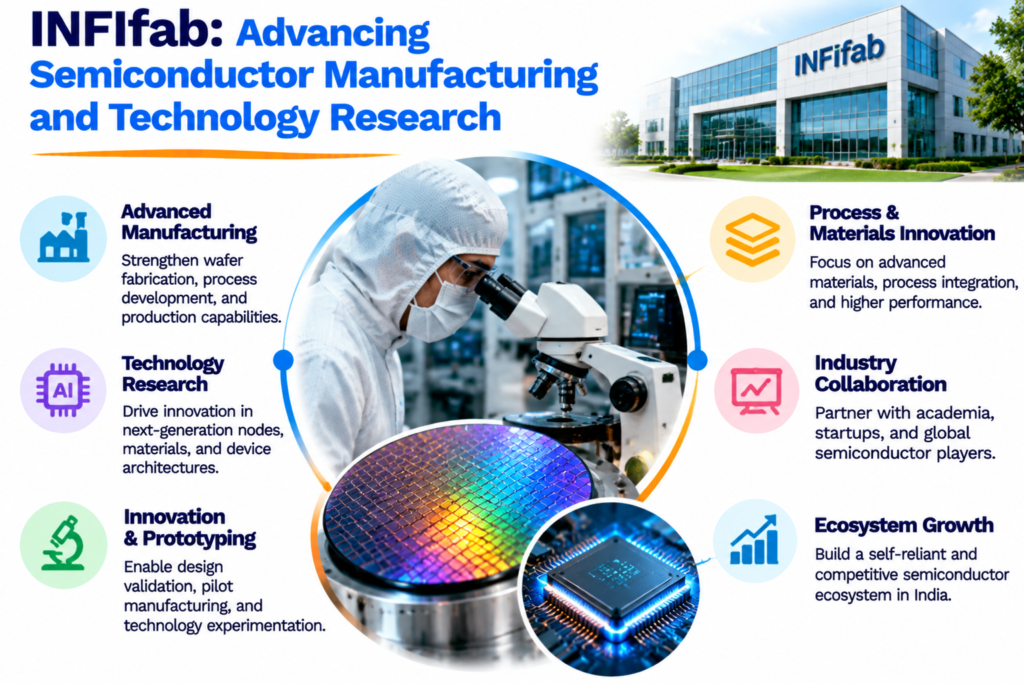
INFIfab is another major semiconductor-focused initiative being supported by the Karnataka government at IISc’s Centre for Nano Science and Engineering (CeNSE). Unlike a general technology incubation programme, INFIfab is focused on building a national facility for semiconductor innovation, advanced manufacturing and technology translation. The proposed infrastructure includes a facility of approximately 96,284 square feet, with a cleanroom of around 20,000 square feet.
Its research areas are expected to include semiconductor fabrication, advanced packaging, MEMS, photonics, quantum technologies and neuromorphic computing. These technologies are becoming increasingly relevant to next-generation electronic systems, specialised processors and advanced computing applications. By strengthening access to specialised research infrastructure, INFIfab aims to help researchers and industry partners develop and validate technologies that could contribute to India’s semiconductor ecosystem.
K-HEAL and Innoverse: Supporting Healthcare and Deep-Tech Innovation
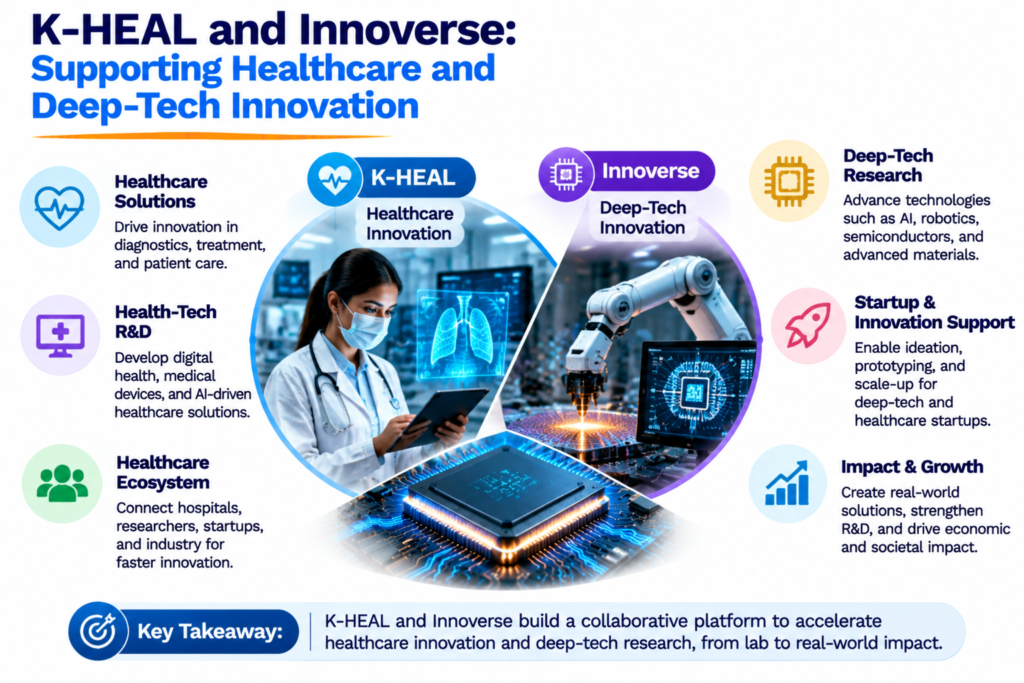
K-HEAL, or Karnataka Health Engineering & Advanced Lifesciences, is designed to strengthen the state’s HealthTech, MedTech and assistive technology ecosystem. The initiative will bring together healthcare professionals, researchers, academic institutions, startups and industry organisations to identify healthcare challenges and develop practical technological solutions. Its focus includes supporting innovation from early-stage concepts and prototyping to testing, commercialisation and wider adoption.
Innoverse, meanwhile, focuses on supporting deep-tech startups working on advanced technologies, including autonomous systems and applications spanning underwater and space technologies. Its accelerator programme aims to support 35 growth-stage ventures over five years, helping businesses move from product development towards commercial expansion. Together, these initiatives demonstrate that Karnataka’s technology strategy extends beyond semiconductor manufacturing and artificial intelligence into other research-intensive industries.