


How Yogi Adityanath’s Government Policies Are Transforming Uttar Pradesh into an Electronics and Semiconductor Hub

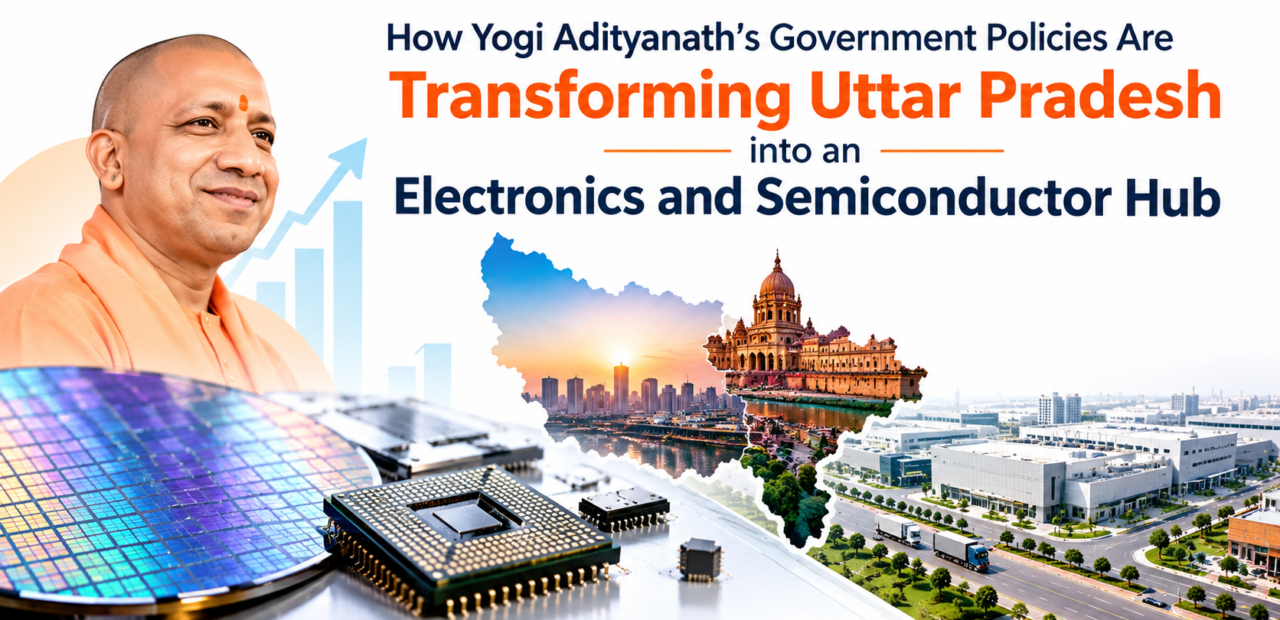
Uttar Pradesh is emerging as a major electronics and semiconductor hub under Chief Minister Yogi Adityanath’s leadership. Through investment-friendly policies, simplified approvals, and industrial incentives, the state is attracting companies in electronics manufacturing, VLSI design, and semiconductor production. Its strong mobile phone manufacturing ecosystem further strengthens its position in India’s technology sector.
The Uttar Pradesh Semiconductor Policy complements national initiatives such as the India Semiconductor Mission by offering financial incentives, land concessions, and infrastructure support. Projects like the Noida International Airport and Yamuna Expressway industrial corridor are boosting connectivity, investment, skilled employment, and the state’s ambition to become a leading semiconductor destination.
Dedicated Policy Frameworks and Strategic Capital Subsidies
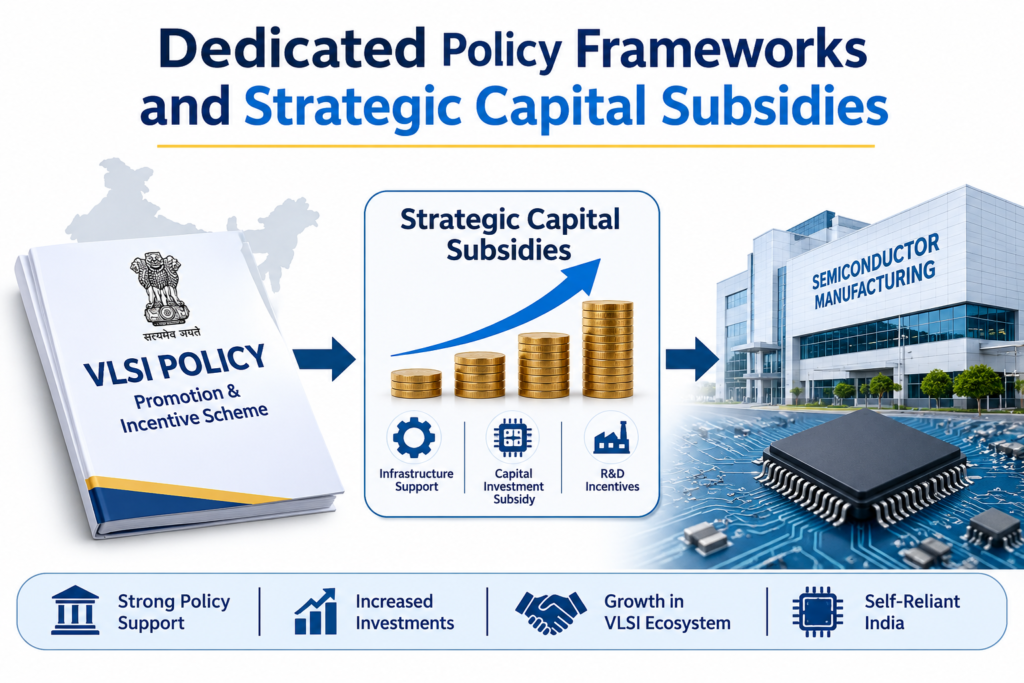
The state’s transformation relies on the UP Semiconductor Policy and the UP Electronics Manufacturing Policy. Recognizing the heavy capital requirements and long gestation periods of chip foundries and assembly lines, the state government offers substantial financial backstopping. Eligible semiconductor projects receive a state subsidy equal to 50% of the capital subsidy granted by the Central Government, effectively lowering setup costs. These fiscal policies provide direct support for Assembly, Testing, Marking, and Packaging (ATMP) units, compound semiconductors, and silicon photonics facilities.
Additionally, non-fiscal and operational subsidies reduce long-term operational expenditures for technology enterprises. The state government grants 100% exemptions on stamp duty and registration fees for industrial land purchases, alongside a decade-long exemption from electricity duties. Companies also benefit from land rebates of up to 75% on initial land allocations in specialized industrial zones. By matching federal incentives with state-level benefits, Uttar Pradesh offers a competitive investment package that attracts multi-billion-dollar global chipmakers and electronic component brands.
Infrastructure Acceleration: EMCs, Yamuna Expressway, and the Semiconductor Park
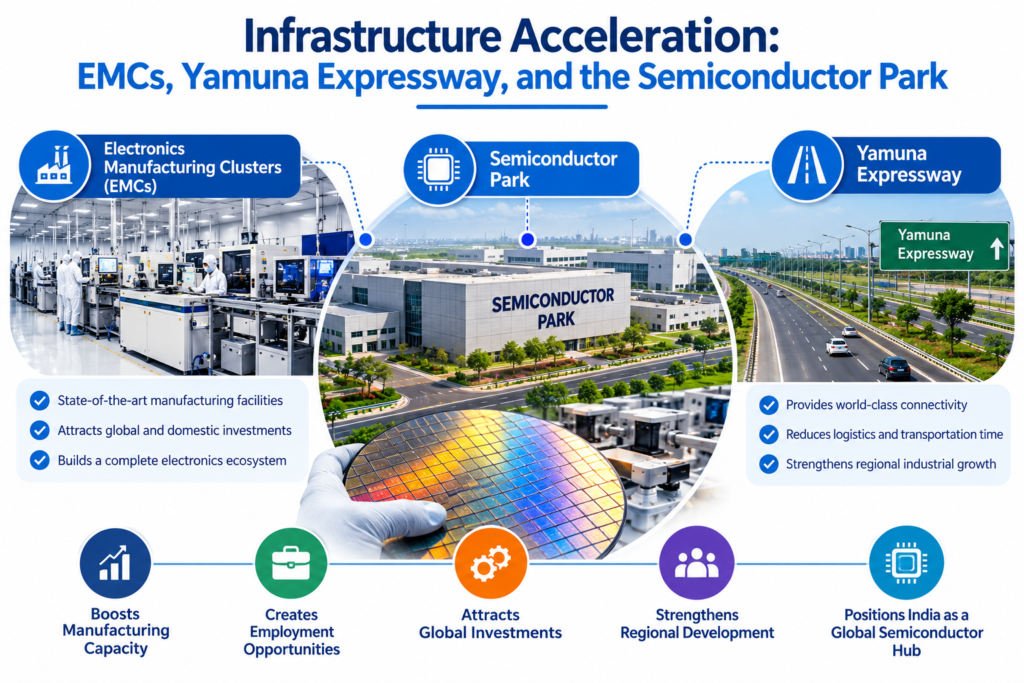
Infrastructure development serves as the foundation of Uttar Pradesh’s industrial execution. The government has developed designated Electronics Manufacturing Clusters (EMCs) in Greater Noida and along the Yamuna Expressway. A landmark initiative is the establishment of a dedicated 1,000-acre Semiconductor Park near the Noida International Airport at Jewar. This strategic location provides seamless air cargo connectivity, direct access to multi-modal logistics hubs, and uninterrupted transport links across northern India.
To meet the strict technical standards of semiconductor manufacturing, the state guarantees dual-grid power networks and high-capacity water supply systems. Chip fabrication plants require uninterrupted electricity and vast volumes of ultra-pure water, which the government supports through dedicated industrial utility corridors. Combined with an expanding network of expressways, these industrial parks allow companies to construct facilities quickly while ensuring high-reliability supply chain operations.
Establishing a Complete Supply Chain: From Mobile Assembly to Component Ecosystems
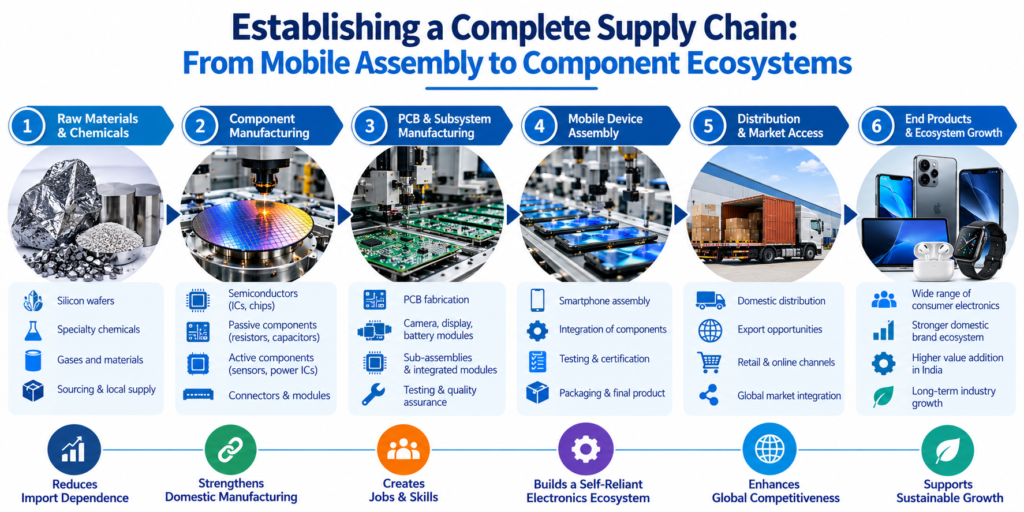
Uttar Pradesh’s initial success in mobile phone assembly laid the groundwork for a broader electronics supply chain. The state now manufactures over 55% of India’s mobile handsets, attracting major global brands and original equipment manufacturers. However, to move beyond simple assembly, the government introduced policy measures that incentivize the local production of high-precision components, display panels, printed circuit board assemblies (PCBAs), and micro-electronic parts.
This focus on component localization helps build a resilient domestic supply chain. By encouraging ancillary industries, raw material suppliers, and specialized packaging units to set up operations near major assembly hubs, the government has reduced import dependencies and transport overheads. The presence of ATMP facilities and component manufacturers ensures that the state’s electronics sector operates as an integrated ecosystem rather than isolated assembly plants.
Human Capital, Research Infrastructure, and Talent Development
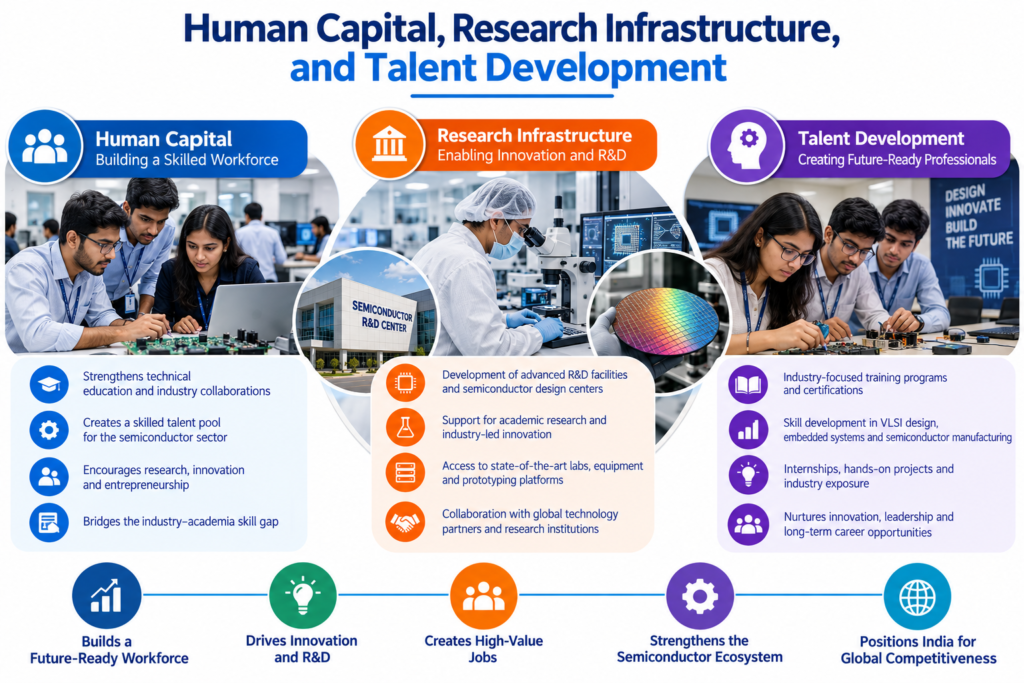
A sustained semiconductor and Very Large Scale Integration (VLSI) ecosystem relies on a steady pipeline of skilled engineering talent. To bridge academia and industry, the state government works directly with leading technical institutions like IIT Kanpur and IIT BHU, alongside state technical universities. The UP Semiconductor Policy provides dedicated funding to setup Centers of Excellence (CoE) and specialized R&D centers, offering up to 50% project cost reimbursements for advanced research facilities.
Furthermore, the state incentivizes talent acquisition and technical training in specialized fields like VLSI design, electronic design automation (EDA), and microchip testing. The government provides internship support allowances for engineering graduates and offers financial assistance to technical institutions for faculty training and expert workshops. These human resource initiatives ensure that foreign and domestic investors have immediate access to job-ready engineers, circuit designers, and plant technicians.
Investor Confidence, Ease of Doing Business, and Future Growth Horizons
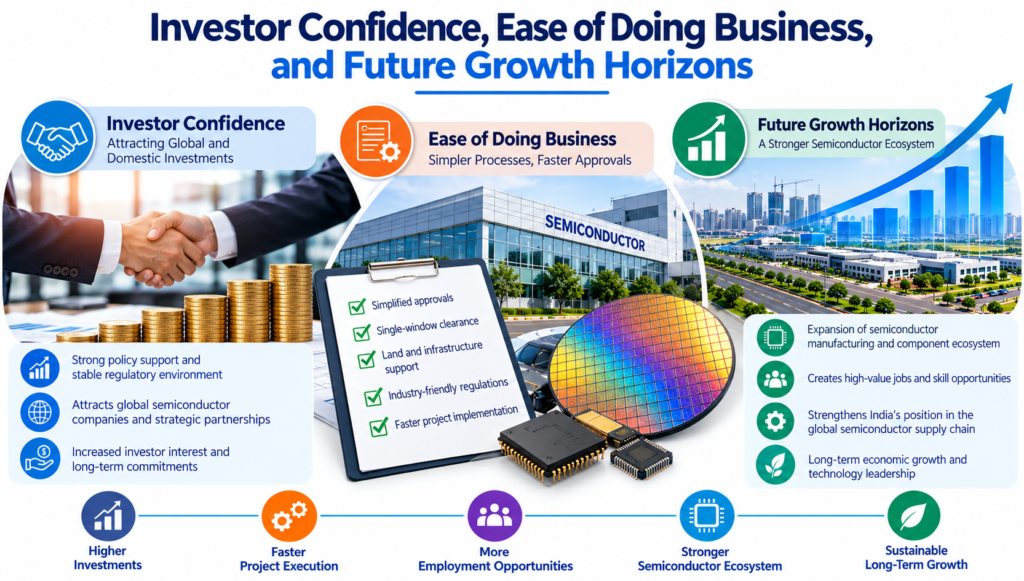
Beyond financial subsidies, single-window clearances and administrative reform have significantly boosted investor confidence. Through digital portals like Nivesh Mitra, the state government has streamlined industrial approvals, land allotments, and environmental clearances. This reduction in bureaucratic delay allows high-tech companies to transition from initial project proposals to ground-breaking and commercial production within accelerated timelines.
Looking ahead, Uttar Pradesh is positioned to expand its market share in deep-tech, artificial intelligence, robotics, and advanced semiconductor packaging. With billions of rupees in committed investments, active packaging facilities, and a deep talent pool, the state’s proactive governance model serves as a benchmark for regional industrialization. By aligning state incentives with global manufacturing trends, Uttar Pradesh is securing its role as a vital link in the global microelectronics supply chain.